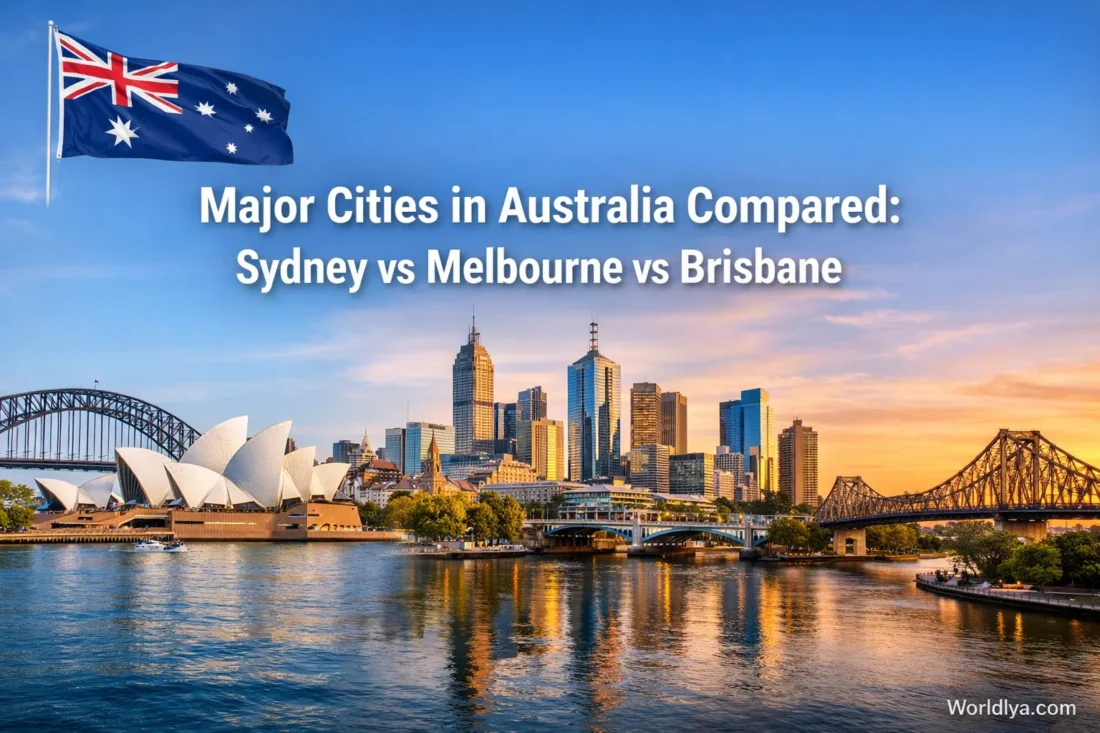
Australia’s three best-known east-coast cities do not feel like different versions of the same place. Sydney leans grand and visual, with harbour views that keep showing up in your memory long after the trip ends. Melbourne pulls you in through detail: laneways, trams, cafés, galleries, bookshops, live sport, and streets that reward walking without a rigid plan. Brisbane moves with a lighter step, shaped by river curves, subtropical weather, open-air dining, and an everyday rhythm that feels easier on the shoulders. So which city fits you best? Not the one with the loudest reputation. The one whose pace, climate, transport style, and weekend options match the way you actually like to travel.
Sydney Grabs You Fast. Melbourne Rewards Repeat Days. Brisbane Feels Lighter on the Clock.
That is the short version. The real difference shows up in how each city handles weather, movement, neighbourhood life, and the kind of weekends you can build around it.
City Snapshot
| Measure | Sydney | Melbourne | Brisbane |
|---|---|---|---|
| Metro Population | 5,557,233 | 5,350,705 | 2,780,063 |
| Population Change in 2023–24 | +107,538 | +142,637 | +72,930 |
| Annual Mean Maximum Temperature | 21.8°C | 19.9°C | 25.5°C |
| Annual Rainfall | 1,211.1 mm | 648.3 mm | 1,149.1 mm |
| Mean Sunshine per Day | 6.8 hours | 6.0 hours | 7.4 hours |
| Latest Published Airport Total | 42.54 million passengers (2025) | 36.15 million passengers (FY25) | 25.0 million passengers (2025) |
| Transport Personality | Rail, light rail, buses, and ferries | Tram-led inner-city movement | River ferries with a relaxed feel |
Population figures refer to Greater Capital City Statistical Areas. Airport totals are the latest published figures and do not all use the same reporting period, so they work best as a scale signal rather than a perfect like-for-like ranking.
How These Three Cities Feel Day to Day
Sydney: Harbour Drama, Big Landmarks, and a Faster Pulse
Sydney is the city that announces itself early. Circular Quay, the Opera House, the Harbour Bridge, The Rocks, Bondi, Manly, Darling Harbour, and the coastal walks give it instant visual range. Even a short stay can feel full. That matters more than people admit. A city that gives you a strong first day often becomes the city you remember most vividly.
The trade-off is tempo. Sydney often feels like the most switched-on of the three. Great for people who like visible energy, busy water edges, polished restaurant districts, and an itinerary with momentum. Surry Hills, Newtown, Paddington, and Barangaroo each change the mood, but the city still carries a clear sense of movement and scale.
- Best for: first-time visitors, postcard scenery, ferry rides, coastal walks, harbour dining
- Feels strongest when: your trip is short and you want memorable visuals without much warm-up time
- Watch for: longer cross-city travel times if you try to pack beaches, inner suburbs, and western districts into one day
Melbourne: Street Life, Culture, and a City That Improves With Time
Melbourne works differently. It rarely tries to impress you all at once. Instead, it stacks pleasures: Fitzroy in the afternoon, Carlton for an easy dinner, the CBD laneways for coffee, Southbank for galleries and river walks, the Queen Victoria Market for daytime browsing, the MCG for sport, St Kilda for shoreline air. The city rewards people who like to wander first and decide later.
It also stands out for urban movement. Melbourne’s tram network is the largest operational tram network in the world, with 250 km of double track, more than 160 million trips a year, and roughly 1,600 stops. That is not a decorative detail. It changes how the city feels. Inner-city movement becomes less about planning every leg and more about stepping into the day.
Melbourne also added more people than any other Australian capital in 2023–24. That growth shows up in its scale, its food scene, its outer-suburban expansion, and its widening cultural orbit. You can feel the city stretching, but its inner core still knows how to keep human-sized corners intact.
- Best for: café culture, live music, galleries, sport, neighbourhood wandering, repeat visits
- Feels strongest when: you care more about daily urban life than landmark collecting
- Watch for: weather shifts that can change the mood of a day faster than the map suggests
Brisbane: Warm-Air Living, River Space, and a Looser Rhythm
Brisbane makes a softer first impression than Sydney and a less tightly packed one than Melbourne. That is part of its appeal. The Brisbane River shapes the city in a way you can actually use, not just admire. South Bank, New Farm, Kangaroo Point, West End, Fortitude Valley, and Howard Smith Wharves give the city different textures without making it feel fragmented.
This is also the city where climate changes behaviour the most. Brisbane’s annual mean maximum temperature is 25.5°C, and it averages 7.4 hours of sunshine per day. Outdoor breakfasts, riverside walks, evening ferries, and winter days spent outside feel natural here rather than aspirational. Brisbane City Council places the city’s resident population at 1.36 million within the local government area, and the wider metro keeps growing. In 2023–24, Brisbane was one of the capitals that still posted a net internal migration gain. People are not only arriving from overseas. Many are choosing it from within Australia too.
Brisbane is also stronger economically than older stereotypes suggest. The city council’s published figures put Greater Brisbane’s gross regional product at $225 billion, with almost 146,000 registered businesses. That helps explain why the city no longer feels like a stopover between beach destinations. It feels like a place with its own centre of gravity.
- Best for: warm-weather city breaks, riverfront dining, outdoor routines, lighter urban pace
- Feels strongest when: you want a city trip that leaves room to breathe
- Watch for: summer conditions that can feel fuller and warmer than the numbers alone suggest
Climate Comfort and Seasonal Rhythm
Many city comparisons stop at “warm” or “cool.” That is too blunt to be useful. Sydney sits in the balanced middle: warmer than Melbourne, cooler than Brisbane, and bright enough to keep outdoor plans viable for much of the year. Its annual rainfall is high, but so is its everyday scenic payoff. Water is part of the city’s identity, and the weather often feels tied to the harbour rather than separate from it.
Melbourne is cooler, drier, and less sunny on average than the other two. That does not make it dreary. It makes it layered. The city is excellent for people who enjoy coat weather, indoor culture, moody café hours, bookshop afternoons, and the shift from sport to dinner to late-night conversation without needing beach conditions to hold the day together.
Brisbane offers the most outdoor-friendly winter and the strongest sunlight average of the three. That matters for longer stays, not just holidays. A city with dependable outdoor hours changes how you eat, exercise, socialise, and recover from workdays. That is why Brisbane can feel unusually easy once you settle into it.
Simple climate read: Sydney suits readers who want the most balanced mix. Melbourne suits readers who do not need warm weather to enjoy a city. Brisbane suits readers who feel happier when the day naturally starts outside.
Moving Around the City
Transport changes whether a city feels easy or tiring. Sydney has the broadest-feeling network mix for a visitor: trains, light rail, buses, and ferries. The ferry element matters. It turns movement into part of the experience instead of dead time between attractions.
Melbourne is the inner-city winner for intuitive everyday movement. The tram is not just practical; it helps organise the city mentally. People often feel confident in Melbourne faster because the network is visible, frequent, and woven into daily street life.
Brisbane turns the river into transport. The CityCat and ferry network runs across 22 terminals, with a fleet of 28 CityCats and 5 KittyCats. That gives Brisbane something rare: public transport that also doubles as one of the nicest ways to see the city.
- Most scenic commute: Sydney and Brisbane
- Most intuitive inner-city movement: Melbourne
- Best mix for landmark-heavy sightseeing: Sydney
- Most relaxed public transport mood: Brisbane
Travel Reach and Weekend Range
This is one of the most useful comparison points, and it is often underplayed. A city is not only its CBD. It is also the set of escapes sitting one good day-trip away.
- Sydney gives you the Blue Mountains, Royal National Park, the Hunter Valley, the Central Coast, and famous beach suburbs that are practically part of the city story itself.
- Melbourne opens toward the Great Ocean Road, Yarra Valley, Mornington Peninsula, Phillip Island, and a dense calendar of sport and arts inside the city itself.
- Brisbane reaches toward Moreton Bay, North Stradbroke Island, the Sunshine Coast, the Gold Coast, and the Scenic Rim with unusual ease for a city of its size.
Air access supports that range too. Sydney Airport handled 42.54 million passengers in 2025, reinforcing its role as Australia’s busiest international gateway. Melbourne Airport published 36.15 million passengers in FY25, with record international numbers. Brisbane Airport reached 25 million passengers in 2025, its busiest year on record. So the three cities are not simply popular. They are busy because they connect well, and that affects how easy they feel to enter, leave, and use as a base.
Best Match by Travel Style
Choose Sydney
- Harbour views matter more to you than hidden corners.
- You want beaches, ferries, and landmarks in the same trip.
- Your stay is short and you want a city that starts strong on day one.
- You like a polished, visibly global atmosphere.
Choose Melbourne
- You care about neighbourhood life, food, galleries, and live events.
- You enjoy walking, browsing, and letting a city unfold slowly.
- You like public transport that feels built into the street.
- You value atmosphere over postcard perfection.
Choose Brisbane
- You want warm-weather city life that still feels urban.
- Riverfront walks and outdoor dining sound better than big-ticket landmarks.
- You prefer a city that feels open rather than tightly packed.
- You want easy reach to coastal escapes without leaving city comfort behind.
The Right Choice Depends on Your Rhythm
For many first-time visitors, Sydney still makes the easiest opening move. It is visually immediate, internationally connected, and packed with recognisable places. For readers who care more about how a city feels after breakfast, after the museum, after sunset, and after three unplanned detours, Melbourne often leaves the deeper mark. For readers who want a city break with sunlight, river space, and a daily pace that stays friendly, Brisbane is often the most comfortable fit.
There is no universal winner here. That is the point. Sydney, Melbourne, and Brisbane are not rivals fighting over the same kind of traveller. They are three very different answers to the same question: what should a major Australian city feel like when you actually live in it for a few days?
Sources
- Australian Bureau of Statistics — Regional Population, 2023–24 Financial Year
- Australian Bureau of Statistics — Population Projections, Australia, 2022 Base to 2071
- Bureau of Meteorology — Sydney Climate Statistics
- Bureau of Meteorology — Melbourne Climate Statistics
- Bureau of Meteorology — Brisbane Climate Statistics
- Sydney Airport — Traffic and Operational Performance Q4 2025
- Melbourne Airport — Busiest Month Ever in December
- Brisbane Airport Corporation — Annual Reports
- Brisbane Airport — Record-Breaking 2025 Update
- Yarra Trams — Facts and Figures
- City of Sydney — Visitor’s Guide to Sydney
- Brisbane City Council — CityCats and Ferries
- Brisbane City Council — Brisbane’s Key Economic Facts