
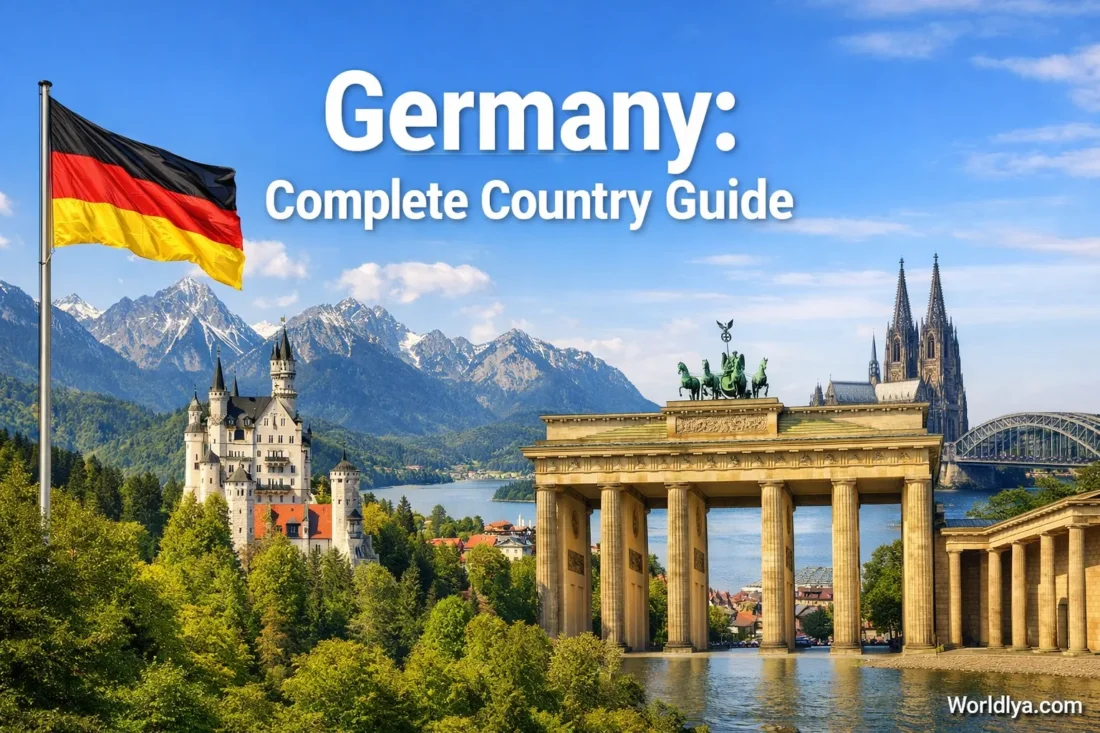
Germany rewards travelers who slow down enough to notice how much changes between one region and the next. A morning can begin beside a North Sea harbor, continue through a red-brick old town, and end among lakes or forested hills. Farther south, vineyard valleys, university towns, Alpine foothills, and lively cities create a very different rhythm. There is no single “German experience.” The country works more like a collection of well-connected regions, each with its own food, architecture, dialects, landscapes, and everyday habits.
Germany Guide (34)
Germany in Brief
- Capital: Berlin
- Population: About 83.5 million at the end of 2025
- Area: 357,569 km²
- Official language: German
- Currency: Euro (€)
- States: 16
- Time: CET in winter, CEST in summer
- Calling code: +49
- Emergency number: 112
- Highest point: Zugspitze, 2,962 meters
Useful orientation: Germany sits in Central Europe and shares borders with nine countries. Major rivers include the Rhine, Danube, Elbe, Main, Moselle, and Weser.
How the Country Fits Together
Distances can look modest on a map, yet regional character changes quickly. The north faces the North Sea and Baltic Sea. The west follows busy river valleys and dense city networks. Central Germany brings forested uplands, spa towns, and smaller historic centers. The east mixes cultural cities, lakes, sandstone landscapes, and broad countryside. The south rises through vineyards, plateaus, lakes, and Alpine terrain.
For a first trip, it helps to think in travel zones rather than a checklist of famous places. Berlin and Munich, for example, belong to very different regional stories. Hamburg feels maritime. Cologne feels closely tied to the Rhine. Dresden and Leipzig make a natural pair. Freiburg works as a doorway to the Black Forest, while Nuremberg connects northern Bavaria with routes farther south.
A practical rule: choose one broad region for a short visit, two connected regions for a week, and no more than three for a two-week trip. Germany’s rail network makes movement straightforward, but constantly changing hotels can turn a relaxed journey into a luggage exercise.
Regions That Feel Distinct
Northern Germany
Harbors, islands, dunes, broad skies, canals, and red-brick architecture shape the north. Hamburg, Bremen, Lübeck, Kiel, Rügen, Sylt, and the East Frisian Islands offer very different versions of maritime Germany.
Western Germany
The Rhine and Moselle corridors bring cathedral cities, vineyard slopes, river promenades, castles, and compact old towns. Cologne, Düsseldorf, Bonn, Aachen, Koblenz, Trier, and Mainz are useful bases.
Central Germany
Forests, river valleys, university towns, and half-timbered centers dominate many central routes. The Harz, Thuringian Forest, Kassel, Weimar, Erfurt, Marburg, and the Fulda area suit slower travel.
Eastern Germany
Berlin, Potsdam, Dresden, Leipzig, Saxon Switzerland, the Spreewald, and the lake districts create an easy mix of city culture and outdoor days. Rail links between the main cities are especially convenient.
Southern Germany
Baden-Württemberg and Bavaria offer vineyards, lake country, old university towns, baroque centers, forests, and the Alps. Munich, Stuttgart, Heidelberg, Freiburg, Nuremberg, Bamberg, Lake Constance, Garmisch-Partenkirchen, and Berchtesgaden can anchor a southern itinerary.
Germany’s 16 States
The states are more than administrative names. They often line up with travel identities, school holidays, local traditions, food, and transport networks. This table helps place familiar destinations on the map.
| State | Capital | Travel Character |
|---|---|---|
| Baden-Württemberg | Stuttgart | Black Forest, Heidelberg, Lake Constance, vineyards, spa towns |
| Bavaria | Munich | Alps, Franconian cities, lakes, castles, villages, mountain routes |
| Berlin | Berlin | Museums, neighborhoods, architecture, design, parks, urban lakes |
| Brandenburg | Potsdam | Palaces, lakes, cycling, Spreewald waterways, countryside around Berlin |
| Bremen | Bremen | Historic center, maritime heritage, riverfront, compact city break |
| Hamburg | Hamburg | Harbor, canals, music, museums, warehouses, green waterfront areas |
| Hesse | Wiesbaden | Frankfurt, spa towns, forests, half-timbered towns, Rhine access |
| Lower Saxony | Hanover | North Sea coast, East Frisian Islands, Harz access, Lüneburg Heath |
| Mecklenburg-Western Pomerania | Schwerin | Baltic beaches, Rügen, lake country, seaside resorts, quiet landscapes |
| North Rhine-Westphalia | Düsseldorf | Cologne, Rhine cities, museums, industrial heritage, dense rail links |
| Rhineland-Palatinate | Mainz | Rhine and Moselle valleys, vineyards, castles, Trier, hiking routes |
| Saarland | Saarbrücken | Forested hills, French-influenced food culture, short scenic drives |
| Saxony | Dresden | Dresden, Leipzig, Meissen, Saxon Switzerland, music and art |
| Saxony-Anhalt | Magdeburg | Harz towns, Dessau, Wittenberg, gardens, architecture and design |
| Schleswig-Holstein | Kiel | North Sea and Baltic coasts, islands, Lübeck, sailing, flat cycling |
| Thuringia | Erfurt | Weimar, forests, castles, compact old towns, walking routes |
Which City Fits Your Trip?
Germany has several large cities, but size is not the only useful measure. A smaller place may offer more of what you actually want: walkability, river scenery, a strong museum, a university atmosphere, or quick access to nature.
| City | Choose It For | Good Pairing |
|---|---|---|
| Berlin | Large museums, varied neighborhoods, modern culture, parks, long urban days | Potsdam, Leipzig, Dresden |
| Hamburg | Harbor views, canals, warehouse architecture, music, food markets | Lübeck, Bremen, North Sea coast |
| Munich | Major art collections, parks, elegant streets, lake and Alpine day trips | Nuremberg, Augsburg, Garmisch-Partenkirchen |
| Cologne | Cathedral, Rhine promenade, museums, lively neighborhoods | Bonn, Düsseldorf, Aachen |
| Frankfurt | Excellent connections, river museums, skyline, short-stop convenience | Mainz, Wiesbaden, Rhine Valley |
| Dresden | Art museums, riverfront architecture, palaces, a compact center | Meissen, Saxon Switzerland, Leipzig |
| Leipzig | Music, contemporary art, creative districts, nearby lakes | Berlin, Dresden, Weimar |
| Nuremberg | Old-town streets, museums, seasonal markets, a strong rail position | Bamberg, Würzburg, Munich |
| Heidelberg | Castle views, riverside walks, university atmosphere, compact sightseeing | Mannheim, Speyer, Baden wine areas |
| Freiburg | Sunny old town, local food, cycling, Black Forest access | Black Forest, Baden vineyards, Lake Constance |
| Lübeck | Brick Gothic streets, courtyards, marzipan tradition, Baltic access | Hamburg, Travemünde, Schwerin |
City choice matters more than city count. Berlin can comfortably fill four or five days. Hamburg deserves at least two full days. Munich works well as a three-day city stay plus one or two outdoor day trips. Smaller centers such as Heidelberg, Bamberg, Lübeck, Weimar, or Regensburg can be enjoyed more slowly rather than squeezed into a few hours.
Landscapes Worth Building a Trip Around
- The Alps and Alpine foothills: Bavaria’s southern edge offers mountain railways, lakes, hiking, winter scenery, and villages that make easy bases. Berchtesgaden and the Zugspitze area are two well-known anchors.
- The Black Forest: Forest trails, spa towns, waterfalls, rail journeys, farm landscapes, and villages spread across southwestern Germany. Freiburg and Baden-Baden provide contrasting gateways.
- The Rhine and Moselle: River bends, vineyards, castle viewpoints, ferry crossings, and small towns make these valleys suited to rail, boat, bicycle, or road travel.
- The Baltic and North Sea coasts: The Baltic generally offers resort towns and calmer coastal scenery; the North Sea brings tidal landscapes, islands, dunes, and wide beaches.
- The Harz: Forest paths, historic mining towns, narrow-gauge rail, and the Brocken summit create an accessible upland break in central Germany.
- Saxon Switzerland: Sandstone formations, river views, forest paths, and rail access from Dresden make this one of the country’s easiest nature additions to a city trip.
- Mecklenburg Lake District: Lakes, waterways, cycling paths, and small towns suit travelers who prefer quiet outdoor time.
- The Eifel: Volcanic lakes, beech forest, dark-sky viewing, and walking routes offer a nature escape west of the Rhine.
Germany had 55 UNESCO World Heritage Sites in 2026. They range from old towns, cathedrals, palaces, gardens, and industrial sites to natural areas. Rather than chasing the full list, choose sites that fit your route. Cologne Cathedral makes sense on a Rhine journey; Museum Island belongs naturally in Berlin; Bamberg fits a Franconian itinerary; and the palaces and parks of Potsdam sit beside the capital.
Daily Life, Etiquette, and Small Habits
Daily routines vary between large cities, university towns, villages, and resort areas, yet a few habits help visitors settle in quickly. Timetables, appointments, and reservations are usually treated literally. Arriving a few minutes early is often more comfortable than arriving exactly on time.
Shopping and Payments
- Cards are common in cities, hotels, chain stores, and many restaurants.
- Cash remains useful at small bakeries, market stalls, rural cafés, and some independent businesses.
- Many shops close on Sundays. Stations, airports, fuel stops, and a limited number of local exceptions may still operate.
- Bring a reusable bag. Stores commonly charge for shopping bags.
Restaurants and Cafés
- Seat-yourself and wait-to-be-seated customs both exist, so look for a host or observe the room.
- Water is not always placed on the table automatically. Bottled still or sparkling water is often ordered.
- When service is good, many diners round up or add roughly five to ten percent rather than leaving money silently on the table.
- Say the full amount you want charged when paying, including the tip.
Recycling and Deposits
Many drink containers carry a Pfand deposit. Return them to a reverse-vending machine in a supermarket and use the printed voucher at checkout. Public recycling labels can look detailed at first, but accommodation hosts usually explain the local system.
Greetings and Public Space
Guten Tag is a safe daytime greeting. In smaller shops, cafés, and guesthouses, a brief greeting when entering is appreciated. Keep voices low in residential areas and on quiet public transport, especially in the evening.
German Language Without the Stress
Standard German is used across the country, while regional dialects can sound quite different. English is widely understood in many visitor settings, especially in larger cities, transport hubs, hotels, museums, and universities. It is less reliable in small towns or when dealing with local notices and machines.
| German | Meaning | When to Use It |
|---|---|---|
| Guten Tag | Hello / Good day | Polite daytime greeting |
| Bitte | Please / You’re welcome | Requests and replies |
| Danke | Thank you | Everyday use |
| Entschuldigung | Excuse me / Sorry | Getting attention or moving past |
| Sprechen Sie Englisch? | Do you speak English? | Ask before switching language |
| Die Rechnung, bitte | The bill, please | Restaurants and cafés |
| Wo ist der Bahnhof? | Where is the station? | Directions |
| Einmal, bitte | One, please | Tickets, bakery items, simple orders |
German compound words can look intimidating, but station signs are usually logical. Hauptbahnhof means main station, Ausgang means exit, Eingang means entrance, Gleis means platform or track, and Umstieg refers to a transfer.
Food by Region
German food is far more regional than the usual list of sausages and pretzels suggests. Bakeries are part of daily life, lunch can be the main hot meal, and seasonal ingredients appear clearly on menus. Spring brings white asparagus in many areas. Summer adds berries and fresh salads. Autumn menus often turn toward mushrooms, pumpkin, and orchard fruit. Winter is a strong season for baked goods and warm market food.
- North: fish sandwiches, herring dishes, shrimp, kale dishes, and dense breads.
- Berlin: currywurst, filled doughnuts known locally as Pfannkuchen, international street food, and a broad vegan scene.
- Rhineland and Hesse: potato dishes, herb-based Frankfurt green sauce, onion tart, regional breads, and orchard produce.
- Swabia: Maultaschen, Spätzle, lentil dishes, and onion-topped baked food.
- Bavaria and Franconia: pretzels, dumplings, roast dishes, Weißwurst, and small Nuremberg sausages.
- Saxony and Thuringia: cakes, dumplings, regional sausages, and Dresden Stollen during the winter season.
Vegetarian travelers: city menus usually provide several choices, and plant-based food is easy to find in Berlin, Hamburg, Cologne, Leipzig, Frankfurt, and Munich. In smaller places, ask whether soups, sauces, or dumplings contain meat stock. Bakery displays, weekly markets, and supermarket prepared-food counters are useful for flexible meals.
When to Visit Germany
Germany lies between maritime and continental weather patterns. Conditions can change within a day, and regional differences matter. Coastal areas tend to be breezier. Eastern inland areas often have warmer summer days and colder winter spells. The south becomes cooler with elevation, while the Upper Rhine area is often among the milder parts of the country.
| Season | What It Feels Like | Works Well For | Plan For |
|---|---|---|---|
| Spring March–May | Cool starts, longer days, blossoms, changeable weather | Cities, gardens, cycling, Rhine routes, fewer peak-season crowds | Layers, rain protection, mixed temperatures |
| Summer June–August | Long daylight, warm periods, outdoor events, busy resort areas | Coasts, lakes, hiking, city evenings, family trips | Advance booking, sun protection, occasional hot days and storms |
| Autumn September–November | Mild early weeks, vineyard color, cooler and darker later | Walking, food trips, forests, cultural cities, wine regions | Shorter daylight and wetter late-season weather |
| Winter December–February | Short days, cold conditions, seasonal markets, snow mainly at elevation | Museums, concert trips, festive towns, Alpine winter activities | Cold rain in lowlands, holiday closures, limited daylight |
May, June, September, and early October often balance comfortable weather with long sightseeing days. July and August suit coasts, lakes, and outdoor travel, though school holiday periods can raise demand. December is popular for seasonal markets, while January and February are quieter in many cities outside trade-fair dates and winter resorts.
Getting Around
Long-Distance Trains
ICE, IC, and EC trains connect large cities and many regional centers. Flexible fares cost more, while train-specific saver fares can be cheaper when booked early. Seat reservations are optional on many domestic trains but useful on busy Fridays, Sundays, holiday weekends, and major event dates.
Allow breathing room for connections. Ten minutes can work on paper, yet a longer transfer is less stressful when traveling with luggage, children, or limited mobility. The DB Navigator app is useful for schedules, platform changes, tickets, and delay information.
Regional and Local Transport
In 2026, the Deutschland-Ticket costs €63 per month. It covers participating local buses, trams, U-Bahn, S-Bahn, and regional trains across Germany. It does not normally cover ICE, IC, or EC long-distance services. The ticket is sold as a subscription, so visitors should read cancellation dates and provider terms before buying.
City transit systems often use zone-based fares. A ticket may need validation before travel, though mobile tickets are usually activated digitally. Never assume the same rule applies in every city; check the ticket screen, machine, or platform notice.
Driving
A car is most useful for villages, rural guesthouses, scenic roads, and mountain areas with limited evening transport. It is usually unnecessary in Berlin, Hamburg, Munich, Cologne, Frankfurt, or central Dresden. Germany drives on the right. Some urban areas use low-emission zones, and parking rules are closely marked. Read signs rather than relying on what nearby cars appear to be doing.
Cycling and Walking
River routes, lake districts, northern plains, and many cities are well suited to cycling. Keep out of marked cycle lanes when walking; they may look like part of the pavement. In old towns, cobblestones and slopes can slow wheelchairs, strollers, and rolling luggage, so route planning matters.
Where to Stay
Germany’s accommodation range includes large hotels, family-run guesthouses, hostels, serviced apartments, spa hotels, mountain huts, farm stays, and holiday apartments. The right location often saves more time than a cheaper room far outside the center.
- City breaks: stay near an S-Bahn, U-Bahn, tram, or central rail stop rather than insisting on the busiest old-town street.
- Small towns: check evening restaurant hours and the last local bus before booking.
- Nature trips: ask whether a regional guest card includes local transport or attraction discounts.
- Trade-fair cities: Frankfurt, Hanover, Cologne, Düsseldorf, Munich, and others can become much more expensive during major events.
- Holiday apartments: confirm cleaning fees, local visitor taxes, check-in method, and whether linens are included.
Booking rhythm: reserve early for summer islands, Alpine resorts, school holiday periods, large festivals, Christmas-market weekends, and major exhibitions. Outside those dates, flexible city stays are often easier to arrange.
Planning by Trip Length
Seven Days: Berlin, Leipzig, and Dresden
- Days 1–3: Berlin for museums, neighborhoods, parks, and one evening performance or food district.
- Day 4: Leipzig for its center, music heritage, and creative districts.
- Days 5–7: Dresden for museums and the Elbe, with one day in Saxon Switzerland or Meissen.
This route keeps train journeys short and combines three cities with clearly different personalities.
Ten Days: Rhine, Heidelberg, Black Forest, and Munich
- Days 1–2: Frankfurt and Mainz, using the first day to settle in.
- Days 3–4: Middle Rhine or Moselle base for river scenery, small towns, and a castle visit.
- Days 5–6: Heidelberg and nearby towns.
- Days 7–8: Freiburg and a Black Forest day trip.
- Days 9–10: Munich for art, parks, and Bavarian food.
This itinerary suits travelers who want scenery without giving up museums and urban comfort.
Fourteen Days: North to South by Rail
- Days 1–3: Hamburg, including harbor areas and one museum day.
- Day 4: Lübeck or Bremen.
- Days 5–7: Berlin, with Potsdam as an optional half-day or full-day trip.
- Days 8–9: Dresden and the Elbe Valley.
- Days 10–11: Nuremberg and Bamberg.
- Days 12–14: Munich, with a lake or Alpine foothills excursion.
The route covers a large part of the country, yet each stop still receives enough time to feel like a place rather than a station platform.
Germany for Different Travel Styles
For Museum Travelers
Berlin, Munich, Dresden, Frankfurt, Cologne, Hamburg, and Nuremberg provide strong collections. Check weekly closing days; Monday closures remain common but are not universal.
For Outdoor Travelers
Use one city as a gateway rather than changing bases daily. Dresden, Freiburg, Munich, Koblenz, and Hamburg each connect well with nearby landscapes.
For Families
Choose fewer bases and book accommodation near direct transport. Science museums, zoos, model railways, castle grounds, lakes, and short boat trips work well between longer sightseeing days.
For Accessible Travel
Many attractions and transport services publish step-free details, but historic centers can include cobbles, slopes, and older buildings. Look for verified accessibility information and contact accommodation directly about lifts, bathroom layout, and entrance steps.
Practical Travel Notes
- Entry: Germany is in the Schengen Area. Passport and visa requirements depend on nationality and can change, so use an official entry page before booking.
- Electricity: 230 V, 50 Hz. Type F sockets are standard; Type C plugs also fit many outlets.
- Water: Tap water is generally safe to drink unless a local notice states otherwise.
- Mobile service: Coverage is strong in cities and along major routes, but gaps can occur in forests, valleys, and rural areas.
- Public toilets: Paid facilities are common at stations, shopping centers, motorway stops, and attractions. Keep a small amount of change available.
- Healthcare: Carry suitable travel insurance. Visitors eligible for the European Health Insurance Card should check what it covers in Germany before departure.
- Emergency help: Dial 112 free of charge for urgent medical help or the fire service.
- Local closures: Opening hours may change on public holidays, Sundays, and seasonal dates. Check the official page for any must-see attraction shortly before visiting.
Questions Travelers Often Ask
How Many Days Are Enough for Germany?
Seven days are enough for one region or a compact three-city corridor. Ten to fourteen days allow two or three connected regions without rushing. A countrywide highlights trip needs careful route choices and usually works better by rail than by repeated flights.
Is Germany Easy to Visit Without a Car?
Yes, especially for cities, Rhine routes, and many established visitor regions. A car becomes more useful for remote villages, rural accommodation, mountain trailheads, or late-evening travel outside main corridors.
Can Visitors Rely on English?
English is often available in visitor-facing settings and larger cities. Learn a few German phrases and keep translated addresses or booking details ready for smaller towns, local buses, medical visits, and independent businesses.
Is the Deutschland-Ticket Useful for Tourists?
It can be useful for a month containing several regional journeys or a longer city stay. It does not normally cover ICE, IC, or EC trains, and it is a subscription product. Read the cancellation deadline before purchase.
Which German Region Suits a First Visit?
Choose by interest. Berlin, Leipzig, and Dresden suit culture-focused rail travel. The Rhine and Moselle suit scenic towns and castles. Bavaria suits cities, lakes, and Alpine access. Hamburg and Lübeck work well for maritime architecture and northern atmosphere.
What Should Travelers Book in Advance?
Book timed-entry museums, popular palaces, long-distance saver trains, summer island accommodation, Alpine cable cars during busy periods, and city rooms during major fairs or seasonal weekends.