
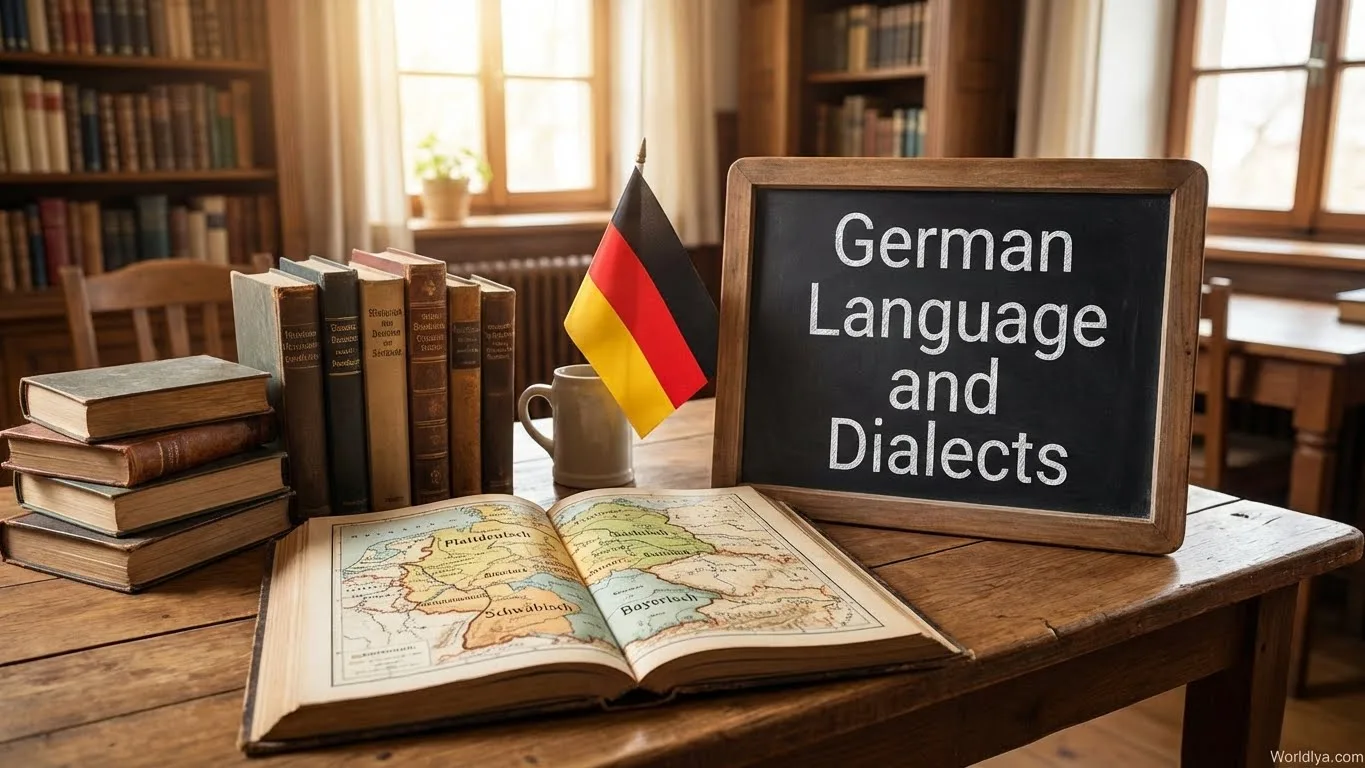
German can feel like a familiar song—until you travel a couple of hours and the lyrics suddenly change. That’s not “wrong German”. That’s dialect, and it’s one of the most charming parts of the language. You’ll notice teh rhythm, the melody, and even everyday words shift from region to region, like the same recipe cooked with different local spices.
What You’ll Get From This Guide
- How Standard German relates to regional speech
- A clear, beginner-friendly map of the main German dialect groups
- Real-life examples you might hear (without getting lost in jargon)
- Practical tips for travelers and learners who want to understand more German, more often
German Language Basics You’ll Notice Fast
German is written with the Latin alphabet, plus a few signature characters that show up everywhere. Once you spot them, reading starts to feel surprisingly approachable.
Umlauts (ä, ö, ü)
They’re not decorations. They often change a word’s sound and meaning, like schon vs schön.
ß (Eszett)
In many places, ß signals a long “s” sound. In Swiss Standard German, it’s typically written as ss instead.
Pronunciation has a few famous “tells,” too. The ch sound in ich can be soft, sharper, or even shift in some dialects. If you’ve ever heard ich become something like isch or ick, you’ve already met dialect in the wild.
Dialects don’t “break” German.
They show you where the language has been—and how people actually live in it.
Standard German and Everyday Speech
When people say “German,” they often mean Standard German—also called Standarddeutsch or, in everyday talk, Hochdeutsch. It’s the version you’ll see in newspapers, official writing, most textbooks, and nationwide broadcasting.
Standard German follows an official set of spelling and punctuation rules, maintained by the Council for German Orthography. For learners, that’s good news: written German isn’t a free-for-all. There’s a clear, shared standard.
A Helpful Reality Check
- People mix standard and regional speech all the time.
- You might hear a strong dialect at home, then a more standard style at work.
- German is also pluricentric: standard usage can differ slightly across Germany, Austria, and Switzerland—especially in vocabulary and pronunciation.
If you’re learning German, aim your foundation at Standard German. It’s like learning the main highway system first. Dialects are the scenic roads—worth it, unforgettable, and easier once you know the map.
A Simple Map of German Dialects
There are dozens of regional varieties, yet many introductions group them into three big families. Think of this as a “zoomed-out” view that keeps things clear.
| Big Dialect Group | Where You’ll Often Hear It | What Stands Out |
|---|---|---|
| Low German (Niederdeutsch / Platt) | Northern areas | Often feels the most distinct from Standard German |
| Central German (Mitteldeutsch) | Middle regions | A wide “bridge” area with many local forms and accents |
| Upper German (Oberdeutsch) | Southern areas and Alpine regions | Includes well-known varieties like Alemannic and Bavarian |
Inside each group, you’ll find smaller dialects (sometimes tied to cities, valleys, or even neighboring villages). That’s why German dialects are often described as a continuum: changes can be gradual rather than “one border, one dialect.”
Low German: Plattdeutsch
Low German is most associated with northern areas and has its own rich internal variety. For many Standard German speakers, it can sound like a cousin rather than a sibling—familiar in places, surprising in others. If you love language history, this is a fun rabbit hole.
Central German: The Middle Band
Central German covers a large area and includes many regional ways of speaking, from recognizable city accents to deeper local dialect. You’ll often hear dialect “flavor” in vowels and rhythm, even when people stick mostly to standard vocabulary.
Upper German: Southern Variety
Upper German includes several well-known families. Two you’ll see mentioned a lot are Alemannic (which includes regional forms like Swabian and Swiss German varieties) and Bavarian (found across parts of the southeast and neighboring areas). The sound can be especially distinctive—warm, musical, and proudly local.
Accent Versus Dialect: What’s The Real Difference?
This question matters because it changes what you should expect.
- Accent: mainly pronunciation. The words and grammar stay close to Standard German.
- Dialect: pronunciation plus regional vocabulary, expressions, and sometimes grammar.
A quick test: if someone says a sentence and you understand every word but it “sounds different,” that’s often an accent. If you’re missing key words and the sentence structure shifts, you’re closer to dialect territory.
Small Word Changes That Feel Huge
Ever ordered something simple and realized there are three popular regional words for it? Welcome to German daily life. These differences are usually friendly, practical, and kind of fun.
| Meaning | Common Standard Word | Other Regional Words You Might Hear |
|---|---|---|
| Bread roll | Brötchen | Semmel, Schrippe, Weck |
| Potato | Kartoffel | Erdapfel (in some regions) |
| Hello (informal/regional) | Hallo | Moin, Grüß Gott, Grüezi |
Gentle Tip
Regional words are rarely “either/or.” People often know multiple options and switch depending on who they’re talking to. If you’re unsure, just ask with a smile: “What do you call that here?”
Hear It: A Quick Listening Tour
Reading about dialects is useful. Hearing them is where it clicks. Listen for two things: vowels (they often shift first) and rhythm (dialects can sound faster, slower, sharper, softer—sometimes all in one sentence).
Try this: play 30 seconds, pause, and repeat what you heard out loud—even if you don’t understand every word. Your ear learns patterns before your brain labels them.
How To Understand Dialects as a Learner
You don’t need to “master” dialect to enjoy it. A smart approach is to build comprehension in layers.
- Lock in Standard German for core grammar and everyday phrases.
- Train your ear with short clips from different regions (subtitles help).
- Collect tiny wins: 5–10 regional words you hear often in a place you visit.
- Ask for Standard German when you need clarity: “Könnten Sie bitte Hochdeutsch sprechen?”
When Dialect Feels “Too Fast”
- Focus on keywords (nouns and verbs)
- Listen for place names and numbers
- Ask for a repeat: “Noch mal, bitte?”
When You Want To Join In
- Use one local greeting
- Keep the rest in Standard German
- Let locals lead—mirroring works better than guessing
Mini Guide: Dialect Clues You Can Spot
You don’t need technical linguistics to notice patterns. Here are a few friendly signals people often pick up quickly:
- Different “ch” flavors: softer, sharper, or shifting to a different sound in some regions
- Vowel changes: familiar words suddenly sound “rounded” or “flattened”
- Local vocabulary: one everyday item gets a brand-new name
- Sentence melody: the same German, different music
And yes, it can be surprising at first. Then it becomes addictive. You start hearing where someone is from the way you hear an instrument’s tone.
Quick Takeaways You Can Use Today
- Standard German gives you the widest reach across German-speaking areas.
- Dialects add color, identity, and local flavor—no pressure to be perfect.
- If you feel lost, ask for Hochdeutsch politely. People usually understand and adapt.
- Listening practice is the fastest way to get comfortable with regional speech.
Common Questions
Is dialect “less correct” than Standard German?
Not at all. Dialects are natural language varieties. Standard German is a shared written and formal norm—dialects are how many people sound at home and in local life.
Should beginners learn a dialect?
Start with Standard German. Once you’re comfortable, add dialect listening for fun and comprehension. It’s like learning to understand different singing styles after you know the song.
Will people understand me if I speak Standard German?
In most everyday situations, yes. Standard German is widely understood, even where local dialect is strong.
Sources
- German Language Guide – Grammar, Dialects and Usage Worldlangs.org
- Goethe-Institut – Dialect Hotline: The Diversity of German Dialects
- Rat für deutsche Rechtschreibung – About the Council
- Philipps-Universität Marburg – Research Center Deutscher Sprachatlas (About)
- Duden – Rules for “s, ss and ß”
- Atlas zur deutschen Alltagssprache – Project Round Overview
- Wikipedia – German Dialects