
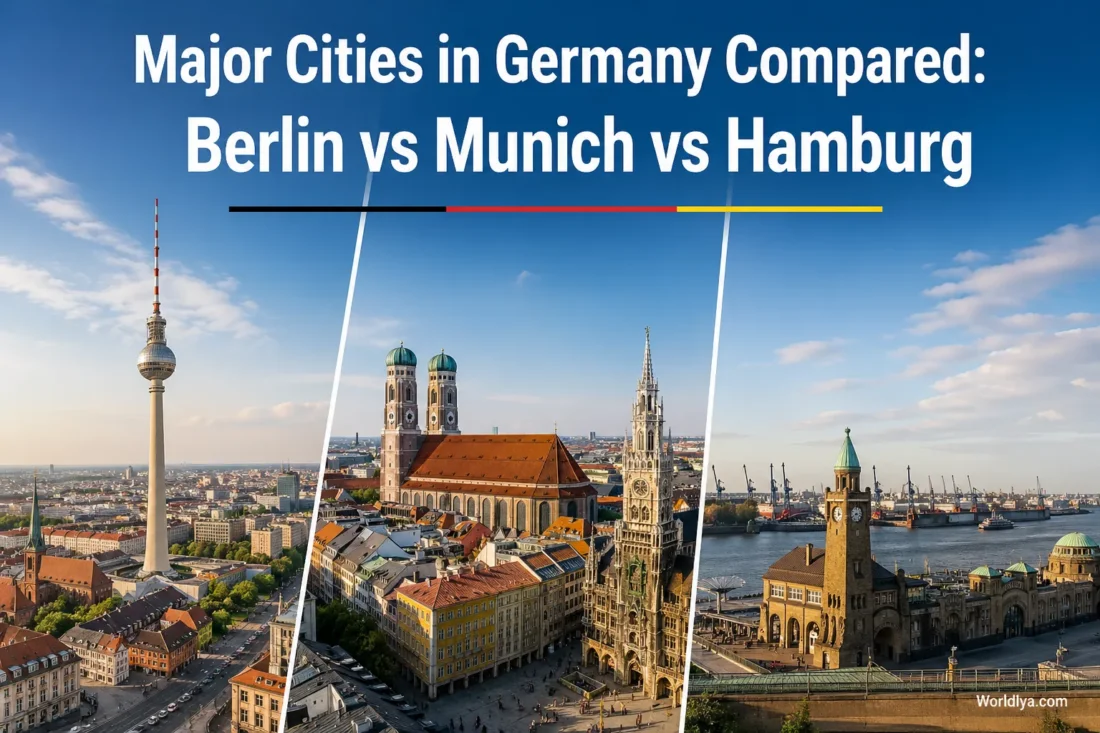
Germany’s three biggest city personalities do not feel like copies of one another. Berlin is wide, layered, artistic, and restless in the good sense. Munich feels neat, green, and polished, with a strong Bavarian character. Hamburg moves with water: canals, harbour air, brick warehouses, lakes, ferries, and a northern calm that slowly wins people over. If you are trying to understand Germany through its major cities, comparing Berlin vs Munich vs Hamburg is one of the most useful places to start.
Berlin vs Munich vs Hamburg in Plain English
Think of the three cities as three different doors into Germany:
- Berlin is the door for people who want scale, museums, street life, creative districts, late cafés, international food, and a city that changes from one neighbourhood to the next.
- Munich is the door for people who like order, parks, museums, elegant streets, beer gardens, Alpine day-trip energy, and a city centre that is easy to enjoy on foot.
- Hamburg is the door for people who love water, port views, red-brick architecture, ferries, lake walks, music venues, and a softer northern pace.
No city is “better” for everyone. The right answer depends on your trip style, budget, pace, and what kind of Germany you want to meet first.
| Feature | Berlin | Munich | Hamburg |
|---|---|---|---|
| City Feel | Big, creative, spread out | Elegant, tidy, green | Maritime, calm, scenic |
| Population Size | About 3.9 million | About 1.6 million | About 1.9 million |
| Urban Area | Roughly 891 km² | Roughly 310 km² | Roughly 755 km² |
| Good for | Museums, districts, nightlife, global food, creative travel | Old town walks, parks, museums, beer gardens, nearby Alps | Harbour views, ferries, canals, Speicherstadt, relaxed city breaks |
| Visitor Pace | Needs more planning because it is large | Easy to structure around the centre | Easy to enjoy slowly, especially near the water |
| Public Transport | U-Bahn, S-Bahn, trams, buses, ferries | U-Bahn, S-Bahn, trams, buses | U-Bahn, S-Bahn, buses, harbour ferries |
| First Impression | “This city has many cities inside it.” | “This city is polished and walkable.” | “This city breathes through water.” |
Berlin: Big-City Energy With Many Neighborhoods
Berlin is Germany’s largest city, and you feel that scale almost immediately. It does not behave like a neat postcard. It is more like a large notebook filled by many different hands: museum islands, wide avenues, quiet lakes, design shops, food markets, apartment blocks, old courtyards, parks, galleries, and neighbourhood cafés that look ordinary until you sit down for an hour.
The first thing many visitors learn is simple: Berlin is not a one-centre city. You can spend a morning around Museum Island, move to Kreuzberg for food, continue to Charlottenburg for classic architecture, and end the day in Prenzlauer Berg with a calm street full of cafés. Each area has its own rhythm.
Why Berlin Works for Curious Travelers
- Museum depth: Berlin is a strong choice for museum-heavy trips, especially around Museum Island and nearby cultural areas.
- Neighbourhood variety: The city rewards people who enjoy exploring different districts rather than staying only near one main square.
- Food range: You can move from German bakeries to Turkish, Vietnamese, Middle Eastern, Italian, Korean, and vegan-friendly places without much effort.
- Green breaks: Parks, lakes, and riverside paths make Berlin feel less heavy than its size suggests.
What Berlin Feels Like on the Ground
Berlin can feel a little loose at first. That is part of its charm. Streets do not always look polished, and the city does not rush to impress you in one perfect view. It asks you to move around. Walk a few blocks. Take a train. Sit in a small café. Try one district, then another. The reward is a city with texture.
For a first visit, do not plan Berlin as if it were a small old town. Choose clusters. A good day might pair Museum Island with the Spree riverside, or Charlottenburg with shopping and palace gardens, or Kreuzberg with markets and canal walks. Trying to “see everything” in two days is like trying to read a full library by looking at the shelves.
Berlin Is a Good Fit if You Like
- Large cities with many layers
- Art, design, music, museums, and casual neighbourhood culture
- Public transport exploration
- International food and café-hopping
- Trips where every day can feel different
Small warning, in a useful way: Berlin is wide. If you stay far from the areas you want to visit, your days may fill with train rides. Pick your accommodation by district, not only by price.
Munich: Polished Streets, Green Parks, and Bavarian Character
Munich feels more compact than Berlin, even though it is still a large city. The centre is easier to understand on foot: Marienplatz, Viktualienmarkt, churches, shopping streets, museums, beer halls, and parks sit in a pattern that first-time visitors can grasp quickly. The city gives you fewer rough edges and more clean lines.
That does not mean Munich is dull. It has a strong local identity. You see it in the food, the beer garden culture, the architecture, the city’s calm confidence, and the way green spaces are woven into daily life. The English Garden is not just a park on a map; it is part of how Munich breathes.
Munich Strengths
- Easy old-town walking
- Strong museum scene
- Large parks and river areas
- Classic Bavarian food culture
- Good base for Alpine day trips
Munich Trip Style
- Better for tidy plans
- Good for couples and families
- Ideal for museum-plus-park days
- Comfortable for first Germany trips
- Often feels more formal than Berlin
What Munich Feels Like on the Ground
Munich is the easiest of the three to enjoy with a simple plan. Start in the old town, walk through markets and side streets, then move toward a museum district or the English Garden. You do not need to chase the city. It comes to you in a more orderly way.
The city also works well for people who want Germany plus nature. The Alps are not inside Munich, of course, but the feeling of the mountains is close enough to shape the city’s travel mood. Many visitors pair Munich with lakes, castles, or mountain towns. That makes it a useful base for a trip that mixes city culture with outdoor scenery.
Munich Is a Good Fit if You Like
- Walkable city centres
- Clean design, calm streets, and green spaces
- Museums, classical architecture, and traditional food
- Day trips to lakes, towns, and mountain scenery
- A city that feels organized without feeling cold
Useful budget note: Munich often feels pricier than the other two cities, especially for central accommodation. The trade-off is convenience: many visitor highlights are easy to link together in a short stay.
Hamburg: Water, Brick, Ferries, and Northern Calm
Hamburg is Germany’s great northern city, and water shapes nearly everything about it. The Elbe River, the Alster lakes, canals, bridges, harbour views, and ferry routes give the city a different rhythm from both Berlin and Munich. It is urban, but it often feels open. You look down a street and suddenly the city widens into water.
Hamburg is not just a port city in the practical sense. It has turned maritime life into atmosphere. The Speicherstadt, with red-brick warehouse architecture and canals, is one of the most memorable urban areas in Germany. HafenCity adds a newer layer beside it, while the Elbphilharmonie gives the waterfront a modern landmark.
Why Hamburg Stands Apart
- Ferries are part of normal transport: The harbour ferry experience makes everyday movement feel scenic.
- Water gives the city space: The Alster and Elbe areas are ideal for slower walks and easy views.
- Brick architecture creates a strong identity: Speicherstadt and Kontorhaus-style buildings give Hamburg a look that is hard to confuse with Munich or Berlin.
- The pace feels balanced: It is a large city, yet many areas feel calm and breathable.
What Hamburg Feels Like on the Ground
Hamburg is a city for people who enjoy looking around while moving. A ferry ride, a walk near the lakes, a slow loop through Speicherstadt, a coffee near the harbour, a museum stop, then sunset by the Elbe: this kind of day feels natural here. You do not need to pack every hour with a famous landmark.
The city also has a strong music and theatre culture, but you can enjoy Hamburg without chasing a show. The setting itself does much of the work. Water softens the big-city feel. Brick gives it warmth. Northern light gives it mood without drama.
Hamburg Is a Good Fit if You Like
- Harbour views, canals, lakes, and ferries
- Architecture with red brick and waterfront contrast
- Relaxed city breaks with scenic walking
- Music, theatre, and evening culture in a general, visitor-friendly sense
- A large city that does not always feel crowded
Which City Feels Largest?
Berlin is the largest by population and land area, and it feels that way. The distances are real. You may travel 30 minutes and still be inside a very normal part of Berlin. That size is part of the appeal, but it also means you should plan by neighbourhood clusters.
Hamburg is also broad, but water changes the experience. The city opens and closes around rivers, lakes, canals, bridges, and harbour zones. It feels spacious rather than endless.
Munich is the smallest of the three by area, and many visitors find it the easiest to understand quickly. You can cover a satisfying first visit with a central hotel, public transport, and a few well-chosen walks.
Transport Comparison: Getting Around Each City
All three cities have strong public transport. You do not need a car for normal sightseeing. In many cases, a car would make the trip less pleasant, not easier.
| City | Main Transport Options | Visitor Tip |
|---|---|---|
| Berlin | U-Bahn, S-Bahn, tram, bus, ferry | Use station-based planning. Distances between attractions can be longer than they look on a simple map. |
| Munich | U-Bahn, S-Bahn, tram, bus | Many central sights pair well with walking. Use S-Bahn for airport and wider regional movement. |
| Hamburg | U-Bahn, S-Bahn, bus, harbour ferry | Include at least one ferry ride. It is useful transport and a scenic city experience at the same time. |
Train travel between the cities is practical, too. Germany’s rail network links Berlin, Munich, and Hamburg well enough for multi-city trips. Always check current schedules before booking, because route times and connections can change by date, service, and season.
Culture Comparison: Museums, Food, and Daily Life
Museums and Sightseeing
Berlin is the strongest choice if you want dense museum days. Museum Island alone can anchor a trip, and the wider city adds galleries, memorial sites, design spaces, and smaller museums across several districts. Keep the plan respectful, balanced, and not rushed.
Munich is excellent for visitors who like museums mixed with classic city beauty. The Kunstareal museum district, palace visits, churches, markets, and garden walks create a tidy sightseeing flow. It is easier to build a neat two or three-day plan here.
Hamburg shines through setting and atmosphere. Speicherstadt, HafenCity, the harbour, the Alster, and the Elbe create a city where sightseeing often happens between places, not only inside them. Walks matter here.
Food and Cafés
Berlin gives you the broadest international food scene. Munich leans strongly into Bavarian classics, beer gardens, bakeries, and polished dining areas. Hamburg brings northern flavours, fish dishes, harbour-side restaurants, cafés near the water, and a city-break food scene that feels relaxed rather than showy.
Daily Rhythm
- Berlin: flexible, casual, mixed, and spread across districts.
- Munich: orderly, comfortable, green, and easier to plan.
- Hamburg: scenic, water-led, calm, and good for slow exploration.
Cost and Comfort: What Visitors Usually Notice
Costs change by season, hotel demand, events, and how early you book. Still, travellers often notice a pattern. Munich can feel the most expensive for central stays. Berlin has a wide range, but its popular areas are no longer automatically cheap. Hamburg often sits between the two, though waterfront or central hotels can rise quickly during busy periods.
Simple Booking Advice
- Choose area before hotel: A cheaper room far from your sights can cost you time every day.
- Check event dates: Trade fairs, festivals, and large events can raise room prices.
- Stay near transport: A nearby U-Bahn or S-Bahn station is often worth more than a slightly larger room.
- Match the city to your pace: Berlin needs time, Munich rewards structure, Hamburg rewards slow movement.
Best City for a First Trip to Germany?
For a first trip, the right city depends on what you want to feel when you arrive.
| Traveler Type | Best Match | Why It Fits |
|---|---|---|
| Museum-focused traveler | Berlin | Large museum scene, many districts, strong cultural variety. |
| Short city-break visitor | Munich | Compact centre, easy walking, simple planning, green spaces. |
| Waterfront and scenery lover | Hamburg | Harbour, canals, ferries, lake walks, relaxed northern feel. |
| Food explorer | Berlin | Broad international food range across many neighbourhoods. |
| Traditional German atmosphere | Munich | Bavarian food, beer gardens, classic squares, nearby Alpine mood. |
| Slow travel fan | Hamburg | Great for walking, ferry rides, waterside cafés, and calm views. |
| Multi-city rail trip | Berlin + Hamburg or Berlin + Munich | Berlin gives scale; Hamburg adds water, while Munich adds Bavarian character. |
How Many Days Do You Need?
You can sample any of these cities in two days, but the experience improves when you give each city the time it naturally wants.
Berlin
3 to 5 days feels right for a first visit. Use one day for major sights, one for museums, one for neighbourhoods, and extra time for parks, food, or day trips.
Munich
2 to 4 days works well. The centre is manageable, and extra time can go to museums, parks, palaces, lakes, or mountain-side day trips.
Hamburg
2 to 3 days is enough for a strong first impression. Add more time if you enjoy museums, harbour walks, boat trips, or nearby northern destinations.
Best Neighborhood Style by City
Choosing the right area can shape the whole trip. A city can feel easy or tiring based on where you sleep.
| Travel Style | Berlin | Munich | Hamburg |
|---|---|---|---|
| First Visit | Mitte, Prenzlauer Berg, Charlottenburg | Old Town area, Maxvorstadt, near Hauptbahnhof with care for street comfort | Altstadt, Neustadt, HafenCity, St. Georg near good transport |
| Café and Local Streets | Prenzlauer Berg, Kreuzberg, Friedrichshain | Glockenbachviertel, Haidhausen, Maxvorstadt | Sternschanze, Eppendorf, Ottensen |
| Museums | Mitte | Maxvorstadt | Altstadt, HafenCity, Speicherstadt area |
| Water or Parks | Tiergarten, lakeside outer areas for longer stays | English Garden side, Isar areas | Alster, HafenCity, Elbe-side areas |
Berlin vs Munich vs Hamburg for Families
All three cities can work for families, but the trip style changes.
- Berlin is great for older children and teens who enjoy museums, trains, food variety, parks, and changing neighbourhoods. The size means you should avoid overloading the schedule.
- Munich is perhaps the easiest family choice for a first visit. The centre is readable, parks are excellent, and day trips can add lakes or mountain scenery.
- Hamburg works beautifully for families who like ferries, harbour views, model railways, lakeside walks, and easy visual variety. Water makes the city feel like a gentle adventure.
Berlin vs Munich vs Hamburg for Students and Longer Stays
For longer stays, the question changes from “Which city has more sights?” to “Which daily rhythm fits me?”
Berlin suits people who like variety, international circles, creative projects, and a large social map. You can keep discovering new areas for months. The city rewards independence.
Munich suits people who value order, green space, career-focused environments, and quick access to nature. It can feel more expensive, yet many residents appreciate the comfort and outdoor balance.
Hamburg suits people who want a large city with water, design, media, trade, music, and a calmer daily feel. It is urban without always feeling loud.
Best Two-City Combinations
If you cannot choose just one, pair cities that contrast well.
- Berlin + Hamburg: A strong north German route. Berlin gives scale and cultural range; Hamburg adds water, harbour scenery, and a slower mood.
- Berlin + Munich: A classic contrast. Berlin feels loose and experimental; Munich feels polished and traditional. Together, they show two very different urban faces.
- Munich + Hamburg: Good for travelers who want beauty, comfort, food, parks, and scenery without Berlin’s larger, more scattered feel.
- All Three: Ideal for a fuller Germany city route. Start with Berlin for scale, continue to Hamburg for water, end in Munich for Bavarian character and nature day trips.
Common Mistakes When Comparing the Three
- Thinking Germany’s big cities feel the same: They do not. Berlin, Munich, and Hamburg have very different urban personalities.
- Booking by price only: A far-away stay can make Berlin tiring, Munich less charming, and Hamburg less scenic.
- Underestimating Berlin’s size: Berlin needs route planning. Put nearby sights together.
- Seeing Munich only as traditional: Munich also has strong museums, universities, design, technology, and green living.
- Seeing Hamburg only as a harbour: The city also has lakes, elegant residential areas, music, museums, and strong architecture.
- Skipping public transport passes: Day tickets or city transport cards can make sightseeing smoother, depending on your plan.
A Simple Decision Guide
Choose Berlin if you want Germany’s biggest urban experience, many districts, international food, museums, creative energy, and a trip that keeps changing shape.
Choose Munich if you want a clean, elegant, walkable city with Bavarian character, parks, museums, beer gardens, and easy access to nature day trips.
Choose Hamburg if you want water views, harbour ferries, brick architecture, lake walks, music culture, and a large city with a calmer northern feel.
Sample Itineraries for Different Travelers
If You Have 3 Days
- Berlin: One day for central sights and the Spree area, one day for museums, one day for neighbourhoods and parks.
- Munich: One day for the old town, one day for museums and the English Garden, one day for a palace, lake, or nearby town.
- Hamburg: One day for Speicherstadt and HafenCity, one day for harbour and ferry routes, one day for the Alster, museums, and neighbourhood cafés.
If You Have 7 Days
A balanced one-week route could be Berlin for 3 days, Hamburg for 2 days, and Munich for 2 days. This route gives you the biggest contrast: creative capital-city scale, northern water culture, and Bavarian elegance.
If you prefer slower travel, pick only two cities. Berlin + Hamburg works well for northern Germany. Berlin + Munich gives the strongest contrast. Munich + Hamburg feels smoother and less intense.
Final Comparison: Which One Would You Enjoy Most?
If you like a city that keeps opening new doors, pick Berlin. If you prefer a city that feels graceful, green, and easy to organize, pick Munich. If your ideal city break includes water, ferries, brick warehouses, and slow scenic walks, pick Hamburg.
The best part? These cities do not cancel each other out. They complete the picture. Berlin shows Germany’s large, creative, international side. Munich shows its polished southern side. Hamburg shows its maritime northern side. Put them together and Germany becomes easier to understand, not as a single mood, but as a set of places with their own voices.
Frequently Asked Questions
Is Berlin Better Than Munich or Hamburg?
No single city is better for every traveler. Berlin is better for scale, museums, food variety, and creative districts. Munich is better for classic city beauty, green space, and easy planning. Hamburg is better for water views, harbour atmosphere, ferries, and relaxed walking.
Which City Is Best for a First Visit to Germany?
Munich is often the easiest first city because the centre is simple to enjoy. Berlin is better if you want a larger and more varied trip. Hamburg is a great first choice if you prefer scenic walks, waterfront areas, and a calmer pace.
Which City Is the Most Walkable?
Munich usually feels the most walkable for first-time visitors because many central sights sit close together. Hamburg is very pleasant for scenic walks near the water. Berlin is walkable by district, but not as a whole-city walking experience because it is much larger.
Which City Has the Best Public Transport?
All three have strong public transport. Berlin has the widest big-city network. Munich is easy to use for central and regional travel. Hamburg stands out because harbour ferries are part of the local transport experience.
Can You Visit Berlin, Munich, and Hamburg in One Trip?
Yes. A one-week trip can include all three if you enjoy moving quickly, but two cities may feel better for slower travel. Berlin plus Hamburg is a strong northern route, while Berlin plus Munich gives a sharper contrast.
Sources
The following official and high-authority pages were used to check population, area, tourism, and transport details:
- Berlin Business Location Center: Berlin at a Glance
- Berlin Official City Portal: Public Transportation
- Germany Capitals and Major Cities Overview
- City of Munich: Population Statistics
- Official Munich Portal: Public Transport
- Statistik Nord: Hamburg Population Register
- Hamburg Official Visitor Portal: Public Transport
- Deutsche Bahn: Train Timetables and Tickets