
Updated: August 19, 2026 What changed?
Australia looks simple on a map at first: coastlines, famous cities, beaches, and then a vast inland space. That inland space is where the word Outback starts to make sense. It is remote, wide, dry in many places, culturally meaningful, and closely tied to how Australia works as a country.
The Outback is not just “the middle of Australia.” It is a way people describe remote inland Australia, especially areas far from the big coastal cities. It also helps explain something bigger: why Australia’s economy can be strong while much of its land remains sparsely populated, natural, and difficult to move through.
The Simple Answer
Yes, Australia has a strong advanced economy by many practical measures. It has valuable natural resources, a large services sector, globally known education providers, steady tourism appeal, productive farms, and well-developed cities. The Outback matters because it holds many of the landscapes, minerals, pastoral areas, travel routes, and cultural places that help shape that economy.
A good way to understand Australia is this: the coast is where most people live, but the inland helps explain much of the country’s scale, identity, and export strength.
What the Australian Outback Is
The Australian Outback usually means the remote inland parts of Australia, away from the heavily populated coastal belt. It is not one official fenced area. There is no single line on the map where the Outback begins and ends.
That is part of the charm. Ask different Australians where the Outback starts, and you may get different answers. Some will point to red desert country. Others may think of cattle stations, long highways, mining towns, dry riverbeds, star-filled skies, or small communities far from the nearest large city.
In practical terms, the Outback is best understood as remote inland Australia with low population density, large natural landscapes, and long distances between settlements.
| Feature | Simple Meaning | Why It Matters |
|---|---|---|
| Distance | Places can be many hours apart by road. | It shapes transport, tourism, services, and daily life. |
| Climate | Many areas are arid or semi-arid, though not all are desert. | Water, farming, travel planning, and settlement patterns depend on it. |
| Population | Large land areas have few people. | Australia’s cities and inland regions feel very different. |
| Land Use | Pastoralism, mining, tourism, conservation, and cultural heritage all appear. | The Outback contributes to exports, jobs, visitor interest, and national identity. |
Where the Outback Fits in Australia’s Map
Most Australians live near the coast, especially around cities such as Sydney, Melbourne, Brisbane, Perth, Adelaide, and Hobart. The Outback sits behind that coastal pattern. It stretches through large parts of the Northern Territory, Western Australia, South Australia, Queensland, and parts of inland New South Wales.
It is easy to picture the Outback as only red sand and desert. That is too narrow. Some areas are rocky. Some are grassland. Some have savanna, woodland, ranges, gorges, salt lakes, or cattle country. In northern Australia, the landscape can look very different from the dry Red Centre.
Helpful idea: The Outback is less about a perfect border and more about remoteness, low population density, inland landscapes, and long-distance life.
Why the Outback Matters
The Outback matters because it helps explain Australia beyond postcard images. Beaches and city skylines are only one side of the country. The inland shows Australia’s scale. It shows why water, distance, resources, roads, rail, air links, and regional towns play such a large role in everyday planning.
It Shapes Australia’s Identity
Many people connect the Outback with open space, red earth, long roads, cattle stations, and starry night skies. Those images are not the whole story, but they do explain why the Outback feels so central to how Australia is imagined.
It is also home to places with deep First Nations cultural meaning. Visitors are usually encouraged to learn local guidance, respect cultural places, and treat the land as more than scenery. That attitude makes travel richer and more thoughtful.
It Supports Tourism
Outback travel attracts visitors who want more than a city break. They may come for national parks, road trips, stargazing, guided walks, wildlife, geology, art, local food, or a slower sense of space. For many travelers, the first long drive through inland Australia becomes the moment the country starts to feel real.
Well-known Outback-linked places include Uluṟu-Kata Tjuṯa National Park, the MacDonnell Ranges, Kings Canyon, Coober Pedy, Kalgoorlie, Birdsville, and parts of the Kimberley.
It Connects to Resources and Food
Some of Australia’s most valuable export stories are tied to inland or regional areas. Mining, energy, cattle, grain, wool, transport routes, and regional service towns all connect the Outback to the wider economy.
The Outback is not separate from the economy. It is one of the places where land, distance, resources, and infrastructure meet.
Is Australia’s Economy Strong?
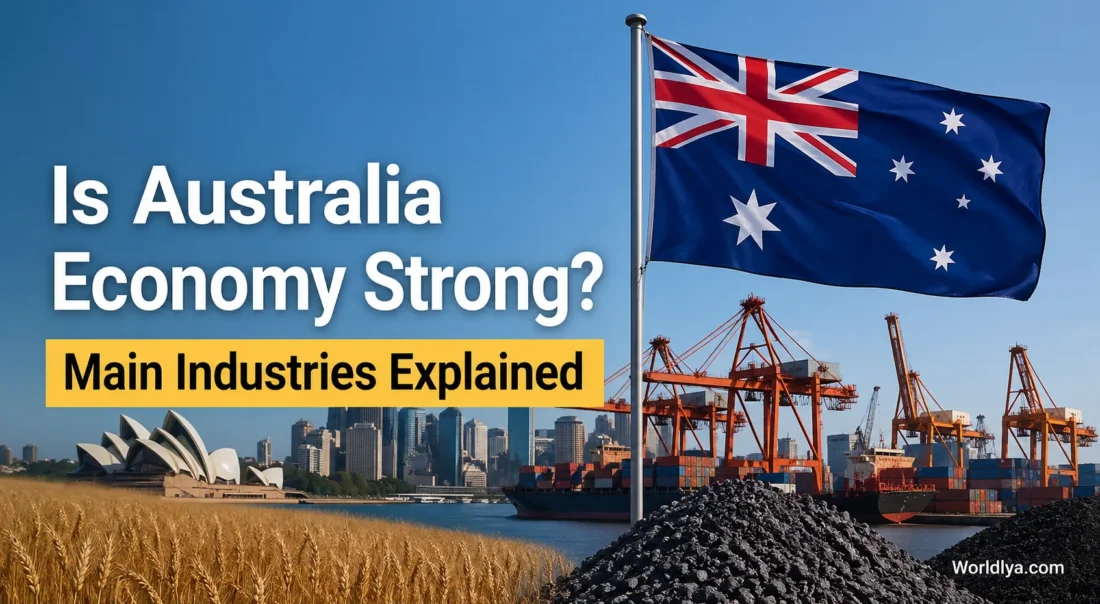
Australia’s economy is usually described as strong because it has several income streams rather than one single engine. Services, resources, education, tourism, farming, construction, finance, and professional work all play a role.
Recent national accounts data also shows continued growth. Australia’s GDP rose 0.3% in the March quarter of 2026 and 2.5% over the year to March 2026. For the 2024–25 financial year, the economy grew 1.4% in chain volume terms, while national net worth rose to A$21.4 trillion.
Does that mean every household feels rich? Not automatically. A national economy can grow while people still care about rent, groceries, fuel, wages, and interest rates. A stronger answer is this: Australia has a well-developed and resource-backed economy, but its strength is easier to understand sector by sector.
Growth
Australia recorded positive GDP growth in the latest official quarterly and yearly figures available for March 2026.
Export Base
Iron ore, coal, natural gas, education-related travel, gold, and visitor travel are major export earners.
Sector Mix
The economy is not only mining. Services, construction, education, tourism, agriculture, finance, health, logistics, and technology all matter.
Main Industries in Australia Explained
Australia’s economy is easier to understand when you separate what people do every day from what the country sells to the world. Services dominate daily work. Resources dominate many export headlines. Tourism and education connect Australia to global visitors and students. Agriculture keeps the country tied to land, climate, and regional skill.
Services: The Everyday Engine
Services include health care, education, finance, insurance, retail, transport, accommodation, food, professional work, public services, and digital businesses. This is where many Australians work and where much daily spending happens.
Think of services as the part of the economy you touch before lunch: paying with a bank card, visiting a clinic, using public transport, booking a hotel, ordering coffee, studying at a university, or hiring an accountant.
Mining and Resources: Small Footprint, Large Export Value
Mining is one of Australia’s best-known industries because it brings in large export earnings. Iron ore, coal, natural gas, gold, and other minerals all appear in Australia’s export mix. Much of this activity is linked to regional and remote areas, which is where the Outback connection becomes clear.
Mining does not employ everyone, and it is not the whole economy. Still, it has a large effect on trade income, regional towns, ports, railways, engineering work, equipment suppliers, and government revenue.
Agriculture and Food: Land, Skill, and Seasons
Agriculture includes beef, sheep, wool, grains, dairy, fruit, wine grapes, cotton, sugar, and other food products. It is not always a huge share of total GDP, yet it has a strong presence in regional Australia and in the country’s image abroad.
In Outback and rangeland areas, pastoralism is especially visible. Large cattle stations and sheep properties may cover enormous areas because the land can support only low-density grazing. That scale surprises many visitors. One farm can feel like a small country.
Education: A Global Service Export
Australia’s universities, colleges, English-language schools, and vocational providers attract international students. Education-related travel is counted as a service export because overseas students spend money in Australia while they study.
This is one reason Australia’s economy should not be viewed only through mines and farms. A lecture hall in Melbourne, a research lab in Sydney, or a training college in Brisbane can be part of the export story too.
Tourism: Nature, Cities, Food, and Distance
Tourism links Australia’s landscapes to income. Visitors come for cities, beaches, reefs, wildlife, road trips, food, events, and remote places. International visitation reached 8.3 million trips in the year ending December 2025, according to Tourism Research Australia.
The Outback gives Australian tourism something few countries can copy: open distance, red landscapes, desert skies, remote national parks, long highways, and cultural places that ask visitors to slow down.
Construction and Housing: The Built Side of Growth
Construction includes homes, apartments, roads, rail, ports, energy projects, schools, hospitals, warehouses, and commercial buildings. It links population growth, city planning, regional development, and infrastructure spending.
In a country as large as Australia, construction is not only about buildings. It is also about connection: roads that cross desert country, rail lines that move freight, airports that link remote towns, and ports that send exports overseas.
Finance, Professional Work, and Technology
Finance, insurance, accounting, law, engineering, consulting, design, software, data services, and research help the economy operate behind the scenes. They may not look as dramatic as a mine or a cattle station, but they help businesses manage money, risk, planning, design, trade, and growth.
These industries are strongest in major cities, yet they still support regional projects. A mining site, tourism operator, farm exporter, or construction company often needs city-based finance, technology, legal, and engineering support.
Australia’s Main Exports in Plain English
Export data helps explain why Australia is often seen as resource-rich, but not resource-only. In 2024, the largest goods and services exports included minerals, energy, education-related travel, gold, and personal travel.
| Export | Approximate 2024 Value | What It Means |
|---|---|---|
| Iron ore and concentrates | A$124.5 billion | Australia sells large volumes of iron ore used in steelmaking. |
| Coal | A$85.2 billion | A long-running resource export with major links to regional production and ports. |
| Natural gas | A$67.4 billion | An energy export connected to large infrastructure and regional supply chains. |
| Education-related travel | A$51.5 billion | International students support universities, colleges, housing, retail, and local services. |
| Gold | A$35.7 billion | A high-value mineral export with strong links to Western Australia and other regions. |
| Personal travel excluding education | A$22.7 billion | Visitor spending across holidays, food, accommodation, transport, and experiences. |
This table tells a useful story. Resources are very important, but people also come to Australia to study and travel. That mix matters. It means the economy is not only shaped by what comes out of the ground. It is also shaped by people, skills, services, and places.
How the Outback and the Economy Connect
The Outback is not just a travel idea. It connects to the economy in several practical ways.
- Resources: Many mining and energy projects sit in remote or regional areas.
- Transport: Long highways, rail corridors, air routes, and ports help connect inland production to global markets.
- Tourism: Remote landscapes attract visitors looking for nature, space, road trips, and guided cultural experiences.
- Pastoral land: Cattle and sheep grazing shape large parts of rangeland Australia.
- Regional towns: Small towns provide fuel, food, repairs, accommodation, health services, schools, and local jobs.
- Science and land knowledge: Weather, geology, ecology, water, and land management all matter in remote Australia.
A Simple Way to Picture It
If Australia’s coastal cities are the front rooms of the house, the Outback is the wide back country that keeps reminding you how large the property really is. You may not pass through it every day, but you cannot understand the whole place without it.
Why Australia Can Be Urban and Outback at the Same Time
Australia is highly urban in daily life. Most people live in cities and large towns. Yet the country’s land area is huge, and much of it is arid or semi-arid. This creates a split personality that visitors often notice quickly.
In the morning, you can be in a modern airport or city café. Later, you might fly over hours of dry inland country with only thin roads and tiny settlements below. Both are Australia. One does not cancel the other.
This contrast explains why Australia’s economy has both city-based services and remote-area industries. Finance, education, media, health care, and technology cluster in cities. Mining, pastoralism, road tourism, renewable energy projects, and regional logistics often point inland.
What Visitors Should Understand Before Seeing the Outback
The Outback rewards curious travelers, but it is not a place to treat casually. Distances are long. Weather can change plans. Phone coverage may be limited outside towns. Some roads need suitable vehicles. Many cultural and natural places have visitor rules that should be followed with care.
- Plan distances honestly. A short line on a map can mean many hours on the road.
- Respect local guidance. Signs, ranger advice, Traditional Owner guidance, and park rules exist for good reasons.
- Carry enough water. Dry landscapes can be unforgiving even on a pleasant-looking day.
- Book ahead in remote areas. Accommodation, tours, fuel stops, and permits can be limited.
- Travel with patience. The Outback is not designed for rushing. That is part of its appeal.
Common Myths About the Outback
| Myth | Better Explanation |
|---|---|
| The Outback is all desert. | Many areas are dry, but the Outback includes deserts, ranges, grasslands, savanna, woodlands, salt lakes, and towns. |
| Nobody lives there. | Population density is low, but remote communities, towns, pastoral families, workers, artists, rangers, and tourism operators all live and work there. |
| It has no economic role. | Mining, pastoralism, tourism, transport, energy, and regional services connect the Outback to national income. |
| It is only for adventurous travelers. | Some trips are rugged, but many Outback places can be visited through guided tours, sealed roads, flights, rail journeys, and well-planned routes. |
Why the Outback Helps Explain Australia’s Strength
Australia’s economy is strong partly because it combines different strengths. The country sells resources, welcomes students, attracts visitors, grows food, builds infrastructure, and runs advanced services. The Outback connects to several of those strengths at once.
It gives Australia mineral wealth, tourism appeal, pastoral land, remote research value, and a sense of scale that few countries can match. It also reminds readers that economic strength is not always found in busy streets. Sometimes it sits far inland, under a clear sky, beside a rail line, a cattle station, a national park, or a mining town.
So, is Australia’s economy strong? Yes, but the most useful answer is not a slogan. Australia is strong because it has a broad economic base, valuable exports, respected education services, natural attractions, skilled workers, and regions that contribute in very different ways.
The Outback matters because it shows the part of Australia that is easy to miss from a city hotel window. It is not just empty space. It is geography, culture, distance, resources, tourism, food production, and identity wrapped into one big inland story.
Frequently Asked Questions
What is the Australian Outback?
The Australian Outback is a common term for remote inland Australia, especially areas far from major coastal cities. It has no single official border, but it is usually linked with low population density, long distances, arid or semi-arid landscapes, pastoral areas, mining regions, and culturally meaningful places.
Is the Outback only desert?
No. Many Outback areas are dry, but the Outback is not only desert. It can include grasslands, savanna, rocky ranges, woodlands, salt lakes, gorges, cattle country, small towns, and remote national parks.
Why is the Outback important to Australia?
The Outback matters because it shapes Australia’s identity, tourism, resource exports, pastoral industries, regional towns, transport routes, and understanding of distance. It is one of the best ways to understand Australia beyond its coastal cities.
Is Australia’s economy strong?
Australia has a strong advanced economy by many practical measures. It has services, resources, education, tourism, agriculture, construction, finance, and professional industries. Recent official data also shows continued GDP growth, though people’s day-to-day experience can vary by household and region.
What are Australia’s main industries?
Australia’s main industries include services, mining and resources, education, tourism, agriculture, construction, finance, health care, professional services, transport, and technology. Resource exports are highly visible, but services are central to daily economic life.
Sources
- Australian Bureau of Statistics — Australian National Accounts: National Income, Expenditure and Product
- Australian Bureau of Statistics — Australian System of National Accounts
- Department of Foreign Affairs and Trade — Australia’s Top 25 Exports, Goods and Services 2024
- Tourism Research Australia — International Tourism Results
- Australian Government — Outback Australia: The Rangelands
- Geoscience Australia — Areas of Australian and Territory Deserts
- Reserve Bank of Australia — Statement on Monetary Policy Overview