
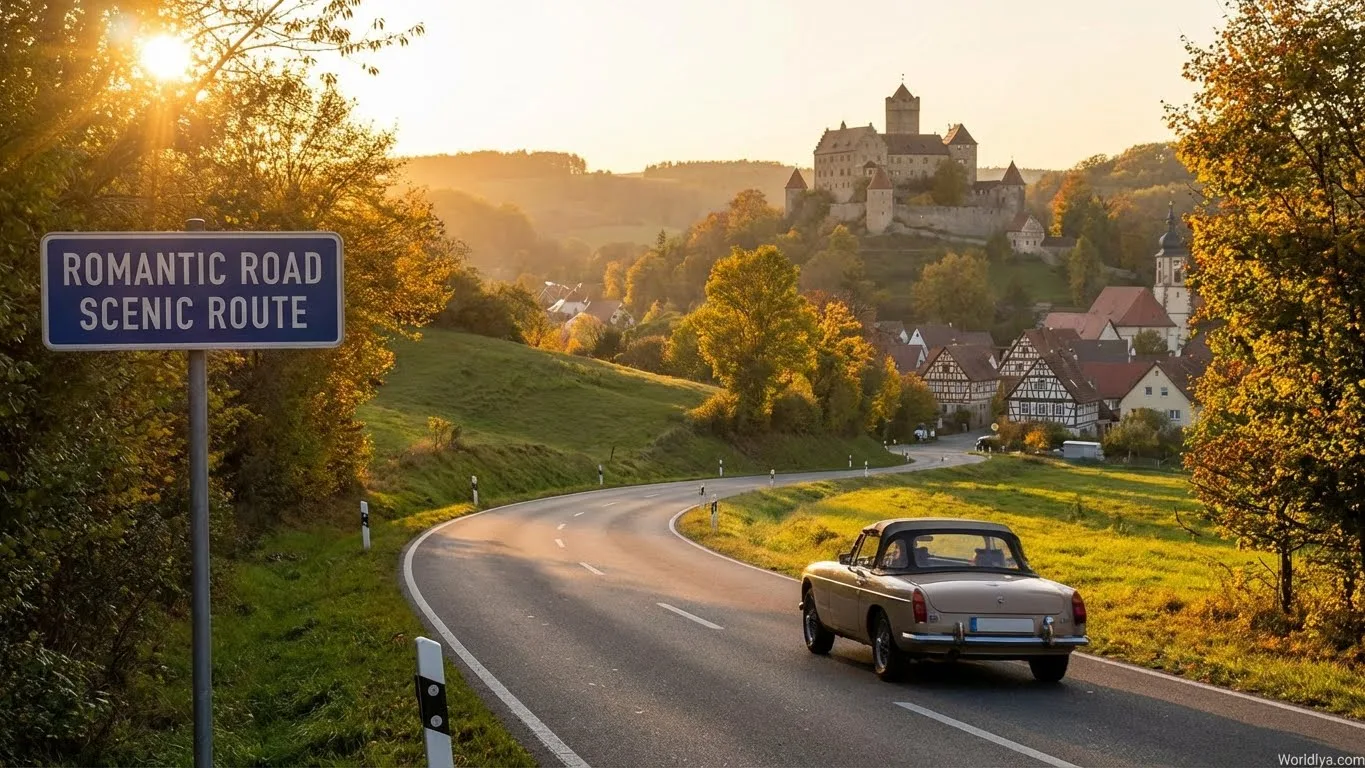
Germany’s Romantic Road connects river valleys, vineyard towns, medieval walls, Renaissance squares, quiet countryside and the foothills of the Bavarian Alps. The signed route runs for about 460 kilometres between Würzburg and Füssen, linking 29 official towns across Bavaria and Baden-Württemberg. You could drive from one end to the other quickly, but that would miss the point. This is a route made for unhurried walks, overnight stays and the occasional stop that was never on your original plan.
Romantic Road Trip Planner
- Official road route: About 460 kilometres
- Official towns: 29
- Northern endpoint: Würzburg
- Southern endpoint: Füssen
- Comfortable trip length: Four to seven days
- Fast highlights trip: Three days
- Vehicle signs: Brown Romantic Road signs
- Cycle route: About 500 kilometres
- Walking route: About 500 kilometres
Good to know: Navigation apps may place you on faster roads that bypass the official route. Add individual towns as waypoints and watch for the brown tourist signs.
What The Romantic Road Actually Is
The Romantic Road is not one continuous highway. It is a marked touring route that joins local roads, towns and rural landscapes between the River Main and the Alps. It was established in 1950 and has since become one of Germany’s best-known holiday routes.
The scenery changes as you travel south. Around Würzburg and the Tauber Valley, vineyards, rivers and cultivated hills shape the view. Medieval town walls become the main theme around Rothenburg ob der Tauber, Dinkelsbühl and Nördlingen. South of Augsburg, the land opens into meadows, lakes and Alpine foothills before the route reaches Schwangau and Füssen.
The word romantic refers less to candlelit dinners and more to an idealised landscape of old towns, castles, churches and winding country roads. It feels like travelling through a sequence of carefully framed scenes, yet each town has its own pace and identity.
Official Town Order From North To South
Würzburg, Wertheim, Tauberbischofsheim, Lauda-Königshofen, Bad Mergentheim, Weikersheim, Röttingen, Creglingen, Rothenburg ob der Tauber, Schillingsfürst, Feuchtwangen, Dinkelsbühl, Wallerstein, Nördlingen, Harburg, Donauwörth, Rain, Augsburg, Friedberg, Landsberg am Lech, Hohenfurch, Schongau, Peiting, Rottenbuch, Wildsteig, Steingaden, Halblech, Schwangau and Füssen.
How Many Days You Need
| Trip Length | What It Feels Like | Suitable Stops |
|---|---|---|
| 2 days | A selective trip rather than the full experience | Rothenburg, Dinkelsbühl, Füssen and Schwangau |
| 3 days | Busy but workable for major sights | Würzburg, Rothenburg, Nördlingen, Augsburg and Füssen |
| 5 days | A balanced first visit | Main towns plus Weikersheim, Dinkelsbühl and Landsberg |
| 7 days | Time for smaller towns and relaxed evenings | Most major stops and several rural detours |
| 10 days or more | Slow travel with museums, walks and longer stays | The full route with nearby lakes and countryside |
Five days suits many first-time visitors. It allows enough time to explore on foot without turning every morning into an early departure and every afternoon into a race for parking.
Best Direction To Travel
Würzburg To Füssen
Travelling south creates the most natural landscape progression. Vineyards and river towns gradually give way to Alpine scenery, with Neuschwanstein and the mountains forming a memorable final stage.
Füssen To Würzburg
Starting in the south works well when arriving through Munich or when a timed castle visit fixes your first travel day. The route becomes gentler as you continue north toward Franconia and the Main Valley.
Neither direction is wrong. Choose according to flights, train connections and accommodation. North to south offers the stronger visual finale; south to north can simplify travel from Munich.
Best Time To Visit
Late April Through June
Spring brings fresh countryside, longer days and comfortable walking conditions. Gardens around palaces and historic buildings begin to fill with colour. Some seasonal attractions and transport services start during this period, though opening dates vary.
July and August
Summer provides long daylight hours, full attraction schedules and active town centres. Reserve rooms and timed castle tickets early, especially around Rothenburg, Füssen and Schwangau. Starting popular visits early in the morning leaves more of the afternoon for smaller places.
September and Early October
This period often combines mild daytime conditions with changing colours in vineyards and forests. It is well suited to driving, cycling and town walks. Daylight shortens as October approaches, so avoid planning too many stops after lunch.
Late November and December
Historic centres gain seasonal decorations and festive markets. The atmosphere can be lovely, but the trip needs a different rhythm. Days are shorter, some attractions use reduced hours and winter road conditions may affect rural sections. Base yourself in fewer towns rather than changing hotels every night.
Weather planning: Conditions can differ between Würzburg and the Alpine end of the route on the same day. Carry a light waterproof layer even when the morning forecast looks settled.
Essential Romantic Road Stops
Würzburg: Palaces, Vineyards and River Views
Würzburg makes a practical northern base thanks to its rail connections and range of accommodation. Its main landmark is the Würzburg Residence, an 18th-century palace recognised by UNESCO together with its court gardens and Residence Square.
Allow time for the grand staircase, decorated halls and gardens rather than treating the palace as a photo stop. Elsewhere in the city, the Old Main Bridge offers views toward Marienberg Fortress and the surrounding vineyard slopes.
- Suggested time: Half a day to one full day
- Stay overnight: Yes, especially when travelling by train
- Good for: Architecture, museums, riverside walks and local wine culture
The Tauber Valley: Smaller Towns That Reward Extra Time
Between Würzburg and Rothenburg, the route passes through a chain of towns that many short itineraries skip. They are ideal for travellers who enjoy palace gardens, market squares and quieter streets.
- Wertheim: A riverside old town near the meeting point of the Main and Tauber, overlooked by castle ruins.
- Bad Mergentheim: A spa town with a palace complex, gardens and a walkable centre.
- Weikersheim: Known for its Renaissance palace and formal garden beside the historic market square.
- Röttingen: A small walled town suited to a short walk and café stop.
- Creglingen: A useful stop for the Herrgottskirche and its carved altar by Tilman Riemenschneider.
Trying to visit every Tauber Valley town in one day creates more parking time than sightseeing time. Pick two or three according to your interests.
Rothenburg Ob Der Tauber: The Famous Walled Town
Rothenburg ob der Tauber is the route’s most photographed medieval town. Towers, gates, steep roofs and narrow lanes fill the old centre, while sections of the fortifications can be explored on foot.
The busiest visitors often arrive in the middle of the day. Staying overnight changes the experience. Early morning and evening walks reveal quieter courtyards, side streets and long views across the Tauber Valley.
- Walk part of the town wall.
- Visit the Market Square and Town Hall area.
- See Plönlein, then continue beyond the familiar viewpoint.
- Enter St. James’s Church to view its carved artworks.
- Follow a side street away from the central shopping lanes.
Allow at least four hours. A full day or overnight stay feels much less hurried.
Dinkelsbühl: Colourful Streets Within Old Defences
Dinkelsbühl has a compact historic centre enclosed by towers, gates and old defences. Its broad main streets, colourful façades and Gothic St. George’s Minster create a different townscape from Rothenburg.
It works well as an overnight alternative for travellers who prefer a smaller centre. Walk through several gates, circle part of the outer edge and return through the streets around the minster.
Nördlingen: A Complete Wall Inside A Meteorite Crater
Nördlingen stands within the Nördlinger Ries, a landscape formed by a meteorite impact roughly 15 million years ago. The old town is surrounded by a complete walkable wall measuring about 2.7 kilometres.
The wall circuit gives changing views over rooftops, gardens and defensive structures. St. George’s Church and its tower, known as Daniel, dominate the centre. Anyone interested in geology can also visit the Ries Crater Museum.
Harburg and Donauwörth: Castle and Danube Stops
Harburg is centred on a hilltop castle complex above the Wörnitz Valley. Tour access and opening periods can vary, so check the castle’s current schedule before shaping the day around an interior visit.
Further south, Donauwörth sits where the route reaches the Danube. Reichsstraße forms the visual centre of the old town, lined with colourful historic buildings. The railway station also makes Donauwörth a useful connection point for visitors combining trains with local transport.
Augsburg: A City Stop With More Than One Story
Augsburg is larger than the medieval towns to its north, so it deserves more than a hurried drive through the centre. Maximilianstraße, the Town Hall area, the Fuggerei and the city’s waterways can fill a full day.
The Augsburg Water Management System has UNESCO status and includes canals, fountains, waterworks and related structures across the city and surrounding area. You do not need to see every component. A walking route through the centre reveals how water has shaped Augsburg’s streets and public spaces.
Landsberg Am Lech: A Riverside Pause
Landsberg am Lech combines a colourful old town with a broad river setting. The main square, decorated façades, Bayertor gate and river weir are all within a manageable walking area.
This is a pleasant place to slow the itinerary before the final Alpine section. A few hours work well, though an overnight stay gives you an easy start toward Steingaden, Schwangau and Füssen.
Wieskirche: Rococo Art In An Alpine Meadow
The Pilgrimage Church of Wies stands near Steingaden in a rural setting close to the Alps. Its restrained exterior gives little warning of the light, colour and detailed Rococo decoration inside. UNESCO recognises the church for both its artistic character and its preserved setting.
This remains an active place of worship. Visit quietly, check for services and avoid treating the interior as only a photography location. The surrounding landscape also deserves a few minutes before returning to the road.
Schwangau and Neuschwanstein: The Alpine Finale
Neuschwanstein Castle rises above Hohenschwangau near the lakes and mountains surrounding Schwangau. Since 2025, it has formed part of the UNESCO-listed Palaces of King Ludwig II of Bavaria alongside Linderhof, Schachen and Herrenchiemsee.
Castle admission uses timed tours. The ticket time is not the time to arrive in the village. Visitors still need to park or leave the bus, reach the ticket area and travel uphill to the entrance.
Neuschwanstein Planning Notes
- Book through the official Hohenschwangau ticket system.
- Arrive in Hohenschwangau around 1.5 to 2 hours before the admission time.
- The castle entrance is uphill from the ticket and parking area.
- Walking, shuttle bus and horse carriage options do not all reach the entrance itself.
- Shuttle and bridge access can change with weather or maintenance.
- Keep the timed tour confirmation available offline.
2026 reference: The listed regular admission fee for Neuschwanstein Castle is €21. Seasonal opening hours apply, and additional booking charges may appear. Verify the final price and access conditions before travel.
Füssen: More Than The Route Endpoint
Füssen marks the southern end of the Romantic Road, but it should not feel like a place to leave immediately. Its old town sits beside the River Lech beneath the High Castle and the former St. Mang monastery.
The centre is easy to explore on foot, while nearby lakes and mountain routes provide options for an extra day. Füssen also has a railway station, making it a practical finish for travellers returning to Munich or continuing elsewhere by public transport.
Three-Day Romantic Road Itinerary
Day One: Würzburg To Rothenburg
- Begin at the Würzburg Residence and court gardens.
- Walk part of central Würzburg or cross the Old Main Bridge.
- Drive through the Tauber Valley, choosing one stop such as Weikersheim.
- Reach Rothenburg by late afternoon.
- Stay overnight and walk the old town after the daytime visitors leave.
Day Two: Rothenburg To Augsburg
- Take an early wall walk in Rothenburg.
- Continue to Dinkelsbühl for a two-hour visit.
- Walk a section of Nördlingen’s complete wall.
- Drive through or pause at Harburg.
- Stay in Augsburg.
Day Three: Augsburg To Füssen
- Walk through central Augsburg in the morning.
- Pause at Landsberg am Lech.
- Visit Wieskirche near Steingaden.
- Continue to Schwangau for a pre-booked castle visit or outdoor viewpoints.
- Finish with an evening in Füssen.
This schedule includes the main names but leaves little room for museums, long meals or spontaneous stops. A fourth night makes the journey far more relaxed.
Five-Day Romantic Road Itinerary
| Day | Route | Main Experiences | Overnight |
|---|---|---|---|
| 1 | Würzburg | Residence, gardens, old centre and river | Würzburg |
| 2 | Würzburg to Rothenburg | Wertheim or Weikersheim, Tauber Valley and evening walk | Rothenburg |
| 3 | Rothenburg to Nördlingen | Dinkelsbühl, town walls and medieval centres | Nördlingen |
| 4 | Nördlingen to Landsberg | Harburg, Donauwörth, Augsburg and Lech riverside | Landsberg or Augsburg |
| 5 | Landsberg to Füssen | Wieskirche, Schwangau, Neuschwanstein area and Füssen | Füssen |
Seven-Day Romantic Road Itinerary
- Würzburg: Palace, gardens, central streets and river views.
- Tauber Valley: Wertheim, Bad Mergentheim, Weikersheim and nearby countryside.
- Rothenburg: Full day and overnight stay inside or near the old centre.
- Dinkelsbühl and Nördlingen: Two walled towns with different street plans and architecture.
- Harburg, Donauwörth and Augsburg: Castle views, Danube stop and city exploration.
- Landsberg and Pfaffenwinkel: Riverside streets, rural churches and Wieskirche.
- Schwangau and Füssen: Timed castle visit, lakes, old town and Alpine scenery.
Where To Stay Along The Romantic Road
| Base | Why Stay Here | Suitable For |
|---|---|---|
| Würzburg | Rail access, restaurants and a strong first or final day | Car-free arrivals and city stays |
| Rothenburg | Quiet evening and early-morning access to the old town | First-time visitors and photographers |
| Dinkelsbühl | Compact centre with a relaxed overnight atmosphere | Travellers avoiding larger bases |
| Nördlingen | Wall circuit, geology museum and central route position | Families and history enthusiasts |
| Augsburg | Wide choice of rooms, dining and public transport | Longer city visits |
| Landsberg Am Lech | Convenient break before the Alpine section | Slower road trips |
| Füssen | Rail station, old town and access to lakes and castles | Car-free departures and extra nights |
| Schwangau | Close to castle ticket areas and walking routes | Early timed admissions |
Sleeping inside historic centres can be atmospheric, but parking may be separate from the accommodation. Confirm parking location, access hours and luggage arrangements before arrival.
Driving and Parking Without Unnecessary Stress
- Use town names as waypoints. Entering only Würzburg and Füssen may send you onto a faster route away from the signed road.
- Follow the brown signs. They identify the touring route for cars and motorcycles.
- Park outside old centres. Many medieval streets are pedestrianised, narrow or restricted.
- Check hotel access. Accommodation inside a historic quarter may use a nearby public car park.
- Carry a parking payment option. Payment methods differ between towns and car parks.
- Do not schedule by distance alone. A short section can take hours once walks, meals and viewpoints are included.
- Save an offline map. Rural mobile coverage and data roaming conditions can vary.
A small car is easier to handle in compact parking areas and village streets. Large luggage is rarely useful on a route where hotels may have stairs, older entrances or parking several minutes away.
Travelling The Romantic Road Without A Car
A car offers the most freedom, yet several major stops can be combined by train and bus. Würzburg, Donauwörth and Augsburg connect with Germany’s long-distance rail network, while regional services reach many other towns. There is no single train that follows the road from beginning to end.
A Practical Rail-Based Route
- Arrive in Würzburg by long-distance or regional train.
- Travel to Rothenburg using regional connections, normally with a change.
- Continue through regional hubs such as Ansbach, Nördlingen, Donauwörth or Augsburg according to the chosen stops.
- Take regional rail to Füssen.
- Use local buses between Füssen station and Hohenschwangau for the castle area.
Train travellers should build fewer bases and use day trips. Moving every night with luggage adds transfers and reduces walking time.
Romantic Road Coach In 2026
The published 2026 Romantic Road Coach timetable lists Sunday services from 26 April through 27 September 2026, linking Frankfurt, Würzburg, Rothenburg, towns farther south, Munich and onward connections toward Augsburg and Füssen.
Several locations operate as request stops and require booking and payment at least three days before departure. The published service does not carry bicycles. Check the current timetable carefully because the coach is seasonal and does not serve every town every day.
Cycling The Route
The signposted long-distance cycle route covers about 500 kilometres and uses green route signs. It follows quieter roads and paths rather than copying the car route exactly. The northern sections include river valleys and rolling terrain; the southern section becomes hillier near the Alps.
A week suits experienced touring cyclists, while eight to ten days provides more time for town visits. Confirm bicycle carriage rules separately for each train because capacity, reservations and permitted services can differ.
Food and Local Flavours Along The Route
The route crosses several regional food areas rather than presenting one fixed menu. In the north, Würzburg and the Tauber Valley are closely associated with Franconian wine. Farther south, Swabian and Bavarian dishes become more common.
- Franconian dishes: Regional sausages, roast dishes, seasonal asparagus and local breads.
- Tauber Valley: Local wines, small wineries and seasonal menus.
- Swabian cooking: Maultaschen, Spätzle and onion-based dishes.
- Southern Bavaria: Dumplings, cheese dishes, pastries and meals suited to mountain regions.
- Bakery stops: Fresh bread, filled rolls and cakes provide an easy lunch between towns.
Restaurant kitchens in smaller towns may close between lunch and dinner or finish service earlier than expected. Check dining times before arriving late, especially outside summer.
What To Pack
For Town Walks
- Supportive walking shoes
- Light day bag
- Reusable water bottle
- Compact rain layer
- Portable phone charger
For The Road
- Offline route map
- Parking payment card or cash
- Charging cable and vehicle adapter
- Sunglasses
- Small umbrella
Cobblestones, slopes and wall walks make comfortable footwear more useful than formal shoes. Layers are also helpful because mornings near the Alps can feel cooler than afternoons farther north.
Planning Choices That Can Weaken The Trip
- Adding every official town: Twenty-nine stops look manageable on a map but leave little time to experience any one place.
- Changing hotels nightly: Packing, parking and check-in can consume the quietest hours of the day.
- Relying only on navigation software: The fastest route is not always the Romantic Road.
- Booking Neuschwanstein too tightly: Reaching the village is only the first step; the castle entrance is farther uphill.
- Visiting Rothenburg only at midday: An overnight stay reveals a calmer side of the old town.
- Ignoring smaller stops: One palace garden or riverside town often becomes a favourite memory.
- Scheduling long lunches before timed entries: Service pace and travel time can make the day feel rushed.
Frequently Asked Questions
Is The Romantic Road Worth Visiting?
It suits travellers who enjoy historic town centres, castles, churches, countryside and road trips with frequent stops. Visitors looking only for dramatic driving roads may prefer to combine it with the German Alpine Road, since much of the appeal comes from leaving the car and exploring on foot.
Can You Drive The Romantic Road In One Day?
You can cover a large part of the distance in one day, but there will be little time for towns or attractions. Two days allow only selected highlights. Four or five days create a more rewarding trip.
Which Town Is The Most Beautiful?
Rothenburg is the familiar postcard choice, while Dinkelsbühl offers colourful streets and Nördlingen has a complete wall circuit. Würzburg stands out for palace architecture, and Füssen adds Alpine scenery. The preferred stop depends on whether you value architecture, landscape, quiet streets or museums.
Do You Need A Car?
No, but a car makes smaller villages and rural sights easier to reach. Train-based visitors can create a satisfying route around Würzburg, Rothenburg, Augsburg and Füssen, then add buses or occasional local transfers.
Where Should First-Time Visitors Stay?
Würzburg, Rothenburg, Augsburg and Füssen form practical bases. On a slower trip, add Dinkelsbühl, Nördlingen or Landsberg am Lech.
Is Neuschwanstein Directly In Füssen?
No. The castle is above Hohenschwangau in the municipality of Schwangau, a short journey from Füssen. Local buses connect Füssen railway station with the castle area.
Is The Route Suitable For Families?
Yes. Town walls, towers, castles, river walks and the Nördlingen crater story can keep different age groups interested. Reduce daily driving, include open spaces and avoid filling every hour with indoor visits.
A Balanced Romantic Road Plan
Begin with one major sight each morning, choose one smaller stop after lunch and arrive at the overnight town while there is still time to walk. Stay two nights in at least one place. Reserve Neuschwanstein before fixing the southern part of the itinerary, and let the weather decide whether extra hours go toward gardens, museums, lakes or town walls.
The route becomes more enjoyable when it stops behaving like a checklist. A five-minute photo stop rarely tells you much about a town. An unplanned hour on a wall, beside a river or in a palace garden often does.
Sources
- Official Romantic Road Route, Towns and Travel Information
- Official Romantic Road Maps, Planning Material and 2026 Coach Timetable
- German National Tourist Board Romantic Road Information
- Official Neuschwanstein and Hohenschwangau Ticket Information
- Bavarian Palace Administration Neuschwanstein Visitor Information
- UNESCO: Würzburg Residence With The Court Gardens and Residence Square
- UNESCO: Pilgrimage Church Of Wies
- UNESCO: The Palaces Of King Ludwig II Of Bavaria
- Deutsche Bahn Journey Planning and Local Transport Information