
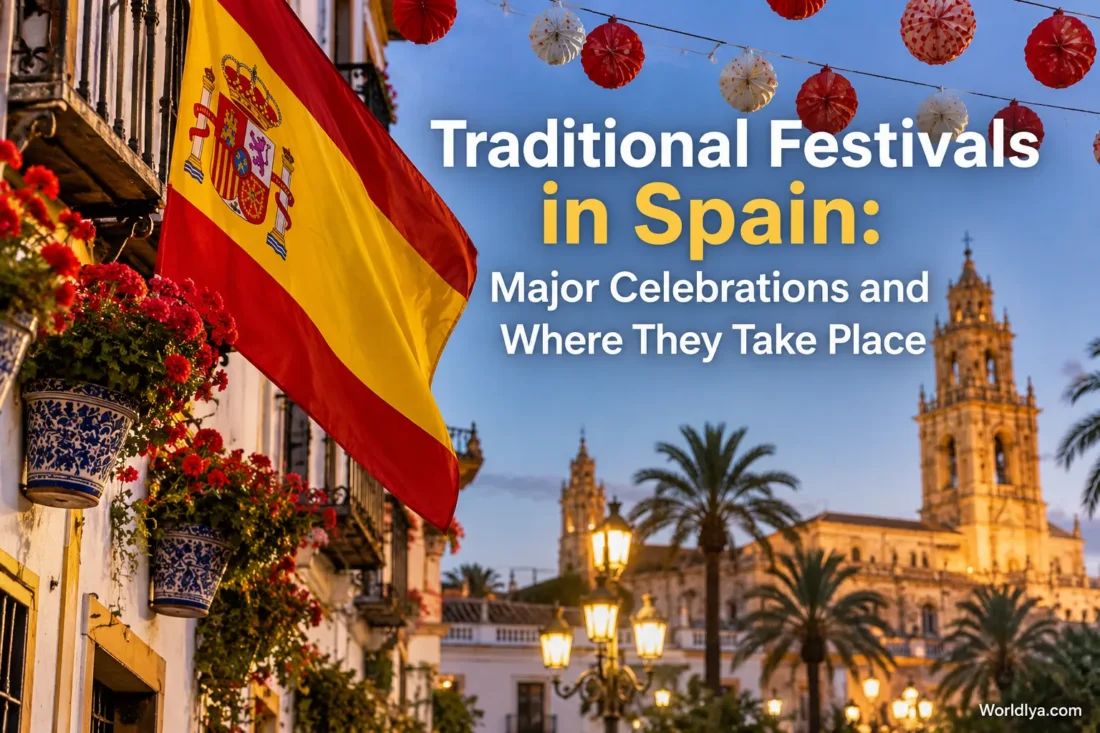
Spain’s traditional festivals are closely tied to place. Valencia fills with enormous handcrafted Fallas monuments in March, Seville builds a temporary fairground of lantern-lit casetas in spring, Córdoba opens flower-filled private courtyards in May, and Pamplona turns white and red every July. Travel a few hundred kilometres and the music, clothing, food, decorations and pace can feel completely different. That regional character is what makes Spain’s festival calendar worth exploring rather than treating it as one national tradition.
Some celebrations follow fixed dates, while others move with the annual calendar. Carnival dates change each year, for example, while San Fermín runs from 6 to 14 July and La Tomatina is held on the final Wednesday of August. Anyone planning a trip around a festival should still confirm that year’s programme with the local organiser before booking.
Major Traditional Festivals and Where They Take Place
| Festival | Location | Usual Time | Known For |
|---|---|---|---|
| Las Fallas | Valencia | March, culminating on 19 March | Ninots, monumental Fallas, music and street celebrations |
| Semana Santa | Across Spain, especially several historic cities | March or April | Processions, music, traditional imagery and local customs |
| Feria de Abril | Seville | Spring, usually April | Casetas, sevillanas, flamenco dress and illuminated fair streets |
| Festival of the Patios | Córdoba | First half of May | Flower-filled courtyards opened by local residents |
| El Rocío | El Rocío, Huelva Province | Late spring | Pilgrimage traditions, decorated carts, music and communal gatherings |
| San Fermín | Pamplona | 6–14 July | White-and-red clothing, music, giant figures and citywide festivities |
| La Tomatina | Buñol | Final Wednesday of August | Large organised tomato-throwing event |
| Grape Harvest Festival | Jerez de la Frontera | Late summer and September | Harvest culture, flamenco, gastronomy and vineyard traditions |
| La Mercè | Barcelona | Around 24 September | Traditional figures, castells, music and street performances |
| Carnival | Cádiz | February or March | Costumes, singing groups and street participation |
| Carnival | Santa Cruz de Tenerife | February or March | Large parades, elaborate costumes and musical groups |
Why Festivals Feel Different Across Spain
Spain’s geography helps explain the variety. Andalusian spring fairs do not look like Valencian Fallas, and neither resembles a northern festival in Navarre. Even celebrations held during the same season can use different instruments, clothing, foods and public spaces.
The venue itself often becomes part of the tradition. In Córdoba, the festival takes place inside real homes and their patios. Seville creates a dedicated fairground that operates almost like a temporary neighbourhood. Valencia uses streets and squares for its Fallas monuments. Barcelona spreads La Mercè across numerous public spaces. The celebration is therefore not simply an event placed inside a city; it often grows from the city’s layout and local habits.
Las Fallas in Valencia
Where: Valencia, on Spain’s Mediterranean coast
When: March, with the central festival days leading to 19 March
Las Fallas turns Valencia into an outdoor exhibition of temporary art. Local Fallas groups commission large monuments made from numerous sculpted figures called ninots. They can be humorous, highly detailed and surprisingly large, with neighbourhoods presenting their own creations.
The work starts long before visitors see the finished monuments. Designers, artists and craftspeople spend months preparing them, which is one reason the festival carries more meaning locally than a simple week of public entertainment.
UNESCO added the Valencia Fallas festivity to its Representative List of the Intangible Cultural Heritage of Humanity in 2016. Its cultural value includes the knowledge involved in creating the monuments, the participation of local communities, music and customs passed between generations.
- La Plantà: the period when completed Fallas monuments take their places around the city.
- Mascletàs: rhythmic daytime pyrotechnic displays strongly associated with the festival atmosphere.
- Street music: marching bands are heard throughout many neighbourhoods.
- Traditional dress: elaborate Valencian clothing is visible during formal festival events.
- La Cremà: the closing tradition on 19 March, when the temporary Fallas monuments complete their annual cycle.
For travellers interested in craftsmanship, Las Fallas rewards slow observation. Look closely at the individual ninots rather than seeing each monument only from a distance. Small sculptural details are part of what makes the festival distinctive.
Semana Santa Across Spain
Where: Celebrated throughout Spain, with especially well-known traditions in cities such as Seville, Málaga, León, Zamora, Valladolid, Salamanca, Cuenca and Cartagena
When: March or April, depending on the annual calendar
Semana Santa, or Holy Week, has many local forms rather than one standard Spanish programme. Processions move through historic streets accompanied by traditional music, carefully prepared religious imagery and groups whose participation may extend across generations.
The atmosphere also changes from city to city. Some places are known for large processions and crowded streets, while others have a quieter character. Traditional music can include brass bands, drums and regional forms of singing. The craftsmanship seen in processional objects, textiles and floral decoration is another part of the experience.
Because the dates move every year, Semana Santa should always be checked against the calendar for the intended travel year. Accommodation demand can also be very different from an ordinary spring week in cities with well-known celebrations.
Feria de Abril in Seville
Where: El Real fairground in Seville, Andalusia
When: Spring, normally around April
Seville’s Feria de Abril began as an agricultural and livestock fair in the 19th century and gradually developed into the social celebration seen today. During festival week, El Real becomes a temporary town of decorated streets, paper lanterns and casetas.
A caseta is a decorated marquee where people gather for food, conversation, music and dancing. Many belong to families, associations or other groups and are private, while public casetas provide places where visitors can experience the fair without a personal invitation.
During the Day
El Real is busy with lunches, traditional dress, decorated carriages and social gatherings. This is often the easiest time to notice the details of the casetas and fairground streets.
After Sunset
The illuminated entrance and rows of farolillos change the appearance of the fairground. Music and sevillanas continue inside the casetas as the streets remain active into the evening.
The flamenco dress, with its fitted shape, ruffles and frequently colourful patterns, is closely associated with the Feria. Visitors do not need traditional clothing to attend. Comfortable smart clothing is common, while footwear matters because a visit can involve far more walking than the compact appearance of the fairground suggests.
Festival of the Patios in Córdoba
Where: Córdoba, Andalusia
When: Usually during the first half of May
Córdoba’s Patios Festival has a very different scale. Instead of huge monuments or a purpose-built fairground, visitors walk through neighbourhood streets and enter courtyards maintained by local residents.
Walls covered with pots of geraniums, carnations and other plants create the festival’s most recognisable view. Fountains, wells, ceramics, staircases and shaded corners form part of the courtyard design. Yet the patios are not merely decorative sets. They developed as living spaces within Córdoba’s traditional homes, where an interior courtyard supplied light, ventilation and a shared area for household life.
The festival has been included on UNESCO’s Representative List of the Intangible Cultural Heritage of Humanity since 2012. During the annual event, participating residents open private courtyards to visitors and take part in the city’s courtyard competition.
What makes Córdoba different? The attraction is not a performance viewed from a seat. Visitors move through real neighbourhoods and domestic spaces, so the festival feels closely connected to everyday architecture, gardening and local hospitality.
El Rocío in Huelva Province
Where: The village of El Rocío near Almonte, Huelva Province, Andalusia
When: Late spring; the date changes with the annual religious calendar
El Rocío combines pilgrimage customs with a large communal celebration. Groups travel toward the village from several parts of Andalusia, traditionally making sections of the journey on foot, on horseback or in decorated horse-drawn carts.
Traditional clothing, singing and shared meals accompany the journey. By the time groups reach El Rocío, the village has become the centre of several days of gatherings and ceremonies.
The setting makes the event especially recognisable. El Rocío has wide sandy streets and distinctive white buildings, producing a very different visual character from Spain’s urban festivals. It also shows how some Spanish celebrations extend beyond a single plaza or parade route: the journey to the destination is part of the tradition itself.
San Fermín in Pamplona
Where: Pamplona, Navarre
When: 6–14 July
San Fermín begins on 6 July and continues until 14 July, filling central Pamplona with people dressed in one of Spain’s easiest festival outfits to recognise: white clothing with a red neckerchief.
The opening is marked by the chupinazo, a rocket launched from the Town Hall. San Fermín is internationally associated with the morning encierros, but the wider programme contains much more. Traditional music, bands, family activities and processions of gigantes y cabezudos — giant and oversized traditional figures — are woven into the city’s festival life.
The Comparsa de Gigantes y Cabezudos is particularly worth knowing about because it reveals a side of San Fermín that photographs of its most famous morning event can easily overshadow. The figures move through the streets accompanied by local musicians, creating a tradition enjoyed by families as well as visitors.
The festival ends on the night of 14 July with Pobre de Mí, when people gather with candles and remove their red neckerchiefs as the celebrations close for another year.
La Tomatina in Buñol
Where: Buñol, in the Province of Valencia
When: The final Wednesday of August
La Tomatina has one very simple visual identity: for a short period, central Buñol becomes the setting for a huge organised tomato-throwing celebration. The tradition dates to 1945 and has developed into one of Spain’s most internationally recognised local festivals.
Its location matters. Buñol is a town rather than a major Spanish city, and the historic centre has limited space. The modern event therefore uses controlled admission rather than functioning as an unrestricted street gathering.
La Tomatina is also much shorter than festivals such as San Fermín or Las Fallas. For visitors, that means the experience is concentrated into a particular morning rather than spread across a week of neighbourhood events.
Planning note: admission arrangements, ticket prices and access details can change. Checking the official Buñol or La Tomatina information for the intended year is more reliable than relying on an older festival timetable.
Grape Harvest Festival in Jerez de la Frontera
Where: Jerez de la Frontera, Cádiz Province, Andalusia
When: Late summer into September
Jerez’s harvest celebrations are closely connected with the start of the local grape harvest. The programme brings together traditions associated with wine culture, horses, flamenco, local food and vineyards.
This is less about one enormous parade than a collection of cultural activities spread through the festival period. Depending on the year’s programme, visitors may encounter music, harvest-related events, gastronomy, equestrian displays, exhibitions and opportunities to learn about vineyards and local wine production.
The festival also gives September visitors a different view of Andalusia from the spring fairs. Instead of lantern-filled fair streets, the seasonal focus is on the agricultural cycle and the traditions that grew around it.
La Mercè in Barcelona
Where: Barcelona, Catalonia
When: Around 24 September
La Mercè is Barcelona’s major city festival. Rather than remaining inside one fairground, its programme is distributed across public spaces, giving visitors a chance to encounter traditional Catalan culture alongside concerts, street performances and community events.
Among its most recognisable traditions are gegants, the large festival figures carried through the streets, and castells, the human towers associated with Catalan festive culture. Parades and traditional dances add another layer to a programme that mixes old customs with contemporary city events.
Because activities take place at multiple venues, La Mercè rewards visitors who check the daily programme rather than heading to one location and expecting the entire festival to be there. Plaça de Sant Jaume and other central spaces often play prominent roles, but the exact programme changes each year.
Carnival in Cádiz
Where: Cádiz, Andalusia
When: February or March; dates change each year
Cádiz Carnival is strongly associated with group singing, costumes, humour and street participation. Preparation begins well before the official carnival period as musical groups rehearse and take part in the well-known competition connected with the Gran Teatro Falla.
Once carnival moves into the streets, Cádiz’s compact historic centre becomes part of the experience. Costumed groups perform in public spaces, formal parades cross the city and residents participate rather than simply watching from the pavement.
This participatory style is one of the easiest ways to distinguish Cádiz from Spain’s other famous carnival destination in the Canary Islands. Cádiz places a strong emphasis on songs, group performances and neighbourhood street culture.
Carnival in Santa Cruz de Tenerife
Where: Santa Cruz de Tenerife, Canary Islands
When: February or March; dates change each year
Santa Cruz de Tenerife approaches Carnival on a much larger visual scale. Elaborate costumes, dance groups, music and major street parades dominate the festival calendar, while the Carnival Queen gala is one of its best-known staged events.
The costume designs associated with the queen candidates can be enormous constructions rather than ordinary fancy dress. Musical groups and organised carnival ensembles also spend months preparing their performances.
Choose Cádiz For
- Street singing
- Compact historic neighbourhoods
- Group costumes
- Humour and public participation
Choose Tenerife For
- Large outdoor parades
- Highly elaborate costumes
- Dance and musical groups
- Large-scale evening events
How Spain’s Festivals Change Through the Year
There is no single “festival season” in Spain. The calendar moves from winter Carnival to spring celebrations, summer town festivals and autumn harvest events.
- February and March: Carnival dominates places such as Cádiz and Santa Cruz de Tenerife.
- March: Valencia prepares for the central days of Las Fallas.
- March or April: Semana Santa traditions appear in cities and towns across the country.
- April and May: Andalusian spring celebrations include Seville’s Feria and Córdoba’s Patios Festival.
- Late spring: El Rocío brings pilgrimage groups toward the village in Huelva Province.
- July: Pamplona celebrates San Fermín from 6 to 14 July.
- August: Buñol hosts La Tomatina on the final Wednesday of the month.
- September: Jerez celebrates its harvest culture, while Barcelona holds La Mercè around 24 September.
Choosing a Festival by Atmosphere
| If You Want… | Consider… | Why |
|---|---|---|
| Traditional craftsmanship | Las Fallas | Large monuments are produced through months of artistic and craft work. |
| Flowers and architecture | Córdoba Patios | Private courtyards become the centre of the festival. |
| Music and dancing | Feria de Abril | Casetas, sevillanas and social dancing shape the fair. |
| A city dressed in one visual style | San Fermín | White clothing and red neckerchiefs create an immediately recognisable look. |
| A short, unusual event | La Tomatina | The central tomato event is concentrated into one morning. |
| Local food and harvest traditions | Jerez Grape Harvest Festival | The celebration follows the grape-growing calendar. |
| Traditional urban culture | La Mercè | Gegants, castells and performances appear across Barcelona. |
| Costumes and parades | Santa Cruz de Tenerife Carnival | The carnival is known for large visual productions. |
| Street singing and participation | Cádiz Carnival | Performing groups and public street culture are central to the experience. |
Festival Traditions Worth Noticing
Large events can make it easy to focus on the obvious spectacle and miss the smaller details. Spanish festivals often communicate local identity through objects, clothing and repeated customs that residents recognise immediately.
- Ninots in Valencia: individual sculpted figures combine to form the larger Fallas monuments.
- Casetas in Seville: temporary social spaces are central to how the Feria works.
- Flower pots in Córdoba: their arrangement reflects years of gardening rather than a one-day decoration job.
- White and red in Pamplona: festival clothing visually unites much of the city during San Fermín.
- Gegants in Barcelona: giant figures appear in traditional Catalan street celebrations.
- Flamenco dress in Andalusia: ruffles, colour and changing designs make the clothing part of the Feria’s visual culture.
- Musical groups in Carnival: months of preparation can sit behind performances that visitors hear in the street for only a few minutes.
Planning Around Festival Dates
A festival trip requires slightly different planning from an ordinary city break. The centre may be busier, public transport may run on special schedules and accommodation close to the event can fill earlier than expected.
- Confirm the date first. Carnival, Semana Santa, El Rocío and several spring fairs move from year to year.
- Check the exact venue. Feria de Abril takes place at El Real rather than throughout every street in Seville, while La Mercè uses numerous sites around Barcelona.
- Reserve accommodation early for major events. Staying within walking distance can be useful when central streets become crowded.
- Use official programmes. A festival name may cover dozens or even hundreds of separate activities.
- Expect different rhythms during the day. Some celebrations feel very different at noon and after sunset.
- Respect private spaces. This matters especially during Córdoba’s Patios Festival, where many participating courtyards belong to residents.
- Allow extra walking time. Festival routes, pedestrian areas and large crowds can make short distances take longer.
One Country, Many Local Traditions
Spain’s famous festivals make more sense when they are connected to their locations. Valencia is inseparable from Las Fallas during March, Seville from its spring Feria, Córdoba from its May patios, Pamplona from July’s San Fermín and Barcelona from La Mercè in September.
That pattern continues in smaller towns and cities across the country. Local festivals preserve distinctive music, crafts, clothing, food traditions and ways of using public space. Seeing several celebrations in different regions can therefore reveal far more about Spain than attending multiple events of the same type.
Sources
- Spain.info – Fallas of San José in Valencia
- UNESCO – Valencia Fallas Festivity
- Seville Tourism – The April Fair
- Córdoba Tourism – The Courtyards Festival of Córdoba
- Spain.info – San Fermín in Pamplona
- Spain.info – La Tomatina in Buñol
- Spain.info – Carnival in Cádiz
- Spain.info – Carnival in Santa Cruz de Tenerife
- Spain.info – La Mercè in Barcelona
- Spain.info – Grape Harvest Festival in Jerez de la Frontera