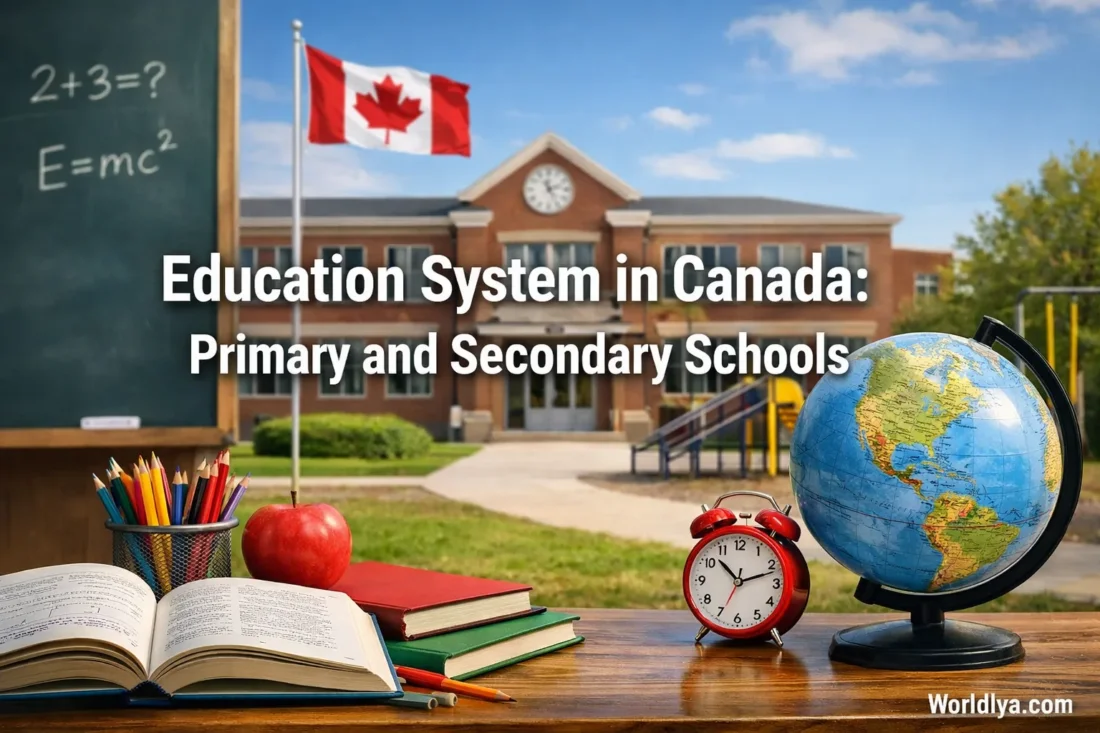
Canada’s primary and secondary schools can feel like a well-organized train network: clear stations (grades), reliable schedules (terms), and lots of routes to get where your child wants to go. This guide breaks down how K–12 works, what “elementary” and “secondary” usually mean, and what families can expect day to day—without the jargon.
How Canada’s K–12 System Is Structured
Typical Flow
- Elementary / Primary starts with Kindergarten (often ages 4–6, depending on region).
- Middle / Junior exists in many areas (sometimes it’s blended into elementary).
- Secondary / High School commonly runs to Grade 12 (with a few regional differences).
What You’ll Notice
- Schools follow a provincial/territorial curriculum.
- Most public schools have no tuition for residents.
- Programs can include French immersion or English/French school options, depending on the community.
Fast Tip
If you’re comparing cities or provinces, focus on the school board and the catchment area (the neighborhood zone that determines the default school).
How Primary and Secondary School Works in Canada
Canada doesn’t run one single “national school system.” Instead, each province and territory sets its own curriculum, grade structure, and graduation requirements. The good news? The experience is still familiar across the country: children move through Kindergarten to Grade 12 (often called K–12), building skills step by step.
Think of it like a recipe with the same main ingredients—literacy, math, sciences, arts, physical education—yet each region adds its own seasoning. That’s why you’ll hear phrases like elementary, middle school, and secondary used a lot, even if the exact grade cutoffs differ.
Compulsory School Ages
In most places, school is required from about age 6 until 16 or 18 (it varies by province/territory). Many children start earlier through Kindergarten, and lots of families also use preschool or early learning programs before that.
Quick Reality Check: If you move between regions, your child may land in a slightly different school structure (for example, a “middle school” might be Grades 6–8 in one place and not exist as a separate school in another). It’s normal. Schools handle these transitions every year.
Primary, Middle, and Secondary Levels
Across Canada, you’ll see these labels most often:
- Elementary / Primary: early foundational years (reading, writing, math, social learning).
- Middle / Junior: a bridge stage where subjects can become more specialized.
- Secondary / High School: credit-based years that lead to a graduation diploma.
Below is a practical map of how it often looks. Use it as a starting point, then confirm details with your local school board.
| Region Pattern | Primary / Elementary | Middle / Junior | Secondary / High School | Notes |
|---|---|---|---|---|
| Common K–12 Model | Kindergarten to Grade 8 (often) | Sometimes separate (often Grades 6–8) | Grades 9–12 (often) | Grade “split” depends on the district and school size. |
| Elementary + Middle + High | Kindergarten to Grade 5 (example pattern) | Grades 6–8 | Grades 9–12 | Common in many larger urban areas with dedicated buildings. |
| Quebec Model | Primary 1–6 | Not always separate | Secondary I–V (typically five years) | After Secondary V, many students continue to CEGEP (post-secondary). |
What Kids Learn
The curriculum is designed to build core skills while keeping learning broad. Early years focus on the basics. Later grades add depth, choice, and real-world applications.
Literacy and Numeracy
Reading, writing, speaking, listening, and math fluency are the “spine” of primary school. Teachers revisit skills in new contexts, so progress feels steady rather than rushed.
Inquiry and Discovery
Science, social studies, and project-based learning encourage curiosity. Students learn to ask good questions, test ideas, and explain what they found.
Arts, Sports, and Life Skills
Music, visual arts, physical education, and health are part of the mix. Schools often add clubs and teams that help kids feel connected.
Language Options
Canada has strong English and French education options. Depending on the community, you may see:
- English-language schools
- French-language schools
- French immersion programs (students learn many subjects in French)
If your child is learning English or French, schools often offer language support programs. Ask your school board what’s available locally.
The School Day and School Year
Most schools run Monday to Friday, starting in the morning and finishing in the afternoon. Times vary by school, yet the rhythm is pretty consistent—like a dependable heartbeat.
- School year: typically begins in late August or early September and ends in June.
- Breaks: usually include a winter break and a spring break, plus holidays and professional development days.
- Lunch: many students bring lunch; some schools offer cafeterias or lunch programs.
School Types You’ll See
When people say “school in Canada,” they usually mean public school, but there are a few common options. None are mysterious once you see them laid out.
Public Schools
Funded through taxes and typically no tuition for residents. These schools follow the official curriculum and serve local neighborhoods.
Separate School Systems
In some regions, you may also find publicly funded separate schools. Availability depends on the province/territory and local school board.
Private Schools and Homeschooling
Private schools charge tuition. Homeschooling is legal in Canada, with regional rules. Families usually register and follow local requirements.
Costs: What’s Usually Free, What’s Usually Optional
- Typically included: instruction, basic access to learning materials, school support services.
- Often optional: school trips, extracurricular fees, yearbooks, special clubs, some supplies.
- Good to ask about: lunch programs, transportation rules, device policies, activity fees.
Assessment, Report Cards, and Graduation
Canadian schools use a mix of classwork, projects, quizzes, and teacher observation. In many places, students also take provincial assessments at certain grades. It’s less about one big “make-or-break” moment and more like a photo album of progress—many snapshots over time.
Report Cards
Report cards usually describe achievement in subjects plus learning skills like organization and responsibility. Some regions use letter grades more heavily in later years, while earlier grades can include more descriptive feedback.
High School Credits and Diplomas
Secondary school is often credit-based. Students complete required courses and choose electives that match their goals. Finish the program and you earn a secondary school diploma (name and requirements vary by region).
Wondering if your child needs a “perfect” plan in Grade 9? Most schools build in guidance and flexibility, so students can explore interests and adjust their path as they grow.
Enrollment Checklist for Families
Enrollment is usually straightforward. The secret is simple: start with the local school board. They’ll tell you which school your address is assigned to and what documents you need.
Step-by-Step
- Find your school board and your neighborhood school (catchment area).
- Check program options (language programs, special programs, supports).
- Gather documents and complete registration.
- Ask about orientation, schedules, and first-day details.
Common Documents
- Child’s proof of identity (often a birth certificate or equivalent)
- Proof of address (to confirm catchment area)
- Immunization record (requirements vary)
- Previous report cards or transcripts (helpful for placement)
- Emergency contact details
Short Video Overview
If you prefer a quick visual explanation, this short overview is a friendly starting point:
Tips for Newcomer Families
New school, new routines, new friends—kids can adapt fast when the first weeks feel predictable. Here are a few helpful moves:
- Ask about language support if your child is learning English or French.
- Meet the teacher early and share anything that helps your child feel confident (learning style, interests, routines).
- Use school communications (emails, apps, newsletters). Small updates add up.
- Start with one activity (a club, a team, or a music program). It’s a shortcut to belonging.
Small but Powerful: If your child is nervous, try this: pick one “anchor” each day (a favorite snack, a short walk to school, a consistent goodbye routine). It’s like giving the day a handle—something easy to hold onto.
Student Support and School Life
Schools commonly provide support that helps students thrive academically and socially. The names vary, the idea stays the same: help early, help kindly.
- Guidance and counseling (especially in secondary school)
- Learning support for students who need extra help or enrichment
- Special education services, tailored to student needs
- Extracurriculars like sports, arts, STEM clubs, and leadership groups
Quick FAQ
Do Canadian schools have “entrance exams” for public primary school?
What if my child arrives mid-year?
Is “middle school” always a separate building?
When do students start planning for life after high school?
Sources
- Council of Ministers of Education, Canada (CMEC): Education in Canada—An Overview
- Government of Canada: Education in Canada (Primary and Secondary) Video Overview
- EduCanada (Government of Canada): Understand the Canadian Education System
- Ontario.ca: Your Child’s Education (Parent Guide)
- Province of British Columbia: Curriculum and Assessment (K–12)
- Statistics Canada: Education Indicators in Canada (Pan-Canadian Tables)
More from Canada Guide
- Moving to Canada: General Residency and Lifestyle Guide
- Canada Government Structure: A Simple Overview
- Canadian Social Etiquette: Politeness and Public Manners
- Exploring Quebec: French Heritage and Traditions
- Public Holidays in Canada: National and Provincial Days
- Driving in Canada: Road Signs and Winter Driving Tips