
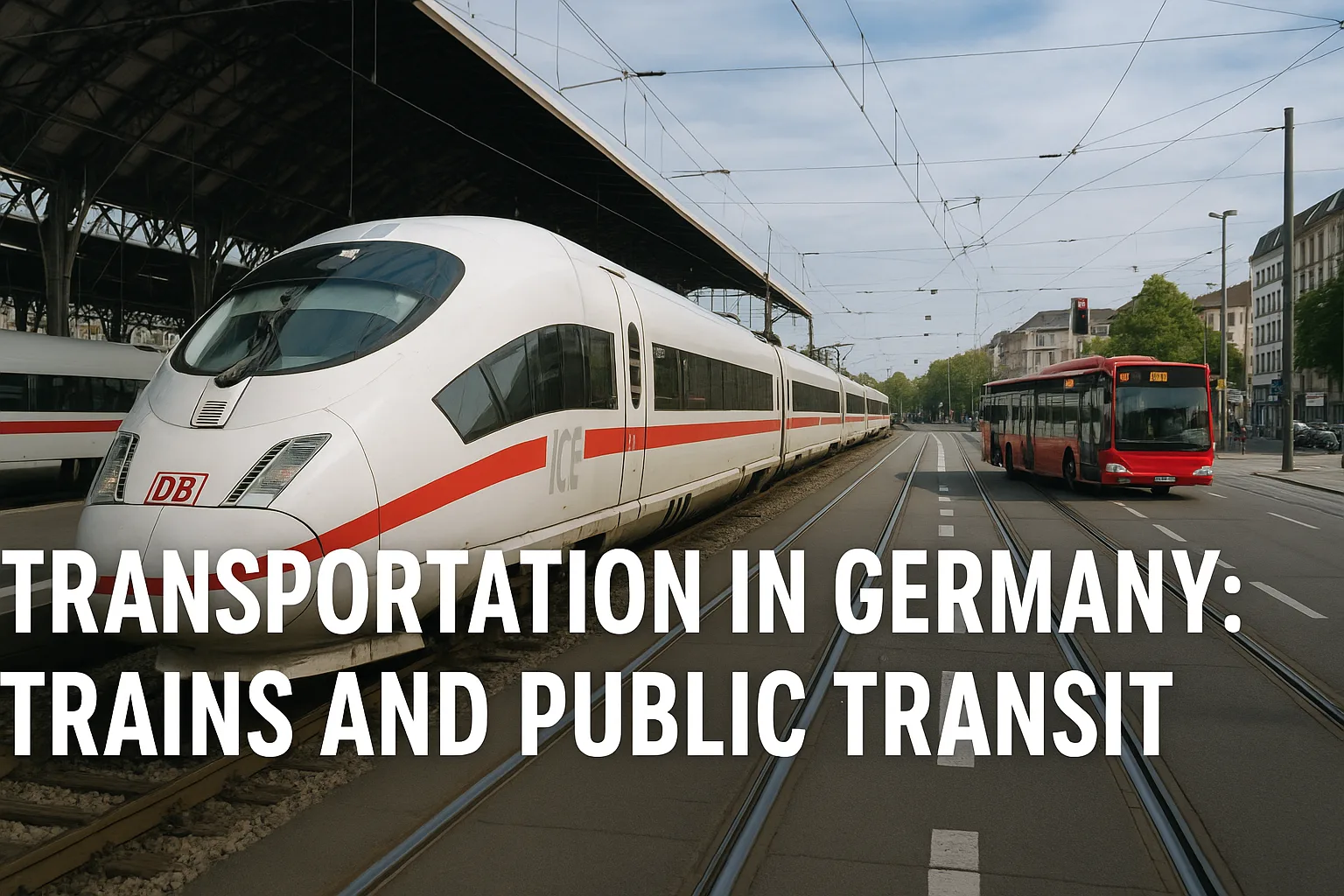
Germany is one of those places where you can land in a city, skip the car keys, and still move around like you’ve got a local friend guiding you. Trains knit the country together, and public transit fills in every gap—subways, city trains, trams, buses… the whole toolbox.
Quick vibe check: what “public transport” means in Germany
Think of it like a well-organized playlist. Long-distance trains handle the big hits between cities. Regional trains handle the everyday travel. Inside cities, U-Bahn, S-Bahn, trams, and buses keep you flowing—often with one ticket system.
- Rail backbone: ICE / IC / EC + regional trains
- City layer: U-Bahn (metro), S-Bahn (city rail), tram, bus
- One big theme: integrated networks (you’ll see the word Verkehrsverbund)
Train types in Germany (so you don’t board the wrong one)
ICE (Intercity Express)
The fast one. If you’re going between major cities, ICE is often the smoothest choice. A seat reservation is usually optional, but nice when you want to sit together or travel at busy times.
- Best for: Berlin–Munich, Frankfurt–Cologne, Hamburg–Berlin (big city hops)
- Tip: Look for a coach number on your reservation so you can stand near the right section of the platform.
IC / EC (Intercity / Eurocity)
Comfortable long-distance trains that are typically a bit slower than ICE. Still great for cross-country travel, especially if the schedule lines up well.
- Best for: medium-to-long trips when ICE timings aren’t ideal
- Tip: Same mindset as ICE: arrive early on the platform, find your coach area, then relax.
RE / RB (Regional Express / Regionalbahn)
The practical everyday workhorses. Regional trains connect towns, suburbs, and smaller cities. They’re also the ones most commonly covered by nationwide regional passes.
- Best for: day trips, commuting, scenic routes
- Tip: Stops are frequent—keep an eye on station screens so you don’t miss your exit.
Platform language that saves time
- Gleis = platform/track number
- Abfahrt = departure
- Ankunft = arrival
- Umstieg = transfer (this is where trasnfer time matters)
Small detail, big payoff: in many stations, the same platform can serve multiple trains—always match train number + destination, not just the time.
Public transit inside cities (U-Bahn, S-Bahn, trams, buses)
Cities in Germany often run transit as one connected ecosystem. You might ride U-Bahn for the center, S-Bahn to reach outer districts and airports, then hop a tram for the last stretch. It feels a bit like switching lanes on a highway—quick, normal, expected.
| Mode | Where you’ll see it | What it’s best at | Friendly tip |
|---|---|---|---|
| U-Bahn | Big cities | Fast inner-city hops | Signs are clear—follow U symbols and line numbers. |
| S-Bahn | Metro regions | City + suburbs | Great for airports and stadiums; check direction by final destination shown. |
| Tram | Many cities | Surface routes, short-to-medium distances | Stops are frequent—perfect for “two stops and done” trips. |
| Bus | Everywhere | Coverage, late-night links | At night, buses often keep the city moving when rail lines thin out. |
Tickets that make sense (without the headache)
Ticket systems vary by city/region, but the logic repeats. Most places use zones (how far you travel) and validity time (how long the ticket works). The good news: once you learn it in one city, the next one feels familiar.
- Single ticket: one ride or a time-limited ride, depending on the city
- Day ticket: perfect if you’ll do more than a couple of rides
- Group ticket: handy when you’re traveling with friends or family
- Subscription passes: best for longer stays and commuting
The Deutschlandticket (nationwide regional travel pass)
If you’re staying a while, this is the pass people talk about for a reason. The Deutschlandticket is a monthly subscription that lets you use regional and local public transport across Germany—think buses, trams, U-Bahn, S-Bahn, and regional trains. It does not cover ICE/IC/EC long-distance trains.
- Best for: commuting, multi-city regional trips, frequent city transit
- Not for: long-distance fast routes where you really want ICE
- Small planning trick: if your trip is mostly regional, this can simplify everything.
Price can change over time, so check the current rate before subscribing. It’s surprsingly easy to manage through official sales channels.
Buying and validating tickets (the part many visitors miss)
In many German cities, there aren’t ticket gates. It’s a “proof-of-payment” style system: you buy a ticket, and you keep it ready. Ticket checks happen, so you want your ticket to be clearly valid.
Digital tickets
- Often valid immediately (or from your chosen start time)
- Easy to store and show on your phone
- Great if you hate dealing with paper
Paper tickets (watch for validation)
- Some paper tickets must be stamped/validated before the first ride
- Validation machines can be on platforms or inside buses/trams
- If your paper ticket already shows date/time, it may not need stamping
Quick rule: if you bought a ticket “in advance,” look around for a validator near the platform or inside the vehicle. One stamp at the start is usually the whole story.
Planning your trip (apps that do the heavy lifting)
Want a low-stress way to plan routes? Use a mix: one app for national rail, one for city details. You’ll get real-time changes, platform info, and better transfer timing—without playing detective at the station.
- DB Navigator (Deutsche Bahn): great for trains and many regional/city connections
- Local transit apps: best for one city’s zone tickets and service alerts
- Maps apps: handy for walking directions to the exact stop entrance
Seat reservations (small upgrade, big calm)
On long-distance trains, a reservation can feel like claiming your little “home base” for the ride. If you’re traveling with others, carrying luggage, or just want to sit by a window, it’s worth considering. Prices vary, and the official booking flow is straightforward.
When I’d reserve a seat
- Fridays and Sundays (popular travel days)
- Holiday periods and major events
- Any trip where you want to work quietly or nap a bit
Transit etiquette (tiny habits that make you look local)
- Let people exit first before boarding. It’s the simple choreography that keeps things smooth.
- Keep bags off seats when it’s busy.
- Quiet zones exist on some trains—treat them like a library corner.
- If you bring a bike, check the carriage signs and be ready to shift position at stops.
Two practical travel recipes (copy-paste into real life)
Recipe 1: city day (Berlin, Munich, Hamburg…)
- Pick your “base” ticket: day ticket if you’ll ride a lot.
- Use transit + walking together (it’s often faster than staying underground all day).
- Save one landmark stop as a “home stop” so you always know how to get back.
Recipe 2: cross-country, no stress
- Search the route in DB Navigator and check transfer time.
- If you’re using regional trains, see if a nationwide regional pass fits your plan.
- Arrive a bit early, find your platform section, and keep your ticket handy.
Mini FAQ
Do I need cash for tickets?
Usually not. Cards and mobile payments are common, and apps make it even easier. Still, having a backup payment method is smart when you’re moving between regions.
Is public transport good for families?
Yes. Stations are built for steady flow, and many systems handle strollers well. For longer train rides, reserving seats can make the day feel lighter.
Will I see ticket barriers?
Sometimes, but not always. Many stations work on trust + inspections. Buy the right ticket, validate when required, and you can ride with a clear conscience.
Sources
- Deutsche Bahn (Official): Deutschland-Ticket details and validity
- German Federal Government: Deutschlandticket Q&A (price, scope, exclusions)
- Deutsche Bahn (Official): DB Navigator app information
- Deutsche Bahn (Official): Seat reservation information
- Verkehrsverbund Bremen/Niedersachsen (VBN): Ticket validation basics
- MVV Munich: Ticket validation rules for common ticket types
- HWR Berlin (University): Semester ticket overview (student mobility)
- Your Europe (EU): Rail passenger rights overview