
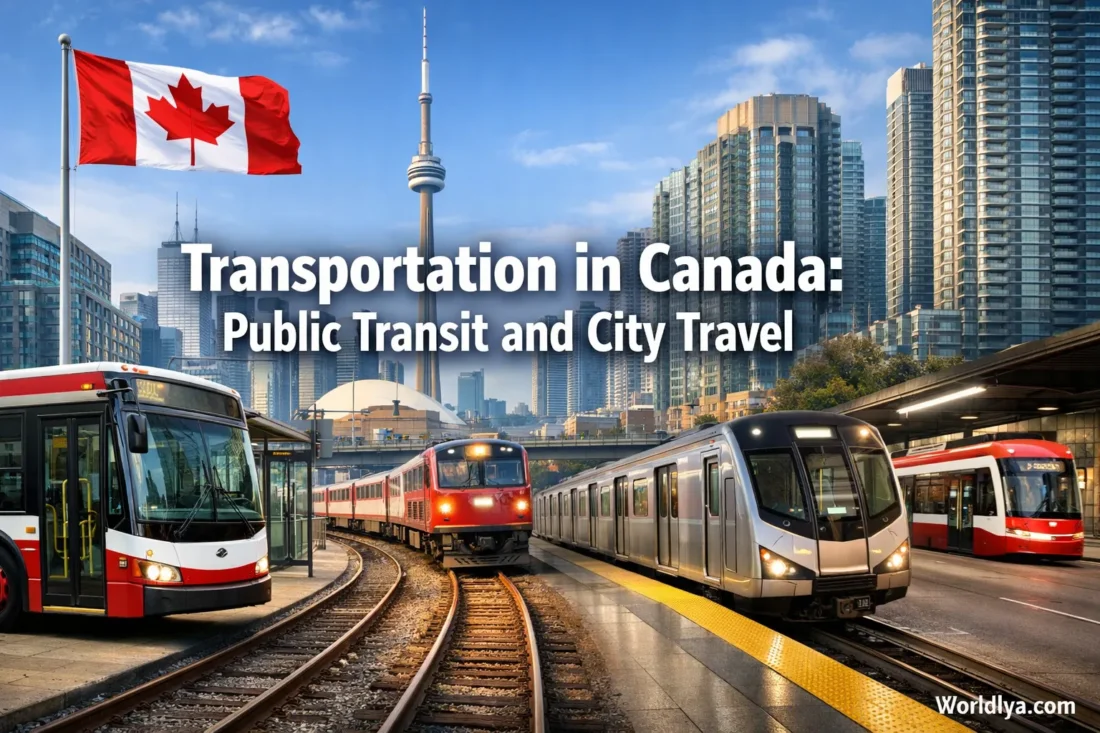
Canada is huge. Like, “your weekend road trip could become a multi-province epic” huge. The good news? Canadian cities make getting around surprisingly simple once you know the basics. If you’re visiting, settling in, or just curious, this guide walks you through public transit in Canada, how to pay, what to expect in major cities, and a few smart habits that make city travel feel effortless.
Quick Snapshot: What City Travel In Canada Feels Like
Best For
- Downtown exploring without a car
- Airport-to-city transfers in major metros
- Daily commuting with fare cards or tap-to-pay
You’ll Typically Use
- Subway / Metro in the biggest cities
- Light rail (LRT) and streetcars
- Buses everywhere, including suburbs
- Ferries in a few waterfront regions
Bring These “Tools”
- A contactless card (or mobile wallet)
- A transit app for live arrival times
- Comfortable shoes for short walks between stops
Tip: In most Canadian cities, transit is designed like a “spoke-and-hub” wheel: you move fast toward the center, then branch out by bus, train, or streetcar. Once you see that pattern, route planning clicks.
How Public Transit Works In Canadian Cities
Public transit in Canada is usually run by city or regional agencies. Each system has its own fare rules, but the “shape” is familiar across the country. If you’ve used transit in one major city, you’ll adapt quickly in another.
The Main Transit Modes You’ll See
- Subway / Metro: high-frequency trains, mostly in the largest cities
- Light Rail (LRT): rail lines that can run above ground, sometimes with stations like a metro
- Streetcars: rail vehicles in city streets, ideal for central neighborhoods
- Buses: the backbone in nearly every region, including late-evening coverage in many areas
- Commuter Rail: longer-distance trains connecting suburbs and nearby cities
- Ferries: common in select coastal / harbor routes
What “Good Coverage” Usually Means
In many Canadian cities, the center is easiest: frequent routes, short waits, and lots of transfer points. As you travel outward, service can become more “schedule-based.” That’s normal.
Small Mental Model
Think of the network like a river system: fast “main channels” (metro/LRT) feed into smaller “streams” (buses). You’re not memorizing everything. You’re learning how it flows.
Paying Your Fare: Cards, Contactless, and Mobile Tickets
Payment is where visitors often overthink things. Don’t. In most places, you’ll use a reloadable fare card, tap-to-pay with a bank card, or a mobile ticketing app. Choose the option that matches how long you’ll be in the city.
Fast Choice Guide
- Here for 1–3 days? Tap-to-pay or short-term tickets can be perfect.
- Here for a week? Look for day passes or a reloadable card.
- Here long-term? Get the city’s card/app for smoother transfers and potential discounts.
One tiny habit that helps: when you tap in, use the same payment method for transfers. If you start with your phone wallet, keep using it for the rest of that trip.
| Payment Option | Where You’ll Commonly See It | Why It’s Useful |
|---|---|---|
| PRESTO (card / mobile wallet) | Many Ontario-area systems (including Toronto’s TTC) | Simple tapping, transfers handled automatically on supported networks |
| Compass Card | Metro Vancouver (TransLink: buses, SkyTrain, SeaBus) | Works across multiple modes; easy transfers |
| OPUS Card | Montréal region (STM and many nearby agencies) | Great for multi-day use and passes |
| ARC | Edmonton region | Account-based payments; fare caps in supported areas |
| peggo | Winnipeg | Reloadable smartcard for regular riders |
| My Fare (mobile tickets) | Calgary | Buy and activate tickets/passes on your phone |
| HFXGO (mobile tickets) | Halifax | Easy phone-based tickets and passes |
| Tap-To-Pay (credit/debit + mobile wallets) | Available on several major systems | No extra card needed; great for visitors |
Think of a fare card like a “city key.” The more you use it, the smoother your day gets.
Planning Trips Without Stress
Transit planning in Canada is mostly about timing and transfers. The simplest approach is also the most reliable: pick one route that gets you close, then walk the last stretch. Cities are built for that “transit + short walk” rhythm.
The 60-Second Pre-Trip Checklist
- Confirm your destination address (even the right entrance matters).
- Check the next departure time for your main leg (train/LRT).
- Spot the transfer point and platform direction.
- Save the route to your phone for easy re-checking.
- Plan a “nice” walk at the end instead of chasing a perfect drop-off.
Transfers: The One Thing To Watch
Transfer rules vary by city, but a common theme is a time window. Once you pay, you can keep moving across lines and directions within that window on supported services.
Practical move: tap (or validate) the same way each time. Switching from a physical card to a phone mid-trip can confuse transfer tracking in some systems.
Little Things That Make You Feel Like A Local
- Let people exit first. You’ll board faster, too.
- On escalators, stand to one side so walkers can pass.
- If you’re carrying a backpack, hold it down by your side in crowded spaces.
- Have your payment ready before you step onto the bus or through the gate.
Watch: Riding City Transit In Canada
Prefer seeing it once instead of reading it twice? This short video shows how riding a major Canadian rapid-transit system works in real life, including fare media and station flow.
City-By-City Playbook: Public Transit and City Travel
Canada doesn’t have one national city-transit system; each metro runs its own network. Still, the “feel” is consistent: tap in, follow signage, transfer within a window, and you’re moving. Use these quick playbooks to get oriented fast.
Toronto (TTC): Subway, Streetcar, Bus
Toronto’s TTC is a classic big-city system: subway lines do the heavy lifting, streetcars connect neighborhoods, and buses fill the gaps. Payment is flexible: you can use PRESTO and, on many services, tap with a contactless debit/credit card or mobile wallet.
- Best strategy: ride the subway for distance, then streetcar/bus for the last stretch.
- Transfer habit: tap the same way each time during your trip.
- Airport link: UP Express connects Toronto Pearson Airport to downtown Union Station in about 28 minutes.
Small win: if you’re exploring downtown, plan a route that ends near a landmark you want to walk around. Transit gets you there; your feet do the fun part.
Vancouver (TransLink): SkyTrain, Bus, SeaBus
Vancouver’s transit feels like a smooth combo: SkyTrain for speed, buses for reach, and the SeaBus for an easy waterfront hop. You’ll see Compass Card everywhere, plus tap-to-pay options on supported services.
- Best strategy: SkyTrain to a neighborhood station, then walk or bus a few stops.
- Waterfront bonus: SeaBus turns a commute into a mini-sightseeing moment.
- Airport link: the Canada Line connects Vancouver International Airport (YVR) to downtown in under 30 minutes.
Montréal (STM): Metro + Buses With A Simple Grid
Montréal’s STM system is friendly once you see the pattern: the Metro covers core areas quickly, and buses extend that coverage in a neat, practical grid. The city is also very walkable in many central neighborhoods, so transit often pairs with a scenic stroll.
- Fare media: OPUS is the well-known regional smart card.
- Airport option: the 747 route links Montréal–Trudeau Airport and key city points, and includes a day-pass style fare product for Zone A travel.
- Best strategy: use the Metro for distance, then walk a few blocks to avoid extra transfers.
Calgary and Edmonton: Light Rail Energy, Easy Phone Tickets
Calgary (Calgary Transit)
- Key mode: CTrain (LRT) plus buses
- Mobile tickets: My Fare app for tickets and passes
- Best strategy: use LRT for the main leg, then bus for neighborhoods
Edmonton (ETS)
- Key mode: LRT plus buses
- Regional fare system: ARC for account-based payments
- Best strategy: tap on/off where required, then walk the last few minutes
Quick note: these Prairie-city systems are straightforward. The biggest “skill” is simply knowing which station or stop is closest to your destination, then walking the final stretch.
Ottawa, Halifax, Winnipeg: Visitor-Friendly Essentials
Ottawa (OC Transpo)
- Key mode: O-Train plus buses
- Tap-to-pay: supported through OC Transpo’s O-Payment (on participating readers)
- Pro move: use one tap method consistently to keep transfers smooth
Halifax (Halifax Transit)
- Key mode: buses and ferries in the harbor area
- Mobile fares: HFXGO lets you buy tickets and passes on your phone
- Good vibe: plan transit to a waterfront point, then walk
Winnipeg (Winnipeg Transit)
- Key mode: buses
- Smartcard: peggo is Winnipeg’s reloadable fare card
- Best strategy: build trips around a main corridor route, then walk a few blocks
Combining Transit With Walking, Bikes, and Short Rides
Public transit shines when you mix it with other simple choices. In many Canadian downtowns, the “best route” is often train + a 10-minute walk. It’s efficient, easy to navigate, and you’ll notice more of the city.
Walking
Canadian city centers often have clear signage and a predictable street grid. If you can walk a few blocks confidently, your transit options multiply.
Bike Share
Several large cities offer bike-share programs. They’re great for short hops from a station to a neighborhood, especially on days when you want to move at your own pace.
Short Rides
Sometimes a short ride fills the gap when transit is indirect. The “smart” version is using transit for the big distance, then a short last-leg ride only if it truly saves time.
Mini Checklist: Your “Transit Day” Starter Pack
- Phone battery (maps + tickets) or a small power bank
- Contactless card or a loaded fare card/app
- Layered clothing so you stay comfortable between stops
- Reusable water bottle for longer walking stretches
Frequently Asked Questions
Do I Need Cash To Ride Public Transit In Canada?
In many places, you don’t. Cards, contactless tapping, and mobile tickets are widely used. Some systems still accept cash on buses, but it’s often slower and may limit transfer options. If you can, go digital.
Is It Hard To Use Transit If I’m Visiting For The First Time?
Not really. Station signage is generally clear, and route planning apps make a big difference. Start with one simple trip (hotel to a landmark), then build from there.
What’s The Easiest Way To Save Time?
Use rapid transit for distance (metro/LRT/SkyTrain), then walk the last part. It’s the quickest “default” plan in most Canadian downtowns.
References
- TTC: Pay Your Fare With Debit or Credit
- PRESTO: Contactless Payments (Credit/Debit and Mobile Wallet)
- TransLink: Pricing and Fare Zones (Transfers and Tap-To-Pay)
- STM: OPUS Card
- STM: 747 YUL Airport / Downtown Service Info
- City of Edmonton: ARC Fare Payment
- Calgary Transit: My Fare Mobile Ticketing
- Winnipeg Transit: About peggo
- Halifax: HFXGO Mobile Fare Payment
- YVR: Public Transportation (Canada Line)
- UP Express: Airport Train Service
More from Canada Guide
- Canadian Social Etiquette: Politeness and Public Manners
- Famous Canadian Food: Poutine, BeaverTails and Maple Syrup
- Universities in Canada: Campus Life and Academic Culture
- Popular Sports in Canada: From Lacrosse to Basketball
- Cost of Living in Canada: Daily Expenses and Shopping
- Indigenous Culture in Canada: Art, History and Traditions