
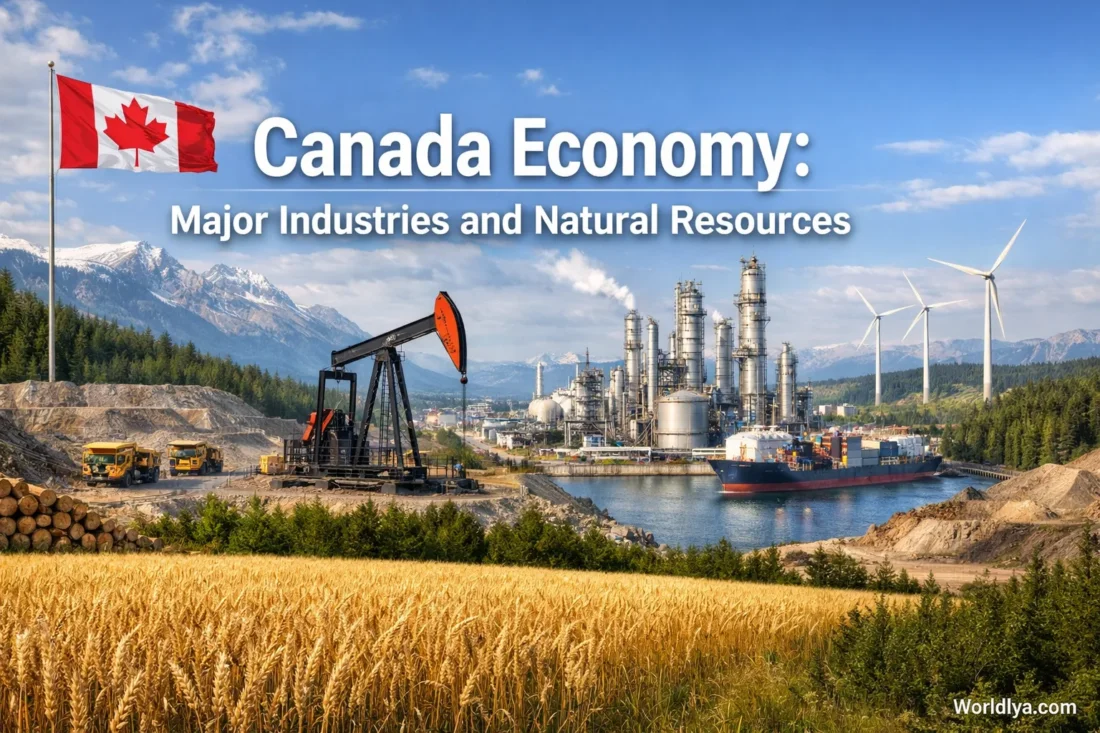
Canada’s economy can feel like a big, well-run workshop: services keep the lights on, industry builds and ships real things, and natural resources supply the raw ingredients. If you’ve ever wondered what Canada actually “does” to generate income and jobs—this guide breaks it down in plain English, with practical examples you’ll recognize in everyday life.
Quick Navigation
- Big Picture: How The Economy Fits Together
- Major Industries People Actually Notice
- Natural Resources: What Canada Has In Abundance
- Resource-To-Product Map
- Where Industries Cluster Across Canada
- Practical Tips: Jobs, Study, Business Curiosity
- Quick FAQ
Tip: skim the headings first, then come back to the sections that match what you’re looking for—jobs, exports, or resources. Your future self will thank you.
Quick Snapshot
Three engines show up again and again:
- Services (finance, tech, retail, logistics, professional work)
- Manufacturing (vehicles, aerospace, food, chemicals, metals)
- Resources (energy, forestry, minerals, agriculture)
Think of it like a three-legged stool: remove one leg, and everything wobbles.
Big Picture: How The Economy Fits Together
Zoom out for a second. Canada’s economy is often described through two big buckets: services-producing industries and goods-producing industries. Services cover the invisible stuff—planning, organizing, financing, shipping, designing. Goods are the visible stuff—homes, vehicles, metal products, food, lumber, energy.
What keeps it interesting is the way these buckets feed each other. A mine isn’t “just” a mine: it relies on engineering, transportation, equipment manufacturing, finance, software, safety services, and skilled trades. Same story for farming, forestry, and factories. This is why Canada’s major industries often overlap like layers in a cake—distinct, but connected.
A Simple Way To Picture It
- Resources supply inputs (energy, wood, minerals, food).
- Manufacturing transforms inputs into products (parts, packaged foods, building materials).
- Services scale it all (logistics, finance, research, sales, repairs).
Major Industries People Actually Notice
Let’s talk about the sectors that show up in real life: the things you can see on highways, in shopping carts, on construction sites, and inside your phone.
Services: The Quiet Backbone
Services are where much of the day-to-day economy lives. They include everything from paying bills to running a warehouse. Some of the most visible service areas:
- Finance and insurance: payments, lending, risk management, business funding.
- Transportation and logistics: trucking, rail, ports, air cargo, parcel delivery.
- Wholesale and retail: the “getting it to the shelf” world—massive, constant, detail-heavy.
- Professional services: engineering, accounting, legal services, consulting, design.
- Technology: software, IT services, cybersecurity, data, digital platforms.
If resources are the “ingredients,” services are the kitchen staff that makes the whole restaurant run on time.
Manufacturing: Turning Inputs Into Products
Manufacturing is value creation in motion—cutting, shaping, assembling, refining, packaging. Canada’s manufacturing world is broad, and government industry overviews highlight areas such as aerospace, automotive, chemicals, biopharma, medical devices, primary metals, textiles, and more.
Common Manufacturing Themes
- Precision (aerospace, advanced components)
- Scale (vehicles, parts, packaging)
- Safety and standards (medical devices, pharmaceuticals)
- Materials mastery (metals, chemicals, plastics)
A Helpful Question
When you hear “manufacturing,” ask: Is this making a finished product, or making parts that enable other industries? Canada has a lot of the second kind—quietly important, easy to underestimate.
Food And Agribusiness: More Than Farms
Agriculture isn’t only about fields and tractors. It’s also about food processing, storage, cold-chain logistics, and packaging. The “value-added” steps—turning raw ingredients into shelf-ready products—create jobs in labs, factories, warehouses, and distribution networks.
Construction And Real-World Building
Construction links many parts of the economy at once: materials (wood, steel, cement), services (engineering, inspections, project management), and manufacturing (fixtures, components, tools). It’s one of the easiest sectors to spot—cranes, trucks, crews—and one of the best examples of how goods and services meet.
Natural Resources: What Canada Has In Abundance
Natural resources are often the first thing people associate with Canada—and for good reason. Official investment overviews describe strengths in areas like energy, minerals and metals, forestry, and related expertise like geoscience and resource management. The key is this: resources matter most when they connect to processing, manufacturing, and services.
Energy: Powering Homes, Industry, And Trade
Energy is a wide category. It includes traditional fuels, but also electricity generation and distribution. Canada’s energy story commonly includes:
- Oil and natural gas (production, processing, transport, supporting services)
- Hydroelectric power (generation, transmission, grid operations)
- Other electricity sources that complement the grid and local needs
What’s easy to miss: energy isn’t only “what comes out of the ground.” It’s also infrastructure, reliability, and skilled operations.
Forest Products: From Timber To Engineered Wood
Forestry can sound old-school until you see modern wood products. Beyond lumber, forest products can include pulp, paper, packaging materials, and engineered materials used in construction. The forest-products value chain has a very “real” feel: harvest planning, milling, manufacturing, shipping, and quality control.
Minerals And Metals: The Hidden Ingredients In Modern Life
Minerals and metals show up everywhere—phones, vehicles, buildings, renewable-energy equipment, and everyday tools. Canada’s mining ecosystem spans exploration, extraction, processing, equipment supply, and specialized services. You’ll often hear about materials such as nickel, copper, gold, potash, uranium, iron ore, and diamonds—not as trivia, but as inputs that keep other industries moving.
A Fast Reality Check
If a country makes cars, batteries, fertilizer, packaging, aircraft parts, or building materials, it needs a steady supply of raw inputs. That’s why minerals, forest products, and energy keep showing up in Canada’s economic conversations.
Resource-To-Product Map
Want a clearer mental picture? Use this map. It connects resources to everyday products, plus the industries that sit in the middle.
| Resource | Turns Into | Where Value Gets Added | Everyday Example |
|---|---|---|---|
| Energy | Fuel, electricity, industrial heat | Utilities, processing, logistics | Home heating, commuting, factory power |
| Timber | Lumber, panels, pulp, packaging | Mills, engineered wood, manufacturing | Construction materials, boxes, paper goods |
| Metals | Alloys, parts, components | Primary metals, machining, assembly | Tools, appliances, vehicles, electronics |
| Potash | Fertilizer inputs | Chemical processing, agribusiness | Higher-yield farming, food supply chains |
| Agricultural products | Food ingredients, oils, feeds | Food processing, packaging, cold-chain | Grocery staples, cooking oils, snacks |
| Critical minerals | Battery and electronics materials | Refining, materials engineering, manufacturing | Phones, laptops, EV parts, power storage |
Where Industries Cluster Across Canada
Canada is huge, so industries naturally form clusters. Not strict lines on a map—more like “gravity zones” where skills, suppliers, and infrastructure gather.
Often-Discussed Clusters
- Ontario: manufacturing (including vehicles and parts) and major service hubs.
- Québec: aerospace strength, manufacturing, and major electricity generation.
- Alberta: energy production plus engineering and supporting services.
- British Columbia: forestry value chains and Pacific-facing logistics.
- Prairies: large-scale agriculture and related processing; minerals in key areas.
- Atlantic Canada: ocean economy activities and food-related value chains.
- North: mining activity where geology and logistics make projects possible.
Why Clusters Matter
Clusters reduce friction. Suppliers are closer. Talent pipelines get stronger. Training programs match real jobs. It’s like a neighborhood where everyone speaks the same “industry language.”
So if you’re researching careers or business opportunities, start with the cluster that matches your interest, then zoom into roles and skills.
Practical Tips: Jobs, Study, Business Curiosity
This section is deliberately hands-on. No fluff. Just ways to turn “Canada economy” into something you can act on.
If You’re Exploring Careers
- Pick one engine to start: services, manufacturing, or resources.
- Match it to a role type: hands-on (trades), analytical (data/finance), technical (engineering/IT), operations (logistics/quality).
- Look for “connector jobs”: logistics coordinators, maintenance planners, safety specialists, quality techs. These exist across many sectors.
If You’re Choosing What To Study
- Resources: geology, mining engineering, environmental monitoring, heavy equipment tech, power systems.
- Manufacturing: mechanical engineering, industrial engineering, mechatronics, quality systems, supply chain.
- Services: accounting/finance, computer science, data analytics, cybersecurity, operations management.
Ask one question before you commit: Do I want to work on physical systems, digital systems, or the bridge between them?
If You’re Just Curious About Exports
Statistics Canada export categories commonly highlight groups such as energy products, metal and mineral products, forestry products, farm and food products, and manufactured goods like motor vehicles and parts and machinery and equipment.
In plain terms: Canada exports inputs and things made from inputs. That’s the theme.
Quick FAQ
Is Canada mostly a resource economy?
No—resources are highly visible and important, but Canada also has a large services base (finance, logistics, tech, retail, professional work) and a well-developed manufacturing sector. The most useful way to see it is through the connection: resources support manufacturing, and services help both expand.
What industries feel “most Canadian” in everyday life?
Expect to see logistics and transportation, construction, finance services, food processing, forest products, energy infrastructure, and manufacturing clusters like vehicles, aerospace, and metals—depending on the region.
Why do natural resources matter if services are big?
Resources create supply chains. Those chains demand engineering, machinery, software, safety systems, transportation, and skilled trades. In other words, a resource project is rarely “just one sector.” It becomes a whole network of work.
What’s the safest way to learn more without getting lost?
Pick one thread—manufacturing, mining, forestry, energy, or exports—then follow it through three steps: inputs → processing → products. That structure keeps your research focused.
Main Points
- Services keep the economy coordinated and scalable.
- Manufacturing turns inputs into higher-value products.
- Natural resources supply the ingredients that feed many supply chains.
- Canada’s real strength is how these three pieces link up.
Sources
- Statistics Canada — Gross Domestic Product By Industry (The Daily Release)
- Statistics Canada — Canadian Domestic Exports By Product Category (Infographic Description)
- Government Of Canada — Manufacturing Industries (Sector Overviews)
- Invest In Canada — Natural Resources Overview
More from Canada Guide
- Wildlife in Canada: Where to See Moose and Bears Safely
- Popular Sports in Canada: From Lacrosse to Basketball
- Indigenous Culture in Canada: Art, History and Traditions
- Canada National Parks: Visiting Banff and Jasper
- Cost of Living in Canada: Daily Expenses and Shopping
- Best Time to Visit Canada: Seasonal Travel Tips