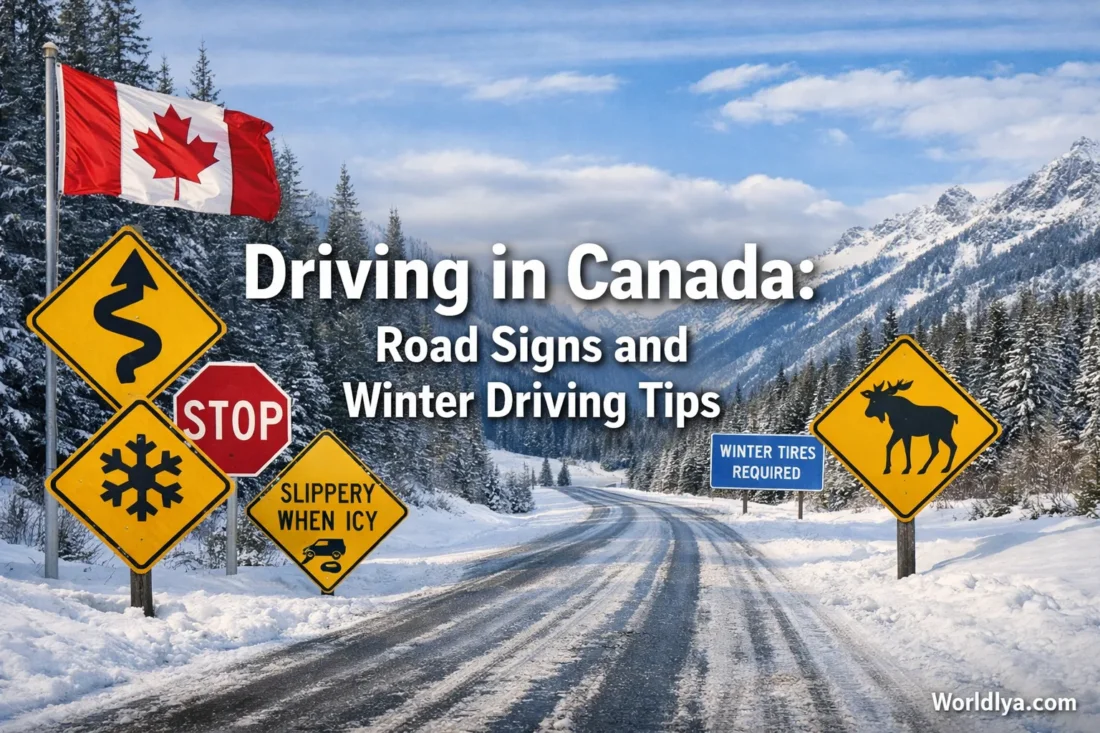
Driving in Canada feels familiar fast… until you notice how much information is packed into shapes, colors, and those crisp km/h numbers. Here’s a simple, practical breakdown: how to read Canadian road signs quickly, plus winter-driving habits that help you stay calm and in control when the road turns white.
Quick Wins You Can Use Today
- Think in km/h. Speed limits are posted in kilometres per hour.
- Read the sign like a shortcut: shape first, color second, symbol/text last.
- Winter driving is mostly smoothness. Gentle steering, gentle throttle, gentle braking.
- When in doubt, slow down early. You “buy time,” and time buys control.
Road Basics That Make Canada Easier
Canada drives on the right side of the road, and most everyday rules feel intuitive. The biggest adjustment for many visitors is simply the metric mindset.
Common Speed Limit “Vibes”
Limits vary by province, city, and road type, but you’ll often see numbers like 50 in built-up areas and 100 on many major highways. The sign always wins.
Tip: If your brain still thinks in mph, keep a tiny conversion table on your phone (there’s one below).
Small Habit, Big Payoff
When you spot a sign, ask yourself one quick question: “Is this telling me what I must do, warning me, or guiding me?” That’s the whole sign system in one sentence.
Once you get that, unfamiliar signs feel less like a puzzle and more like a friendly nudge.
Road Signs In Canada: Shapes, Colors, and Quick Meanings
Canadian signs are designed to be readable at speed. You don’t need to memorize everything. Just learn the “shortcuts” built into the design: shape + color + symbol.
The 3-Second Sign Scan
- Shape: tells you the “type” (stop, yield, warning, school, no-passing).
- Color: tells you the “mood” (rules, caution, guidance, temporary conditions).
- Symbol/Text: confirms the exact message.
It’s like reading a book cover before you open the first page.
Shape and Color Cheat Sheet
| What You See | What It Usually Means | How To React |
|---|---|---|
| Red Octagon | Stop | Full stop, then proceed when safe. |
| Red/White Inverted Triangle | Yield | Slow, give right-of-way, merge smoothly. |
| Black/White Rectangle | Regulatory Rule (speed limit, lane use, turn rules) | Do what it says—these are the “must” signs. |
| Orange Signs | Temporary Conditions (construction, detours) | Expect changes; slow down and follow the posted guidance. |
| Yellow Diamond | Warning (curves, merges, hazards) | Adjust early—speed, lane position, attention. |
| Pentagon (often yellow or yellow-green) | School Area / School Crossing | Slow down, watch carefully, follow posted times/rules. |
| Green Signs | Directions (routes, exits, distances) | Use them for planning; stay calm and move early. |
| Blue Signs | Services / Information (gas, food, hospitals) | Helpful on long drives—especially in winter. |
| Brown Signs | Recreation / Cultural Points | Nice-to-know; great for road trips and sightseeing. |
The Main Sign Families
Regulatory Signs
These are the “rules of the room.” Speed limits, turns, lane use, parking rules. When you see black/white or red with clear instructions, treat it like a direct message.
Warning Signs
Yellow signs are basically saying: “Heads up—something changes ahead.” Curves, merging lanes, steep grades, animal crossings, slippery surfaces.
Temporary Condition Signs
Orange means the road is “in a different mood” today. Lanes may shift, speeds may drop, and workers may be nearby. Read these carefully and early.
Road Markings That Help In Snowy Months
- Yellow lines generally separate traffic going in opposite directions.
- White lines generally separate lanes moving in the same direction.
- Solid lines are a “stay put” hint. Dashed lines are your “lane change may be okay” hint.
- In winter, fresh snow can hide markings. Use road edges, reflectors, and the flow of traffic—while keeping extra space.
Winter Driving In Canada: Preparation and On-Road Habits
Canadian winter driving isn’t about being fearless. It’s about being ready and smooth. Think of your car like a pair of boots: the right gear + steady steps = you move comfortably.
Before You Drive: The Winter-Ready Routine
- Clear the whole vehicle. Windows, mirrors, lights, roof, hood—visibility is comfort, and comfort is better driving.
- Check tires. Good tread and correct pressure matter more when temperatures drop.
- Top up winter washer fluid. Road spray can turn your windshield into a gray blur fast.
- Bring a charging cable. Small thing, big peace of mind.
- Plan the “easy route.” If you can choose a main road that’s plowed more often, take it.
Winter Tires: What To Know Without Overthinking It
Winter tires use rubber and tread patterns built for cold grip. That’s why they often feel more confident on snow and ice than all-season tires. If you’re shopping or renting, look for markings like:
- 3-Peak Mountain Snowflake (often called “mountain/snowflake”): commonly associated with stronger winter performance.
- M+S (“Mud and Snow”): a common all-season marking, sometimes accepted as a minimum requirement on certain routes.
Province Spotlight: Simple Examples
| Place | Common Winter Tire Rule | What You Should Do |
|---|---|---|
| Québec | Winter tires are required Dec 1 to Mar 15 for vehicles registered in Québec (including many rentals). | If you’ll drive there in winter, confirm your tires before you hit the road. |
| British Columbia | On many designated highways, winter tires or chains are required. Typical dates are Oct 1 to Mar 31, with many routes extending to Apr 30. | Watch for the posted route signs, and carry chains when heading into mountain passes. |
| Everywhere Else | Rules can vary by province, route, and season. | Use official provincial guidance, especially for long highway trips. |
On The Road: The “Smooth and Spacious” Method
Space
- Leave more following distance than you think you need.
- Brake earlier, so you brake lighter.
- Give yourself room to change lanes gradually.
Smoothness
- Steer like you’re holding a full cup of coffee.
- Accelerate gently—especially from a stop.
- Avoid sudden moves; your tires love consistency.
Visibility
- Keep lights and windows clean.
- Use defrost early (fog builds fast in cold weather).
- If visibility drops, slow down and keep your moves predictable.
If Your Car Feels Like It’s Sliding
It happens to experienced drivers too. The goal is to respond calmly, not instantly. A good mental script is:
- Look where you want to go. Your hands follow your eyes more than you think.
- Ease off the accelerator. Let the tires “reconnect” with the road.
- Steer gently. Big corrections can make grip harder to regain.
Winter driving rewards patience. You’re not trying to “win” the road—you’re trying to stay relaxed on it.
Mini Practice Plan That Builds Confidence
Want to feel comfortable fast? Try this on a quiet day in a safe, open area (like an empty parking lot):
- Practice very gentle starts and stops. The goal is smoothness, not speed.
- Do a few slow, wide turns and notice how early the car responds to steering.
- Test your “space habit”: pick a reference point and pretend you’re leaving extra distance to it. Make it automatic.
Emergency Kit: Small Items, Big Comfort
- Snow brush / ice scraper
- Warm gloves and a hat
- Small flashlight
- Phone charging cable
- Compact shovel (especially for rural drives)
- Traction aid (a small bag of sand or traction material)
- Water and snack for longer trips
Think of it like packing an umbrella. You don’t plan to need it. You just like knowing it’s there.
Quick MPH To KM/H Conversions
| mph (Approx.) | km/h (Approx.) | Where It “Feels Like” |
|---|---|---|
| 20 | 30 | Very slow urban roll |
| 30 | 50 | Common city pace |
| 40 | 65 | Faster arterial roads |
| 50 | 80 | Many main roads |
| 60 | 100 | Typical highway posting |
| 70 | 110 | Some higher-speed highways |
Final Checklist Before You Start The Engine
Here’s the quick “ready to roll” list. If you can check these off, you’re in a good place.
- Visibility: windows, mirrors, lights fully clear
- Tires: correct type for the route and season, properly inflated
- Time: you’re not rushing (winter hates rushing)
- Space: you’ll follow with extra distance and brake early
- Plan: you know your route, especially if you’re heading through mountain passes
- Kit: basic winter supplies are in the car
References
- Transport Canada – Driving Safely In Winter
- Government Of British Columbia – Designated Winter Tire & Chain Routes
- Government Of British Columbia – Passenger Vehicle Tire and Chain Requirements
- ICBC – Learn To Drive Smart (Signs, Signals, and Road Markings)
- Transportation Association Of Canada – Manual Of Uniform Traffic Control Devices For Canada
- SAAQ (Québec) – Winter Preparation (Winter Tires Period)
More from Canada Guide
- Canada Government Structure: A Simple Overview
- Universities in Canada: Campus Life and Academic Culture
- Canada Economy: Major Industries and Natural Resources
- Indigenous Culture in Canada: Art, History and Traditions
- Exploring Quebec: French Heritage and Traditions
- Canada Population: Regions and Demographics