Indigenous culture in Canada isn’t a single story you can “finish” in one sitting. It’s more like a big, shared library with thousands of shelves—songs, carvings, beadwork, languages, family teachings, seasonal gatherings, and modern creative scenes that keep evolving. If you’re curious, this guide gives you a clear, human-friendly path through art, history, and traditions—without turning it into a textbook.
Quick Cultural Snapshot
Before we jump into styles and traditions, here’s the simplest helpful frame:
- Canada is home to three broad Indigenous groups: First Nations, Inuit, and Métis.
- Within those groups, there are hundreds of distinct communities, each with its own art styles, protocols, and local history.
- In the 2021 Census, 1,807,250 people identified as Indigenous in Canada—about 5% of the total population.
One small mindset shift: instead of asking “What is Indigenous culture?” try “Which Nation or community are we talking about?” That question opens better doors.
The Three Indigenous Peoples and What They Represent
These categories are a useful starting point, not a set of boxes. Think of them as big chapters in a much larger book.
First Nations
Many Nations across the country with rich local identities. You’ll see incredible variety in carving, beadwork, painting, regalia, dance, and storytelling—often shaped by place (coast, forest, prairie, lake country, and more).
Inuit
Deeply connected to the Arctic and sub-Arctic regions, with renowned traditions in stone carving and printmaking, and distinctive music practices like katajjaq (throat singing as a vocal game).
Métis
Known for a vibrant cultural identity expressed through music, dance, and especially floral beadwork and embroidery—so recognizable that Métis bead artists are often called the “Flower Beadwork People.”
Numbers That Help You Visualize the Scale
Culture is not math… but a few baseline numbers help you understand how many people these living traditions belong to today.
| Group | Count (2021) | Color Key |
|---|---|---|
| First Nations | 1,048,405 | Deep Blue |
| Métis | 624,220 | Deep Burgundy |
| Inuit | 70,545 | Deep Green |
| Total Indigenous Population | 1,807,250 | Charcoal |
Art Forms and Visual Languages
Indigenous art in Canada is not just “decoration.” It can be identity, family history, teaching, humour, memory, and place—all at once. Sometimes it’s loud and public. Sometimes it’s small and intimate, like beadwork on something you hold close.
Northwest Coast Carving and Totem Poles
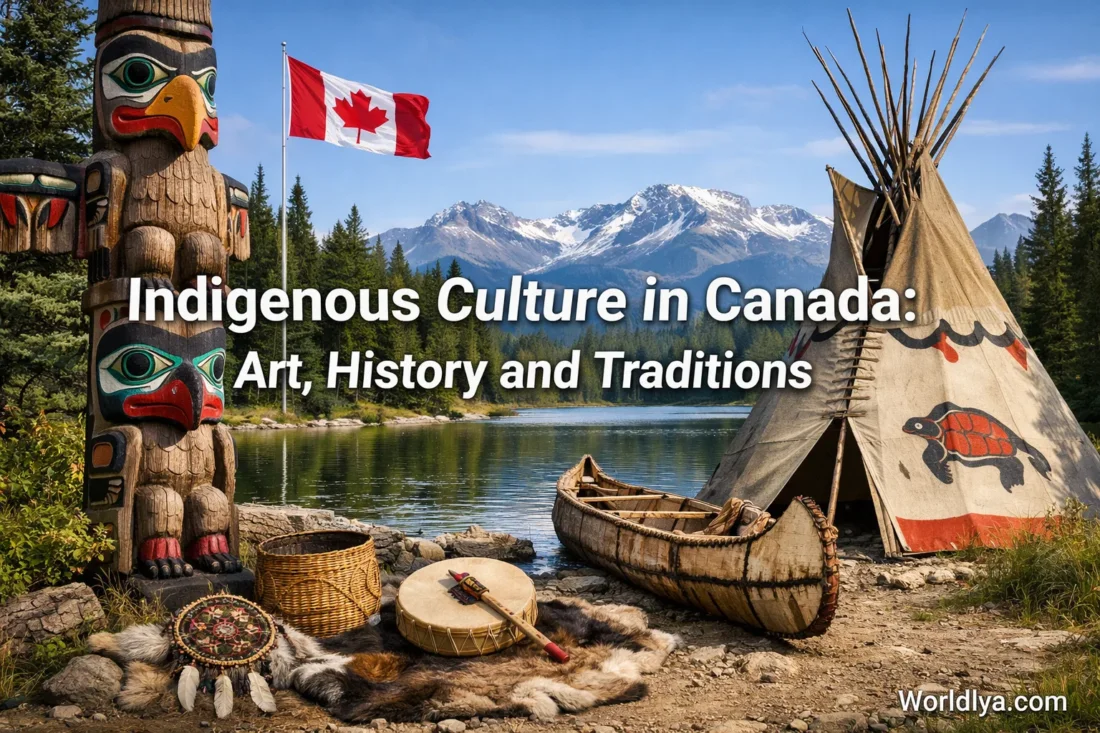
Along the Pacific coast, you’ll often encounter powerful carved forms in wood, especially cedar. Totem poles and related carved works can carry clan stories, honour family lines, mark important places, or welcome guests. When you look closely, details like the eyes, wings, and painted shapes act like a visual signature—almost like handwriting.
Look For This: repeated motifs, balanced symmetry, and confident carving lines that “lead your eye” like a trail through a forest.
Inuit Sculpture and Printmaking
Inuit artists are globally celebrated for expressive sculpture and prints. Stone carving often features clean silhouettes and strong movement—animals, community life, and imaginative beings appear again and again. Printmaking (including techniques like stonecut, stencil, and later styles) creates bold images you can recognize from across a room. If you’ve ever seen a print that feels both graphic and warm, there’s a good chance it came from an Inuit print tradition.
Why Prints Matter
They make storytelling portable. A print can travel, be shared, be collected, and still keep its local voice.
Why Carvings Feel Alive
The best ones don’t just “show” an animal—they suggest breath, pause, and motion. Like a snapshot from a longer story.
Métis Floral Beadwork and Embroidery
Métis floral designs are instantly recognizable: curling leaves, layered petals, and confident symmetry that looks like it grew naturally. Beadwork can appear on clothing, bags, belts, and personal pieces—often made with tremendous patience. Some pieces take hours. Others take months. Either way, the result can feel like you’re looking at a garden made of light.
| Tradition | Common Materials | What You Might Notice |
|---|---|---|
| Carving | Wood (often cedar), paint | Bold shapes, strong outlines, storytelling figures |
| Printmaking | Paper, inks, carved/relief surfaces | High-contrast images, clean rhythm, graphic clarity |
| Floral Beadwork | Glass beads, thread, fabric/leather | Layered flowers, fine detail, balanced composition |
Music, Dance and Voice Traditions
If visual art is one doorway, sound is another. Sometimes the meaning is in the lyrics. Sometimes it’s in the rhythm and the way people move together. Ever felt music pull a room into one shared heartbeat? That’s not an accident.
Powwows: Drums, Dance, and Community Energy
Powwows are gatherings where dance, drumming, song, and community come together. They can feel festive, welcoming, and deeply respectful at the same time. If it’s your first time attending, you’ll get the best experience by doing one simple thing: listen to the announcer’s guidance and follow the local protocols.
Quick Visitor Notes
- Use the word regalia (not “costume”).
- Ask before taking photos—always.
- When instructions are given, follow them. It keeps everyone comfortable.
Katajjaq: Inuit Throat Singing as a Vocal Game
Katajjaq is often described as a vocal game where two partners face each other and exchange repeating sound patterns—one leads, the other mirrors—until someone breaks the rhythm or laughs. It’s playful, skillful, and surprisingly athletic. You can almost hear the conversation inside the sound.
Métis Music and Dance Traditions
Métis cultural expression often shines through lively music and dance. If you ever catch a community performance, listen for the way melody and rhythm trade places—like two friends finishing each other’s sentences.
Culture isn’t a museum label. It’s something people do—together, over time, in real life.
Traditions in Daily Life
When people say “traditions,” it’s easy to imagine only ceremonies or festivals. In reality, traditions also live in ordinary moments: how people teach children, how stories get told, how art gets made, how names are spoken carefully.
- Storytelling (often oral, sometimes written, sometimes visual): stories that teach, entertain, and carry values.
- Making as learning: carving, sewing, beading, weaving, painting—skills passed through hands and time.
- Seasonal rhythms: many cultural practices follow local seasons and landscapes, reflecting deep knowledge of place.
Micro-Checklist: If You Want To Learn With Respect
- Start specific: which Nation or community are you learning about?
- Prefer primary voices: Indigenous artists, cultural centres, museums, and community pages.
- Support creators directly when you can (artist shops, exhibitions, workshops).
- Ask before recording or photographing—no awkward moments, no guessing.
Where To Experience Indigenous Culture in Canada
Want something practical you can actually do with this knowledge? Here are three “paths” depending on your mood.
Art-Lover Path
- Explore Inuit prints and sculptures.
- Look for Northwest Coast carving exhibits.
- Study Métis floral beadwork close-up.
Sound and Movement Path
- Attend a public powwow and follow local guidance.
- Listen to katajjaq and focus on rhythm and breath.
- Watch dance styles with an eye for storytelling.
Family-Friendly Path
- Visit museum learning pages with images and stories.
- Try a beginner craft workshop from a local Indigenous artist.
- Pick one tradition and learn its basics slowly.
FAQ That People Actually Ask
Is it okay to attend a powwow as a visitor?
Often yes, especially public events. The simplest rule is to follow the announcements, ask before photos, and treat regalia and drums with respect. When in doubt, ask a staff member or volunteer.
How do I avoid overgeneralizing Indigenous culture?
Use specific names when you can. Instead of “Indigenous art,” try “Inuit printmaking,” “Métis floral beadwork,” or “Northwest Coast carving.” Specificity shows care.
What’s one detail that helps me “see” Métis beadwork better?
Look at the layering. Many floral designs feel like they have depth—petals and leaves overlap in a way that gives the work motion, not just pattern.
Is katajjaq always performed the same way?
No. It’s often explained as a partner-based vocal game, but practice and presentation can vary. Different performers and communities bring their own choices and style.
What’s the most respectful way to support Indigenous art?
Buy directly from the artist or reputable Indigenous-run galleries and programs. If you’re sharing online, name the artist and the community when that information is provided.
Sources
- Statistics Canada — First Nations People, Métis and Inuit in Canada (2021 Census Infographic)
- Government of Canada — Indigenous Art Centre (Gallery and Program Information)
- Canadian Museum of History — Inuit Prints of Cape Dorset (Introduction)
- Canadian Museum of History — Métis Floral Design (Learning Resource)
- Simon Fraser University — Northwest Coast Totem Poles (Virtual Exhibit)
- Rupertsland Institute — Flower Beadwork People (Métis Beadwork Resource)
- Inuit Art Foundation — The Power of Linocut Printmaking (Inuit Art Quarterly)
- Dartmouth College (Hood Museum) — Object Note Referencing Katajjaq (Throat Singing Game)
- University of Toronto Mississauga — Powwow Etiquette (Visitor Guidance)