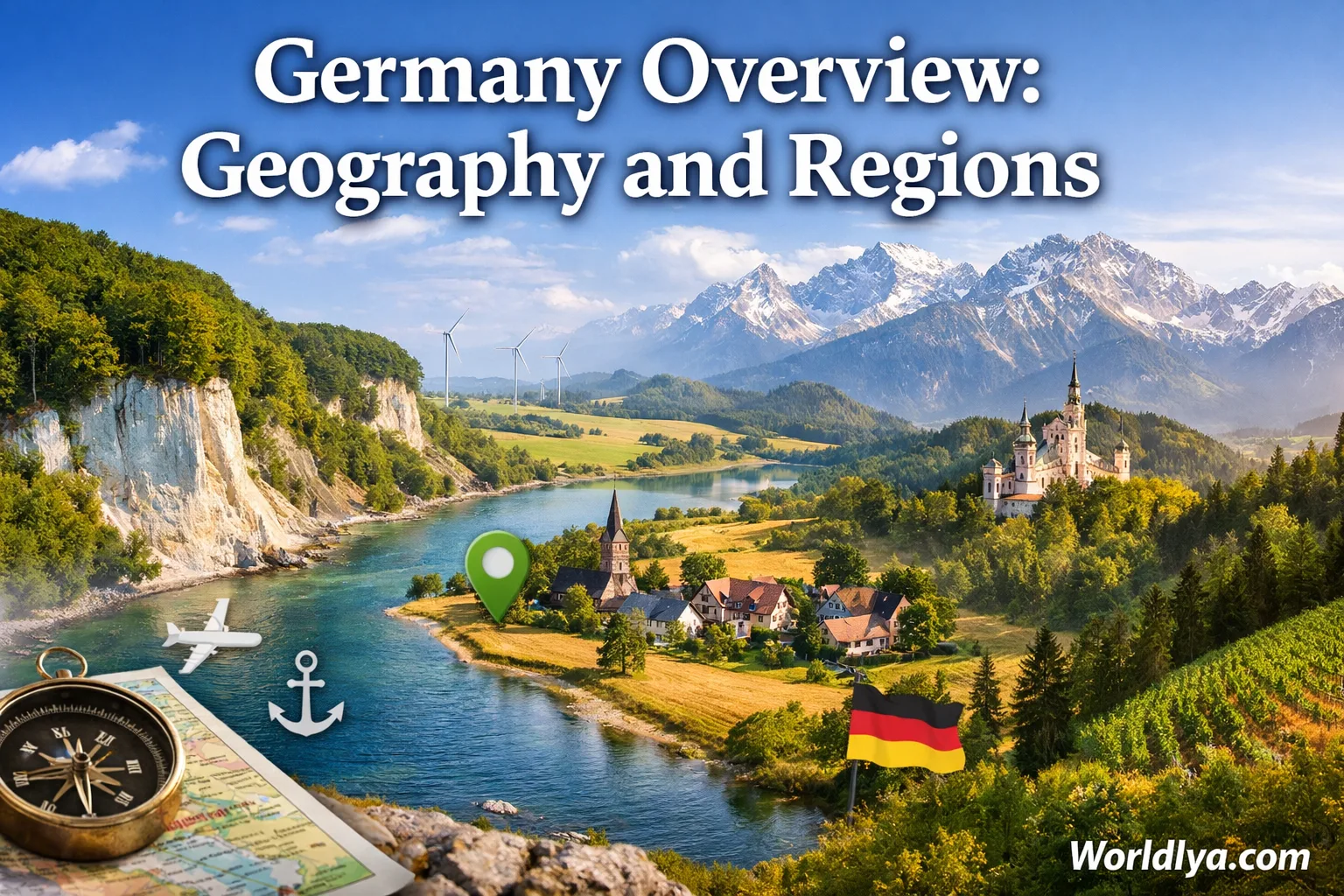
Germany’s geography is a bit like a three-layer cake: a broad, breezy lowland in the north, a hilly “middle” with forests and ridges, and a dramatic alpine edge in the south. Ever wondered why one country can feel beachy, woodsy, and mountainy—sometimes in the same week? That’s the magic of Germany’s regions, shaped by seas, rivers, and a landscape that rises steadily as you travel south.
Quick Snapshot of Germany’s Landscape
What Stands Out
- Two coasts on the North Sea and Baltic Sea
- Three big landscape bands: lowlands → uplands → Alps
- River highways like the Rhine, Elbe, and Danube
- Forest-rich regions with trails, viewpoints, and lakes
Best Way to Picture It
The north is wide and open. The center gets more textured—hills, ridges, valleys. The south climbs into the Alpine Foreland and then the Alps, where Germany’s highest peak, Zugspitze, sits near the border.
If you’re learning about Germany (or planning a future trip), the easiest trick is this: follow the rise in elevation. Germany generally slopes down toward the north, so your scenery shifts with every few hours of travel.
Geography Overview
Where Germany Sits
Germany is in Central Europe, with coastlines in the north and mountains toward the south. That placement matters: Atlantic weather can sweep in from the west, while more continental air often shapes conditions in the east.
- North: North Sea and Baltic Sea coasts
- South: Alpine Foreland and the Alps
- Center: Forested uplands, ridges, and river valleys
A “Region” Can Mean Two Things
People use regions in Germany in a few ways:
- Physical regions (plains, uplands, Alps)
- Natural landscapes (Black Forest, Harz, Eifel, lake districts)
- Administrative regions (federal states), which often follow natural borders like rivers and ridges
Think in layers: the farther south you go, the more the land folds and climbs—like a map slowly gaining texture.
The Three Major Physical Regions of Germany
Germany’s geography is often described in three main zones. It’s a simple way to understand how the country’s cities, landscapes, and climate patterns fit together.
1) The North German Plain
The North German Plain is the spacious, low-lying part of the country. It’s known for flat horizons, farmland, marshy stretches, and coastal landscapes that can feel wonderfully wide-open.
What You’ll Notice
- Coastal features like dunes, tidal flats, and islands
- Big skies and long, straight road views
- Lake areas in the northeast (a surprise for many visitors)
Great For
- Beach days and relaxed seaside towns
- Birdwatching and nature walks near wetlands
- Cycling on flatter routes
2) The Central Uplands (Mittelgebirge)
The middle of Germany is a patchwork of low mountain ranges, plateaus, forests, and valleys. It’s not one single range—it’s more like a quilt of ridges that makes road trips and hikes feel endlessly varied.
Iconic landscapes here include the Harz, the Eifel, the Ore Mountains (Erzgebirge), and the sandstone formations of Saxon Switzerland. You’ll often see rivers carving routes through these uplands, creating scenic valleys and viewpoint trails.
- Best vibe: forests, castles-on-hills, winding viewpoints
- Best pace: weekend hikes, cozy spa towns, scenic train rides
- Little tip: weather can shift quickly with elevation—pack a light layer, even in summer
One fun detail: you can hop between totally different “mini-worlds” here in a day—basalt hills in one area, limestone cliffs in another, then a river valley that feels like a green corridor.
3) The Alpine Foreland and the Alps
Southern Germany rises into the Alpine Foreland—rolling hills, lakes, and postcard villages—before the land lifts sharply into the Bavarian Alps. This is where Germany’s mountain scenery really delivers: crisp ridgelines, deep-green meadows, and the kind of views that make you stop mid-sentence.
What You’ll Notice
- Glacial lakes and clear foothill valleys
- Steeper terrain and faster elevation changes
- Classic alpine weather: sunny mornings can turn into quick afternoon clouds
Great For
- Hiking and gondola viewpoints
- Lake swims in warm months
- Snow sports in winter resort areas
If you want the “wow” factor with minimal effort, the foreland is your friend—views feel close, accesible, and the scenery stacks up fast.
Rivers and Lakes That Shape Germany
Germany’s rivers are like natural guide lines on the map. They connect regions, frame valleys, and often signal a change in landscape—flat plains give way to hills, hills open into broad basins, and so on.
| Waterway | Region Clue | What It’s Known For |
|---|---|---|
| Rhine | West and southwest corridors | Famous valley scenery, vineyards, and historic river towns |
| Danube | Southern route from uplands toward the southeast | Classic “big river” landscapes and wide floodplains |
| Elbe | Central-to-north flow | River meadows and strong links to northern lowlands |
| Weser | Central hills into the north | A calm, scenic route through upland-and-plain transitions |
| Oder | Eastern lowlands | Wide landscapes and wetlands near the northeast |
For lakes, Germany has everything from Alpine-edge lakes in the south to the Mecklenburg Lake District in the northeast, where water and forest can feel almost endless.
Coasts and Islands: North Sea vs. Baltic Sea
North Sea Coast
The North Sea side is famous for tides, mudflats, and wide coastal horizons. The Wadden Sea landscape (tidal flats and islands) is one of the most distinctive coastal environments you’ll find in Europe.
- Vibe: windswept, airy, dramatic skies
- Look for: dunes, dikes, tidal rhythms
Baltic Sea Coast
The Baltic coast tends to feel gentler: sandy beaches, calmer water, and classic seaside resorts. Islands like Rügen are known for bright coastal scenery and inviting summer energy.
- Vibe: relaxed beach towns and boardwalk strolls
- Look for: cliffs, bays, and long sand stretches
Climate and Seasons Across Regions
Germany has a temperate climate, but it’s not “one-size-fits-all.” Coastal areas often feel more maritime, while inland and eastern areas can feel more continental. Add mountains, and you get even more variety—cooler air, more dramatic clouds, and different seasonal rhythms.
Quick Seasonal Feel (Simple Guide)
- Spring: fresh greens, changeable days, great for city + nature combos
- Summer: long daylight, lake swims, lively coasts, warm valleys
- Autumn: golden forests, vineyard colors in river regions, crisp hikes
- Winter: cozy towns, frosty uplands, snow chances near alpine areas
Tip that saves headaches: pack a light rain layer for most months—weather can be playful, especially in the west.
Famous Natural Landscapes You’ll Hear About
Outside of those three broad regions, Germany has many well-known landscapes that come up often in conversation. Here are a few you’ll recognize right away.
Forests and Highlands
- Black Forest (Schwarzwald): dense evergreens, hill towns, trails
- Bavarian Forest (Bayerischer Wald): wooded ridges and quiet nature escapes
- Harz: classic upland range with viewpoints and forest routes
- Eifel: rolling hills and distinctive volcanic features
Valleys, Sandstone, and Waterlands
- Rhine Valley: steep slopes, river bends, scenic overlooks
- Saxon Switzerland: sandstone towers and dramatic ravines
- Spreewald: canals and wetlands with a slow, peaceful rhythm
- Mecklenburg Lake District: lakes + forests, ideal for paddling and cycling
Choose a Region Based on What You Want
Not sure where to focus first? Use this simple match-up. It’s practical, fast, and works whether you’re studying geography or sketching a travel wish-list.
- Want mountains and lakes? Head toward the Alpine Foreland and the Bavarian Alps.
- Want forests and ridge hikes? Aim for the Central Uplands (Harz, Eifel, Erzgebirge, sandstone regions).
- Want beaches and big skies? Pick the North Sea or Baltic coasts.
- Want river scenery? Follow major valleys—especially the Rhine and its famous bends.
Mini FAQ
Is Germany Mostly Flat?
Nope. The north has large flat areas, but the center is full of uplands, and the south rises into serious mountains. That north-to-south climb is one of Germany’s defining patterns.
What’s the Easiest Way to Remember the Regions?
Try this: Plains (north) → Uplands (center) → Alps (south). Simple, sticky, and it makes maps easier to read.
Does the Coast Feel Different on Each Sea?
Yes. The North Sea is more tidal and windswept, while the Baltic is often calmer with classic sandy resort stretches. Different mood, same “ahh” feeling.
References
- Federal Agency for Cartography and Geodesy (BKG) – Geoinformation
- German Weather Service (DWD) – Climate Monitoring: Germany
- German Weather Service (DWD) – German Climate Atlas
- Federal Agency for Nature Conservation (BfN) – Maps and Data
- Encyclopaedia Britannica – Germany: Land
- Wikipedia – Geography of Germany