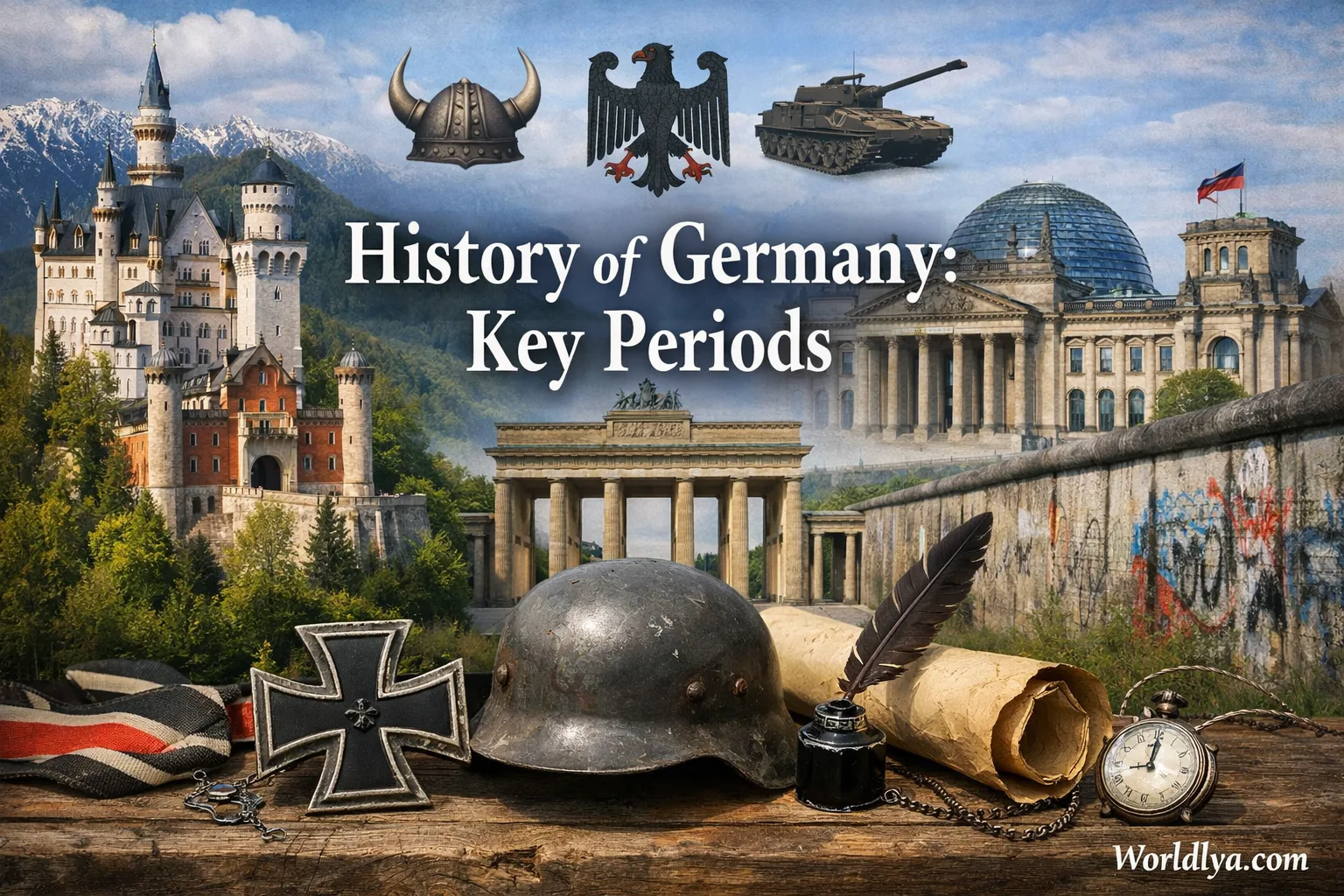
Germany’s history isn’t one straight line—it’s more like a well-organized bookshelf. Each shelf is a different era, and once you know what to look for, the “story” suddenly feels easy to read. This guide breaks down the key periods in a way you can actually use: what shaped everyday life, what changed, and what you can still spot today.
A Friendly Map Of Germany’s Past
Key periods, simple signals, and real-life examples.
If you’ve ever asked, “Why does one German town feel medieval, while another feels super modern?”—you’re in the right place.
Quick Timeline Of Key Periods
- Early Roots (Prehistory to Roman-era frontiers): settlements, trade routes, and local identities
- Early Middle Ages (c. 500–1000): monasteries, farming rhythms, and the rise of towns
- High Middle Ages (c. 1000–1500): cathedrals, crafts, and city life
- Trade Network Era (c. 1200–1600): merchant cities and northern sea routes
- Reformation and Print Culture (c. 1500s): education expands, ideas travel fast
- Enlightenment and Classicism (c. 1700s): universities, music, and new thinking
- Industry and Innovation (c. 1800s): railways, factories, science, and big-city growth
- Modern Germany (c. 1900s to today): design, rebuilding, technology, and cultural variety
Quick Tip: When you visit a place in Germany (or even browse photos), look for three clues: building materials (wood, stone, steel), street layout (curvy lanes vs. grids), and public spaces (market squares, parks, transit hubs). Those clues usually point to a period faster than any date plaque.
Early Roots: From Prehistory To Roman-Era Frontiers
Long before “Germany” was a familiar word, the region was a patchwork of communities shaped by rivers, forests, and trade. The Rhine and Danube worked like natural highways—moving goods, crafts, and cultural habits from one place to another.
What Changed In Daily Life
- Settlements grew near water and fertile land
- Craft skills became more specialized (metalwork, pottery, textiles)
- Local exchange expanded into wider trade corridors
What You Can Still Spot Today
- Major cities clustering along rivers like the Rhine
- Archaeological museums featuring early tools, jewelry, and settlement maps
- Old road alignments that later became regional transport routes
Ever wondered why so many important places sit near waterways? Because for centuries, rivers were the fastest “internet” of their time—carrying goods, news, and new habits.
Early Middle Ages: Monasteries, Fields, and Growing Towns
From around the 6th century onward, communities became more settled and organized around farms, markets, and learning centers. Monasteries mattered a lot here—not only for religion, but because they supported education, record-keeping, agriculture, and craftsmanship.
Look For This: Many medieval towns still have a “logic” that starts at the market square. If streets feel like they radiate from one central point, you’re often seeing a layout rooted in medieval trade days.
This period also built the habit of regional variety. Dialects, local foods, and building styles developed in ways that still give Germany its pleasant mix of identities today.
High Middle Ages: Cathedrals, Craft Guilds, and City Confidence
Between roughly 1000 and 1500, many towns expanded and became more self-confident. You can feel it in the architecture: stone churches, fortified walls, and carefully planned civic buildings. Meanwhile, craft guilds shaped the rhythm of work—setting standards for quality and training apprentices.
| Period Signal | What It Often Looks Like | Why It Matters |
|---|---|---|
| Cathedral Town | Large stone church, old square nearby | Community identity centered around shared spaces |
| Guild Streets | Named lanes tied to crafts (bakers, weavers, smiths) | Skill-based economies and structured training |
| Town Walls | Gates, wall remnants, ring roads | Clear borders shaped movement and trade flow |
If medieval Germany had a slogan, it might be: “Build something that lasts.” That mindset still shows up in restoration projects and the pride many towns take in preserving their old cores.
Cities and Trade: The Hanseatic Web Across the North
In northern Germany, merchant cities formed powerful trade connections across coastal and sea routes. Think of it as a web of harbors—goods and styles traveling from city to city, shaping architecture, cuisine, and city planning.
- Brick Gothic architecture became a signature in the north (where natural stone was scarce).
- City wealth often turned into public buildings: halls, warehouses, and impressive churches.
- Ports encouraged a “worldly” feel—different goods, languages, and habits passing through.
History gets loudest in places where people meet. In Germany, trade cities are exactly that—meeting points that leave visible fingerprints.
Reformation and Print Culture: Ideas on the Move
The 1500s brought a major shift: printed texts spread faster, education broadened, and debates about belief and learning became part of everyday conversations. This wasn’t only about religion—it was also about access. More people could read, share, and challenge ideas.
Why This Era Still Matters
- Printing boosted schools and local learning culture
- Music traditions expanded through written scores
- Public discussion became more common (in homes, markets, and universities)
Easy “Spot It” Clues
- Old university towns with long academic traditions
- Historic printing references in local museums
- Church interiors featuring later-era artwork and written inscriptions
Enlightenment and Classicism: Thinkers, Composers, and New Confidence
By the 1700s, Germany’s cultural life felt like a workshop that never closed. Universities grew in influence, philosophy and literature flourished, and music became a major part of public life. It’s a period where ideas and art start to feel like national treasures—collected, studied, celebrated.
Small Moments That Tell the Story
- A town library with old catalog systems and reading rooms
- Concert halls and opera houses that became civic pride projects
- Classical-era parks and gardens designed for strolling, not rushing
And here’s the fun part: once you notice how much Germany values learning, you start seeing it everywhere—museums with detailed captions, local plaques, even guided walks that treat everyday streets like living textbooks.
Industry and Innovation: Railways, Cities, and Big Change
The 1800s transformed Germany’s pace of life. Railways stitched regions together, factories scaled up production, and cities grew quickly. Science and engineering became everyday forces—changing how people worked, traveled, and built.
- Transport Revolution: rail lines reduced travel time dramatically and boosted regional exchange.
- New City Life: dense neighborhoods, public transit, and bigger cultural venues.
- Technical Confidence: engineering and research became a point of pride.
If medieval towns feel like hand-stitched fabric, industrial-era cities feel like a loom—fast, patterned, and built to scale. You can still sense it in train stations, boulevards, and the “grid” feel of newer districts.
Modern Germany: Design, Rebuilding, and Everyday Comfort
The 1900s and 2000s brought huge shifts in how Germany builds and lives. You’ll see a strong focus on function (clean design, efficient transit), paired with a love for culture (theaters, galleries, music, festivals). Some city centers were carefully restored, and many neighborhoods were redesigned for modern needs.
What Stands Out
- Bauhaus-influenced simplicity (form follows function)
- Walkable centers with strong public transport culture
- Lots of museums that explain not just objects, but daily life
A Practical Way To Read a City
Start at the main square, then walk toward the train station. That short route often crosses multiple eras—older cores, 1800s expansion, and modern planning—like flipping pages in a book.
One tiny confession: sometimes the best history clue is the most ordinary thing—like a neighborhood bakery sign that’s been there forever. Those small continuities are the heartbeat of any timeline, and they’re easy to miss if you only chase “famous” spots. Also, you might notice teh pace of life changes from city to city—history left different rhythms behind.
How To Explore Germany’s Past Without a Textbook
You don’t need to memorize dates. A smarter approach is to match a period with a place-type. Here are easy, user-friendly ways to do it.
- Pick One Era per Day: medieval morning in an old town, industrial afternoon near a railway museum, modern evening in a design district.
- Use Museums That Focus on Daily Life: look for exhibits about housing, work, food, and music.
- Walk the “Material Trail”: timber → stone → steel and glass. It’s surprisingly reliable.
- Look for Market Squares: they’re often the oldest “center” and still the most social.
- Follow a River Promenade: rivers explain why towns sit where they do—and how they grew.
Mini Checklist: “What Am I Looking At?”
- Street Shape: winding lanes often point to older cores
- Rooflines: steep roofs can signal older styles and climate needs
- Public Buildings: big halls and squares hint at civic confidence
- Transport Nodes: stations and broad avenues often reflect 1800s growth
- Design Language: clean lines and open space often reflect modern planning
Key Periods Overview: A Simple Table
| Key Period | Big Theme | Best “Today” Example |
|---|---|---|
| Early Roots | Settlements and routes | River cities, archaeology collections |
| Middle Ages | Town life and craftsmanship | Old squares, cathedrals, city walls |
| Trade Network Era | Merchant culture | Harbor cities, brick architecture |
| Reformation and Print Culture | Education spreads | University towns, print-related exhibits |
| Enlightenment and Classicism | Ideas and arts | Libraries, concert halls, classical parks |
| Industry and Innovation | Speed and scale | Rail hubs, museums of technology, factory districts |
| Modern Germany | Design and comfort | Transit systems, galleries, restored centers |
Common Questions People Ask
Is Germany’s history mostly about kings and big events?
Not at all. A lot of the most interesting story is about daily life: how towns formed, how trade shaped cities, how education spread, and how design choices changed the way people live.
What’s the easiest period to “see” with your own eyes?
Medieval town centers are usually the most visually obvious: market squares, old churches, and compact street networks. After that, 1800s railway areas are often very easy to recognize.
How do I learn fast before a trip?
Choose one timeline overview, then pick two cities and compare them: one with a famous old town and one known for modern design. That contrast teaches you more than a long list of dates.
Sources
- LeMO (German Historical Museum) – Kaiserreich: Everyday Life
- LeMO (German Historical Museum) – Chapters and Timeline Overview
- Haus der Geschichte – Online Projects (incl. LeMO)
- The Federal Archives (Bundesarchiv) – Find Topics Online
- German History in Documents and Images – The German Empire (1871–1918)