
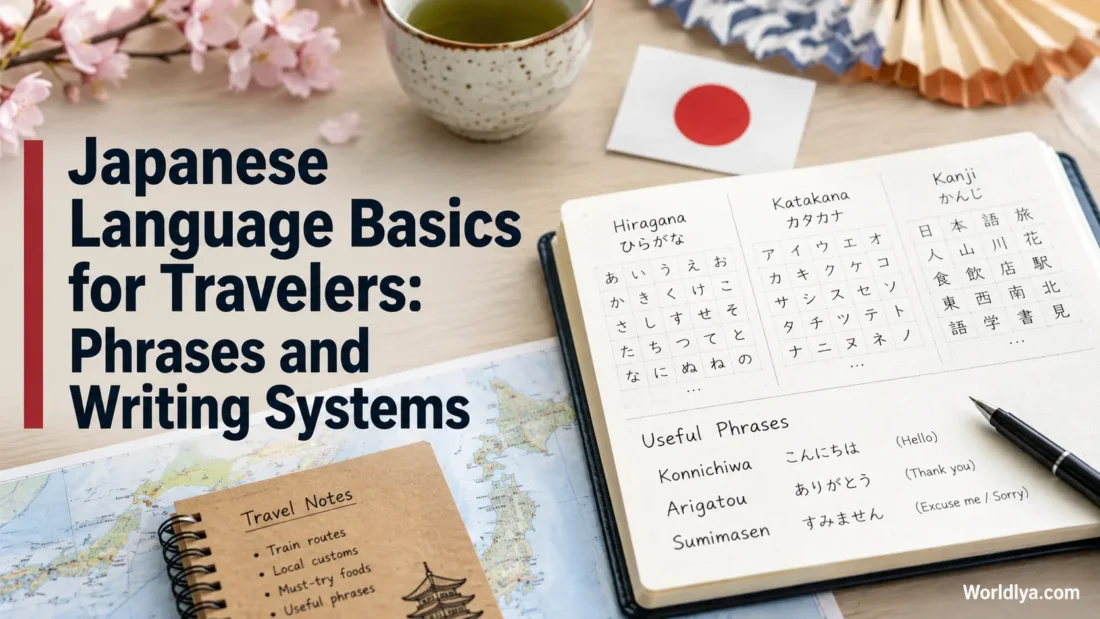
Japanese can feel unfamiliar at first because it does not use just one writing system. A train sign may show 東京, Tokyo, and sometimes kana on the same board. A restaurant menu may mix graceful hiragana, sharp-looking katakana, and meaning-packed kanji in one line. For travelers, the good news is simple: you do not need to read everything. You need to recognize patterns, use a few polite phrases, and know what the writing systems are trying to do.
What Travelers Really Need First
Start with survival Japanese, not textbook perfection. If you can greet people, say thank you, ask where something is, order politely, and recognize station words, your trip already feels easier.
- Learn a few polite phrases that work in many places.
- Read romaji, the Latin-letter version of Japanese, when signs provide it.
- Recognize hiragana, katakana, and kanji without trying to master all three before travel.
- Use short sentences. In travel situations, simple Japanese is not rude when the tone is polite.
The Three Japanese Writing Systems Travelers See
Japanese writing often works like a layered map. One layer gives sound, another gives meaning, and another handles foreign words or emphasis. You may see all of them on food labels, ticket machines, hotel signs, receipts, and maps.
| Writing System | Example | What It Usually Does | Traveler Tip |
|---|---|---|---|
| Hiragana | ありがとう | Shows Japanese sounds, grammar, endings, and many native words. | Good first script to notice because it appears in everyday phrases. |
| Katakana | ホテル | Often shows loanwords, foreign names, brand-like terms, and sound effects. | Useful for spotting words like hotel, taxi, menu, and coffee. |
| Kanji | 駅 | Uses characters with meaning, often for nouns, places, verbs, and signs. | Learn a tiny set for travel: station, entrance, exit, north, south. |
| Romaji | Tokyo | Writes Japanese with Latin letters. | Very helpful on major train signs, airports, maps, and travel apps. |
Small but useful point: Japanese is not written with spaces in the same way English is. Kanji helps the eye separate meaning. Kana fills in sound and grammar. That is why a Japanese sentence can look dense at first, even when the sentence itself is simple.
Hiragana: The Soft Everyday Script
Hiragana is the rounded script you will see in basic phrases, grammar endings, and many words written for easy reading. It is often the first script learners study because it matches Japanese sounds more directly than kanji.
Travelers do not have to memorize every hiragana character before a trip, yet even a few familiar shapes can help. The phrase ありがとう means thank you. The phrase すみません means excuse me or sorry, depending on the moment.
| Hiragana | Romaji | Simple Sound | Where It Helps |
|---|---|---|---|
| あ | a | ah | Reading basic kana charts and short words. |
| い | i | ee | Spotting sound patterns in names and signs. |
| う | u | oo | Understanding the vowel in words like sushi. |
| え | e | eh | Reading simple syllables. |
| お | o | oh | Recognizing polite words that start with o. |
Katakana: The Script That Often Sounds Familiar
Katakana looks more angular than hiragana. Travelers often meet it in words borrowed from other languages. This makes it surprisingly handy. A word may look Japanese, but once you sound it out, it may resemble an English or international word.
| Katakana | Romaji | Meaning | Traveler Use |
|---|---|---|---|
| ホテル | hoteru | hotel | Accommodation signs and booking counters. |
| タクシー | takushī | taxi | Transport areas, station exits, and hotel lobbies. |
| メニュー | menyū | menu | Restaurants and cafés. |
| カード | kādo | card | Payment questions. |
| コーヒー | kōhī | coffee | Cafés, vending machines, and breakfast menus. |
Katakana words may not sound exactly like English. Japanese sound patterns reshape them. Taxi becomes takushī. Card becomes kādo. Once your ear accepts that shift, katakana starts to feel like a travel shortcut.
Kanji: Meaning Packed Into One Character
Kanji can look difficult because one character may carry a whole idea. Travelers do not need a large kanji list. A small set can still be very practical, especially in train stations, shopping streets, public buildings, and maps.
Station Words
- 駅 — station, eki
- 出口 — exit, deguchi
- 入口 — entrance, iriguchi
- 改札 — ticket gate, kaisatsu
Direction Words
- 東 — east, higashi
- 西 — west, nishi
- 南 — south, minami
- 北 — north, kita
Think of kanji as signposts rather than a wall. You may not read a full sentence, but recognizing 駅 for station or 出口 for exit can save time when you are moving through a busy place.
Romaji: Helpful, but Not The Whole Story
Romaji writes Japanese sounds with Latin letters. Travelers meet it on maps, transit signs, tickets, airport boards, and language apps. It is useful, especially when you need to say a place name aloud.
Still, romaji can hide details. Long vowels matter. Obasan and obaasan do not sound the same. Koko means here, while kōkō can mean high school. You do not need to panic over this. Just speak clearly, use context, and point to written names when needed.
Polite Travel Phrases That Work Almost Anywhere
Japanese has many levels of politeness, but travelers can go far with a small polite set. These phrases are safe in shops, stations, hotels, cafés, and casual tourist settings.
| English | Japanese | Romaji | When To Use It |
|---|---|---|---|
| Hello / Good Afternoon | こんにちは | konnichiwa | Daytime greeting in shops, hotels, and casual meetings. |
| Good Morning | おはようございます | ohayō gozaimasu | Morning greeting, polite and friendly. |
| Good Evening | こんばんは | konbanwa | Evening greeting. |
| Thank You | ありがとうございます | arigatō gozaimasu | Use often. It fits almost every travel moment. |
| Excuse Me / Sorry | すみません | sumimasen | Getting attention, passing by, apologizing lightly. |
| Please | お願いします | onegai shimasu | Requests, ordering, ticket counters, taxi directions. |
| Yes | はい | hai | Answering clearly. |
| No | いいえ | iie | Answering politely. A softer gesture may be used too. |
| I Don’t Understand | わかりません | wakarimasen | When spoken Japanese is too fast. |
| Do You Speak English? | 英語を話せますか | eigo o hanasemasu ka? | Ask softly, then keep your question simple. |
The Phrase That Solves Many Moments
Sumimasen is one of the most useful words for travelers. It can mean excuse me when you need attention, sorry when you bump someone lightly, or a polite opener before a question. It is like a small verbal bow.
Asking Where Things Are
The pattern … wa doko desu ka? means Where is …? It is one of the easiest travel sentence patterns because you only change the first word.
| English | Japanese | Romaji | Use Case |
|---|---|---|---|
| Where is the station? | 駅はどこですか | eki wa doko desu ka? | Walking to a station or asking hotel staff. |
| Where is the restroom? | お手洗いはどこですか | otearai wa doko desu ka? | Polite restroom question. |
| Where is the exit? | 出口はどこですか | deguchi wa doko desu ka? | Stations, malls, museums, and large buildings. |
| Where is the ticket gate? | 改札はどこですか | kaisatsu wa doko desu ka? | Train stations. |
| Where is this place? | ここはどこですか | koko wa doko desu ka? | When checking a map with someone nearby. |
Notice the particle は. It is written as ha in hiragana charts, but in this sentence role it is pronounced wa. Travelers do not need a grammar lesson here. Just remember the sound: eki wa doko desu ka?
Ordering Food and Drinks Politely
Restaurants are one of the best places to use basic Japanese because the situation gives context. Pointing is normal. A short phrase plus a smile often works better than a long sentence.
| English | Japanese | Romaji | Note |
|---|---|---|---|
| This, please. | これをお願いします | kore o onegai shimasu | Point to a menu item or display food. |
| Water, please. | お水をお願いします | omizu o onegai shimasu | Polite and simple. |
| Do you have an English menu? | 英語のメニューはありますか | eigo no menyū wa arimasu ka? | Useful in restaurants and cafés. |
| How much is it? | いくらですか | ikura desu ka? | Shops, stalls, and ticket counters. |
| Can I use a card? | カードは使えますか | kādo wa tsukaemasu ka? | Payment counters. |
| It is delicious. | おいしいです | oishii desu | A friendly phrase after eating. |
| Thank you for the meal. | ごちそうさまでした | gochisō sama deshita | Said after eating, especially when leaving. |
A Natural Restaurant Pattern
Point to the menu and say: kore o onegai shimasu. It literally works like this, please. It is short, polite, and easy to reuse.
Train and Station Words Worth Knowing
Japan’s rail signs often include romaji, especially around major routes. Yet a few Japanese words make stations easier to read. Think of these words as small anchors. Once you know them, the station feels less like a maze.
| English | Japanese | Romaji | Where You May See It |
|---|---|---|---|
| Station | 駅 | eki | Station names and maps. |
| Train | 電車 | densha | Transport signs and announcements. |
| Ticket | 切符 | kippu | Ticket offices and machines. |
| Platform | ホーム | hōmu | Station signs, often in katakana. |
| Departure | 出発 | shuppatsu | Airport and rail information boards. |
| Arrival | 到着 | tōchaku | Airport and rail information boards. |
| Place | 場所 | basho | Asking where something is located. |
Useful Transport Questions
- 京都行きですか — Kyōto iki desu ka? — Is this going to Kyoto?
- この電車ですか — kono densha desu ka? — Is it this train?
- 切符をお願いします — kippu o onegai shimasu — A ticket, please.
- 出口はどこですか — deguchi wa doko desu ka? — Where is the exit?
Hotel and Check-In Phrases
Hotel Japanese is usually predictable. Staff may already expect travelers to use English, but a few Japanese phrases can make check-in feel warmer and smoother.
| English | Japanese | Romaji | Travel Note |
|---|---|---|---|
| I have a reservation. | 予約があります | yoyaku ga arimasu | Say this at reception. |
| Check-in, please. | チェックインをお願いします | chekku-in o onegai shimasu | Katakana appears because check-in is a loanword. |
| Is there Wi-Fi? | Wi-Fiはありますか | waifai wa arimasu ka? | Helpful for hotels, cafés, and stations. |
| Can I leave my luggage? | 荷物を預けられますか | nimotsu o azukeraremasu ka? | Useful before check-in or after check-out. |
| What time is check-out? | チェックアウトは何時ですか | chekku-auto wa nanji desu ka? | Ask reception or confirm your booking details. |
Shopping and Payment Phrases
Shopping Japanese can be very short. A polite request, a price question, and a payment question cover many moments.
Point and Ask
これはいくらですか
kore wa ikura desu ka?
How much is this?
Buy Politely
これをください
kore o kudasai
This, please.
Ask About Card Payment
カードは使えますか
kādo wa tsukaemasu ka?
Can I use a card?
Pronunciation Tips That Make You Easier To Understand
Japanese pronunciation is friendly to beginners because vowels are fairly steady. The hard part is often rhythm. Keep it even, avoid heavy stress, and do not turn every word into an English-shaped word.
| Feature | Simple Rule | Example | Traveler Note |
|---|---|---|---|
| Vowels | a, i, u, e, o stay fairly steady. | a as ah, i as ee, u as oo. | Do not stretch English-style diphthongs. |
| R Sound | Japanese r is a light tap, between English r and l. | arigatō | A gentle tongue tap is usually clearer than a hard English r. |
| Long Vowels | A longer vowel can change meaning. | Tokyo is often written Tōkyō. | In romaji, a bar over a vowel often marks length. |
| Double Consonants | A small pause before the consonant. | kippu | Think kip-pu, not ki-pu. |
| Question Ending | Many polite questions end with ka. | doko desu ka? | Raise your tone slightly at the end. |
Mini Phrase Builder For Travelers
You do not need many grammar rules to build useful travel sentences. Use a base pattern, then swap in the thing you need.
Pattern 1: Where Is …?
… wa doko desu ka? means Where is …?
- Toire wa doko desu ka? — Where is the restroom?
- Eki wa doko desu ka? — Where is the station?
- Deguchi wa doko desu ka? — Where is the exit?
Pattern 2: I Would Like … Please
… o onegai shimasu means … please in a polite request.
- Omizu o onegai shimasu — Water, please.
- Kippu o onegai shimasu — A ticket, please.
- Kore o onegai shimasu — This, please.
Reading Signs Without Reading Full Japanese
A traveler’s reading goal is not literature. It is orientation. Can you find the exit? Can you match the station name? Can you notice whether a word is a food, a place, or a direction?
- Look for romaji first. Major transport signs often include Latin letters.
- Match shapes, not full meanings. If your ticket says 新宿, match it to 新宿 on signs. That is Shinjuku.
- Use kanji landmarks. 駅, 出口, 入口, 北, 南 are useful visual anchors.
- Notice katakana for borrowed words. ホテル, タクシー, カード, メニュー can be easier than they look.
- Keep screenshots ready. Showing a hotel name, station name, or restaurant address can help more than trying to pronounce it perfectly.
A Simple One-Day Practice Plan Before Travel
If you only have a short time before departure, avoid overloading yourself. Learn the phrases that you will actually say out loud.
Practice Order
- Ten minutes: greetings, thank you, excuse me, yes, no.
- Ten minutes: where-is pattern with station, restroom, exit, hotel.
- Ten minutes: ordering pattern with this, water, ticket, menu.
- Ten minutes: station words: eki, deguchi, iriguchi, kippu, densha.
- Ten minutes: read a few signs or screenshots from maps and stations.
Common Mistakes Travelers Can Easily Avoid
Most mistakes are small. Japanese speakers are usually used to hearing different accents from visitors. Clear tone, polite words, and patience matter more than perfect grammar.
| Mistake | Better Habit | Why It Helps |
|---|---|---|
| Trying long translated sentences. | Use short patterns. | Short phrases are easier for both sides to understand. |
| Saying only the place name with no polite word. | Add sumimasen or onegai shimasu. | It softens the request. |
| Expecting katakana to sound exactly like English. | Listen for Japanese rhythm. | Loanwords change shape in Japanese pronunciation. |
| Ignoring kanji completely. | Learn a few sign characters. | Even five or ten kanji can help with stations and exits. |
| Speaking too fast. | Slow down and keep vowels clean. | Simple, steady pronunciation is easier to follow. |
Tiny Cultural Notes That Help Language Feel Natural
Language is not just sound. It also carries timing, tone, and small social habits. A phrase can feel warmer when it comes with a slight nod, a calm voice, and a patient pause.
- Use names and places in writing when possible. Showing a hotel name or station on your phone reduces confusion.
- Start with sumimasen. It is a polite doorway into a question.
- Do not worry about sounding advanced. Clear beginner Japanese is often more useful than a memorized sentence you cannot adjust.
- Use gestures gently. Pointing to a menu, ticket, or map is common in travel situations.
Traveler Phrase Sheet
This compact list is made for real movement: arrivals, meals, stations, shops, hotels, and simple help.
| Situation | Phrase | Romaji | Meaning |
|---|---|---|---|
| Greeting | こんにちは | konnichiwa | Hello / good afternoon |
| Thanks | ありがとうございます | arigatō gozaimasu | Thank you |
| Attention | すみません | sumimasen | Excuse me |
| Location | 駅はどこですか | eki wa doko desu ka? | Where is the station? |
| Restroom | お手洗いはどこですか | otearai wa doko desu ka? | Where is the restroom? |
| Restaurant | これをお願いします | kore o onegai shimasu | This, please |
| Shopping | いくらですか | ikura desu ka? | How much is it? |
| Payment | カードは使えますか | kādo wa tsukaemasu ka? | Can I use a card? |
| Hotel | 予約があります | yoyaku ga arimasu | I have a reservation |
| Understanding | わかりません | wakarimasen | I don’t understand |
| Language | 英語を話せますか | eigo o hanasemasu ka? | Do you speak English? |
| Help | 手伝ってください | tetsudatte kudasai | Please help me |
How Much Japanese Is Enough For A Trip?
For a short visit, enough Japanese means you can be polite, ask for basic help, read some transport cues, and recognize the shape of the writing systems. You do not need to read a newspaper. You do not need flawless grammar. You need useful words that survive real travel noise.
Start with sumimasen, arigatō gozaimasu, … wa doko desu ka?, and … o onegai shimasu. Add a few station kanji. Learn why hiragana, katakana, and kanji appear together. That small base can make Japan feel less like a locked door and more like a place you can gently read, ask about, and enjoy step by step.
FAQ
Should Travelers Learn Hiragana Before Visiting Japan?
It helps, but it is not required for a short trip. Hiragana is a good first script because it matches Japanese sounds and appears in everyday phrases. Even learning the basic vowel row and a few common words can make signs and menus feel less unfamiliar.
Is Katakana Useful For Travelers?
Yes. Katakana often appears in words borrowed from other languages. Travelers may recognize words for hotel, taxi, card, menu, coffee, and other daily needs after learning the katakana sound pattern.
Do I Need To Learn Kanji For Travel?
You do not need many kanji. A small travel set is useful: station, exit, entrance, north, south, east, west, ticket gate, and restroom-related words. Recognizing shapes can be enough.
Can I Travel In Japan With Only English?
Many travelers manage with English, maps, translation apps, and romaji signs, especially in larger cities and transport hubs. Learning basic Japanese still makes small daily moments easier and more respectful.
What Is The Most Useful Japanese Word For Travelers?
Sumimasen is one of the most useful. It can mean excuse me, sorry, or a polite way to begin a request. It works in stations, restaurants, shops, and hotels.
Sources
- Japan National Tourism Organization — Learn a Little of The Lingo
- Japan National Tourism Organization — Travel Japanese: Checking in at The Airport
- Japan National Tourism Organization — Travel Japanese: Getting To Your Gate
- The Japan Foundation — Japanese-Language Learning Materials
- The Japan Foundation — Websites For Japanese-Language Learners
- Encyclopaedia Britannica — Kana