
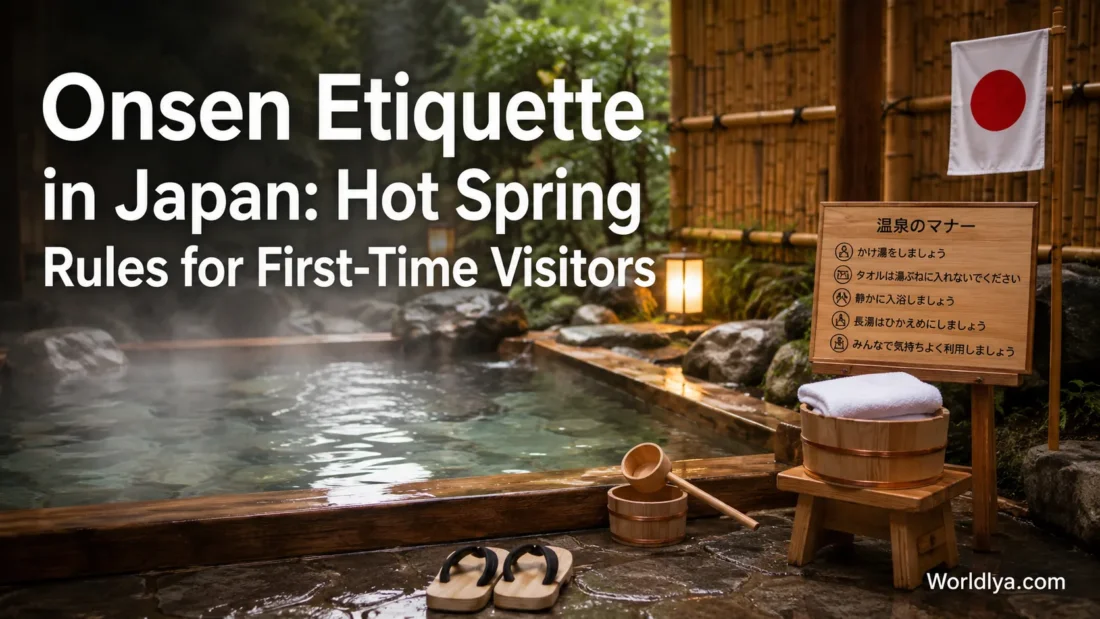
Stepping into a Japanese onsen for the first time can feel unfamiliar. Shoes disappear into a locker, curtains mark separate bathing areas, and everyone seems to know exactly where to go. The routine is easier than it looks. Clean yourself before entering the shared water, keep the bath calm, and follow the facility’s posted rules. Once those ideas click, the experience becomes pleasantly simple.
The One Rule That Explains Onsen Etiquette
The washing area is where you clean your body. The bath is where you soak.
Onsen water is shared. Soap, shampoo, towels, loose hair and unwashed skin stay outside the tub. Think of the bathing pool as a quiet shared room made of water rather than a place for washing or swimming.
What Counts as an Onsen in Japan?
The word onsen refers to naturally sourced hot spring water and, in everyday conversation, to the bathing facility built around it. An onsen may be part of a traditional inn, a modern hotel, a public bathhouse or a countryside day spa.
A sento is a public bath that generally uses heated tap water rather than natural hot spring water. The water source differs, but the basic bathing manners are usually very similar: remove your clothes, wash first and keep towels out of the tub.
Indoor Bath
An enclosed bathing room, often with several pools at different temperatures.
Rotenburo
An open-air bath. It may overlook a garden, forest, mountain slope or enclosed courtyard.
Private Bath
A reservable bath used alone, as a couple or as a family, depending on the property’s rules.
Before You Go: Check the House Rules
Onsen customs are broadly consistent across Japan, but each property controls its own admission policy, opening hours and facilities. A two-minute check can prevent confusion at the entrance.
- Tattoo policy: Confirm whether tattoos are accepted, must be covered or require a private bath.
- Day-use access: Some ryokan accept non-staying visitors only during set hours.
- Towel rental: Towels may be included, rented, sold or brought from your room.
- Amenities: Shampoo and body soap are common, though small local baths may offer fewer supplies.
- Private bathing: Reservable baths may be called kashikiri-buro or kazoku-buro.
- Children’s rules: Age limits and bathing-area arrangements differ by property.
Do not assume that every facility follows the same tattoo, towel or family-bathing policy. Read the property’s website, booking information or entrance signs. Staff members are used to practical questions from first-time visitors.
The Full Onsen Sequence
Most visits follow the same rhythm. The building may look traditional or modern, yet the path from the entrance to the bath rarely changes much.
| Stage | What You Do | What to Remember |
|---|---|---|
| 1 | Remove your shoes | Use the entrance shelf or shoe locker. |
| 2 | Pay or show your bath pass | Ask about towels before entering. |
| 3 | Enter the correct changing room | Check words, symbols and signs rather than curtain color alone. |
| 4 | Undress and store your belongings | Swimwear is normally not worn. |
| 5 | Wash at a seated shower | Rinse away every trace of soap. |
| 6 | Pour warm water over your body | This helps you adjust to the bath temperature. |
| 7 | Enter slowly and soak | Keep your towel and hair out of the water. |
| 8 | Dry lightly before returning | Avoid carrying water into the changing room. |
Removing Shoes at the Entrance
Many onsen have a clear boundary between the outdoor shoe area and the clean indoor floor. Remove your shoes where directed and place them in a shelf, numbered locker or wooden shoe box. Some lockers use a removable wooden key.
You may receive indoor slippers, especially at a hotel or ryokan. Slippers do not enter the changing room or bathing area unless signs clearly say otherwise. Look at what the floor, signs and other guests indicate.
Finding the Correct Bathing Area
Public onsen are usually divided into separate bathing areas. Entrances often use curtains called noren, along with written labels and human-shaped symbols.
| Japanese | Reading | Meaning |
|---|---|---|
| 男 | Otoko | Men |
| 女 | Onna | Women |
Blue and red curtains are common, but color is not a dependable rule. Some facilities use different shades, neutral designs or alternate the bathing rooms on selected days. Read the signs each time you enter.
Inside the Changing Room
Choose an open basket or locker and remove all clothing, including underwear and swimwear. Standard communal onsen bathing is done without clothing. Your large towel stays in the changing room. You may carry a small washing towel into the bathing room.
Lock your valuables when secure storage is available. At a ryokan, leaving passports, larger amounts of cash and unnecessary electronics in the room safe keeps the visit uncomplicated.
- Remove jewellery that may react to mineral-rich water or become hot.
- Take off glasses before entering the bath unless you need them to move safely.
- Bring only your small towel, locker key and any permitted personal washing items.
- Secure long hair before walking into the bathing room.
Phones and Cameras Stay Outside
Do not take a phone, camera or recording device into a communal changing or bathing area. This applies even when the room appears empty. Guest privacy comes before the possibility of a scenic photo.
How to Wash Before Entering the Bath
The bathing room normally has low stools, buckets, mirrors and handheld showers arranged along a wall. Find an unused station and sit down. Remaining seated reduces splashing and keeps the shared space orderly.
- Rinse the stool before sitting.
- Wash your body with soap.
- Wash and rinse your hair when needed.
- Remove makeup, creams and visible cosmetics.
- Rinse your body until no soap remains.
- Rinse the stool, bucket and surrounding floor.
- Return bottles and shower equipment to their original position.
Keep the shower spray close to your body. A handheld shower can send water farther than expected, especially when it twists on its holder. Check behind you before turning it on.
Some facilities provide a basin near the bath for kakeyu, the practice of pouring warm water over yourself before soaking. Begin with your feet and legs, then work upward. Kakeyu helps your body meet the temperature gradually, but it does not replace washing.
Entering and Leaving the Water
Step into the bath slowly. Onsen pools can be hotter than a home bath, and the stone or tile edge may be slippery. Lower yourself without jumping, splashing or blocking the steps.
You do not need to remain fully submerged. Sitting on a submerged ledge or soaking only part of your body is perfectly reasonable. First-time visitors often enjoy a brief soak, a cooling break beside the pool and another short soak later.
Do
- Enter slowly.
- Speak quietly.
- Leave space for others.
- Move carefully on wet floors.
- Take a break when you feel too warm.
Do Not
- Swim, dive or exercise.
- Splash nearby bathers.
- Reserve a large space.
- Eat or drink beside the pool.
- Place soap bottles on the bath edge.
Where the Small Towel Goes
The small towel causes more uncertainty than almost anything else. It can be used for washing and for discreet coverage while walking between the washing station and bath. It must not enter the bathwater.
Fold it and place it on your head, set it on a dry rock or leave it beside the bath where permitted. Avoid dropping it into the pool. If it slips into the water by accident, remove it promptly without making a fuss.
Keeping Hair Out of the Bath
Long hair should be tied high enough that it cannot trail into the water. A bun, clip or secure hair tie works well. Recently washed hair still stays out of the pool because the rule concerns the shared water, not only cleanliness.
Do not submerge your head. Onsen pools are designed for body soaking, not underwater swimming or hair rinsing.
How Quiet Is an Onsen?
An onsen is not always silent. Friends may chat, children may speak and water naturally makes noise. The expected tone is simply calm. Use a low voice and avoid calls across the room.
Watch the atmosphere around you. A small neighborhood bath early in the morning may be almost silent, while a family-oriented hotel bath may feel more relaxed. Matching the room’s volume is usually enough.
Onsen Tattoo Rules
Tattoo policies vary from one onsen to another. Some facilities admit tattooed guests without restrictions. Some accept small tattoos covered by approved patches. Others ask guests to use a reservable private bath.
Check before arriving rather than relying on a general rule about Japan. Search the facility’s admission page for terms such as “tattoo friendly,” “tattoo cover” or “private bath.” When the information is unclear, send a brief message with the approximate size and location of the tattoo.
A Useful Alternative
A private bath offers the same wash-before-soaking routine without a communal changing room. Reservations may be limited to hotel guests or sold in timed sessions, so book early when privacy is part of your travel plan.
Nudity and First-Time Nerves
Feeling shy is normal. Communal bathing may be new to you, even though it is an ordinary part of life for many people in Japan. Guests generally focus on their own routine and give one another space.
The small towel can provide limited coverage while you walk, but it cannot be worn in the bath. Moving calmly is less noticeable than trying to hide every step. After a few minutes, the routine often feels far more natural than expected.
A private onsen is a comfortable choice for couples, families, people who need bathing assistance or anyone who prefers not to use a shared space. It is not a lesser version of the experience; it is simply a different setting.
Bathing Safely and Comfortably
Hot water affects people differently. Temperature, mineral content, travel fatigue and the length of the soak can change how you feel. Let comfort set the pace rather than trying to remain in the water for a fixed number of minutes.
- Drink water before and after bathing.
- Avoid entering immediately after drinking alcohol.
- Do not bathe when you feel ill, feverish, faint or unusually exhausted.
- Take extra care after a long journey, strenuous activity or a very large meal.
- Leave the water slowly if you feel dizzy, light-headed or uncomfortable.
- Follow posted health notices related to the spring water.
- Ask a qualified medical professional for personal advice when you have a health condition affected by heat or bathing.
You never need to prove that you can tolerate very hot water. A shorter soak with cooling breaks is usually more pleasant than staying until you feel unwell.
What to Do After Soaking
Step out carefully and pause if you need to steady yourself. Before opening the changing-room door, use your small towel to remove excess water from your body. This helps keep the changing-room floor dry and reduces slipping.
Whether to shower again depends on the facility, the spring water and personal preference. Some guests leave a light trace of onsen water on their skin. Others rinse because the mineral feel is strong or their skin is sensitive. Follow any posted instructions.
Dry fully with the large towel, get dressed and drink water. Many onsen have a lounge with seats, vending machines or a quiet resting area. Give your body a little time to cool before rushing back into a busy schedule.
Ryokan Onsen Etiquette
At a ryokan, bathing is woven into the stay. Staff may explain the bath hours during check-in and provide a yukata, towels and a room key pouch. Some baths remain open late, while others close for cleaning or switch sides during the day.
- Take your room towel only when the property instructs you to do so.
- Check whether the bath alternates between men’s and women’s use.
- Wear the provided yukata through appropriate shared areas.
- Keep the yukata and large towel in the changing room while bathing.
- Return locker keys, baskets and borrowed items to the proper place.
Ryokan staff know that international visitors may be unfamiliar with the routine. A simple question such as “Should I take the room towel?” or “Where is the private bath?” is entirely normal.
Onsen Visits with Children
Many onsen welcome families, but rules covering age, supervision and use of gender-separated areas differ. Check directly with the facility rather than assuming one national age rule.
- Keep children within arm’s reach around wet floors and deep pools.
- Choose a cooler bath when several temperatures are available.
- Keep the first soak brief.
- Do not bring bath toys unless the facility clearly permits them.
- Explain the no-running, no-splashing and quiet-voice rules before entering.
- Consider a family bath when privacy or easier supervision would help.
Accessibility and Personal Assistance
Traditional onsen buildings may include steps, low seating and slippery stone surfaces. Newer properties may offer handrails, shower chairs, level access or private baths designed for assisted bathing. Facilities vary greatly.
Contact the property before booking when you need step-free access, a bathing chair, permission for a support person or information about pool depth. A private bath can make assistance easier, though its entrance and floor layout should still be checked.
Common First-Time Mistakes
| Mistake | Simple Fix |
|---|---|
| Walking into the bath before washing | Use a seated shower and rinse thoroughly first. |
| Wearing swimwear | Leave all clothing in the changing room unless the facility states otherwise. |
| Putting the small towel in the water | Fold it on your head or leave it beside the pool. |
| Letting long hair touch the bath | Tie it in a high bun before entering. |
| Standing while spraying the shower | Sit on the stool and keep the spray close. |
| Carrying a phone into the bathing area | Lock it away before undressing. |
| Staying in very hot water too long | Use short soaks and take cooling breaks. |
| Assuming tattoo rules are identical everywhere | Check the exact property policy before visiting. |
| Walking wet into the changing room | Use the small towel before crossing the doorway. |
Useful Onsen Words
| Word | Meaning | Where You May See It |
|---|---|---|
| Onsen | Hot spring or hot spring facility | Signs, hotel listings and town names |
| Rotenburo | Open-air bath | Bath maps and accommodation pages |
| Uchiyu | Indoor bath or an inn’s in-house bath | Ryokan bath information |
| Kashikiri-buro | Reservable private bath | Booking pages and front desks |
| Kazoku-buro | Family bath | Hotels and family-oriented facilities |
| Kakeyu | Warm water poured over the body before soaking | Bath entrance or etiquette signs |
| Noren | Fabric entrance curtain | Outside changing rooms |
| Yukata | Light cotton robe | Ryokan rooms and onsen towns |
| Higaeri | Day visit without an overnight stay | Admission and booking pages |
Your First-Visit Checklist
- Check the tattoo and admission policy.
- Bring a hair tie when you have long hair.
- Remove shoes at the marked entrance.
- Leave swimwear, clothing and the large towel in the changing room.
- Wash while seated and rinse away all soap.
- Keep the small towel and hair out of the bath.
- Soak quietly and leave space for others.
- Step out when you feel too warm.
- Dry lightly before entering the changing room.
- Drink water and rest after bathing.
Frequently Asked Questions
Do You Wear a Swimsuit in a Japanese Onsen?
Not in a standard communal onsen. Guests normally remove all clothing before entering the bathing room. A few mixed-gender or outdoor facilities use special bathing garments, but they clearly state this in their own rules.
Can You Take a Towel into the Onsen?
You may carry a small washing towel into the bathing room. Keep it out of the bathwater. The larger drying towel remains in the changing room.
Must You Wash Your Hair Before Every Soak?
You must clean your body before entering the shared bath. Hair washing depends on whether your hair needs washing and on facility instructions. Long hair must always be secured above the water.
Can You Visit an Onsen with a Tattoo?
Yes, when the facility accepts tattoos or provides a suitable private option. Policies differ, so confirm the rules of the exact bath you plan to visit.
How Long Should a First Onsen Soak Last?
There is no universal time. Begin with a short soak, leave before you feel overly hot and return later when comfortable. Water temperature and personal heat tolerance matter more than the clock.
Can Couples Bathe Together?
Standard communal baths are usually separated. Couples can look for a private reservable bath, an in-room open-air bath or a facility that clearly offers mixed bathing with its own clothing rules.
Should You Shower After an Onsen?
Practices vary. Some guests do not rinse after soaking, while others rinse because of sensitive skin or the feel of the spring water. Follow posted instructions and choose what feels comfortable.
Can You Talk inside an Onsen?
Quiet conversation is usually acceptable. Keep your voice low, avoid calling across the room and match the atmosphere of the facility.