
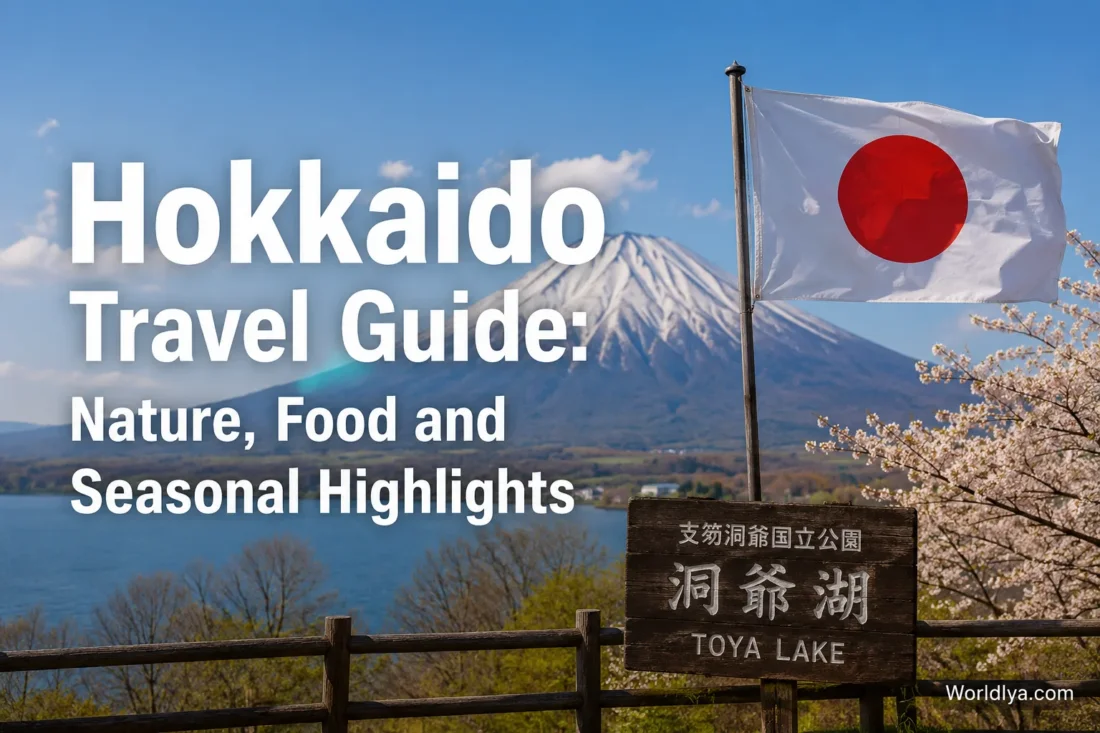
Hokkaido rewards travelers who choose a season before choosing a route. Japan’s northernmost main island changes character through the year: spring arrives late, summer opens the highlands and flower country, autumn moves through the mountains in waves of color, and winter reshapes roads, lakes, forests, and towns with deep snow. The island also asks for a slower pace. Distances are wide, weather can differ sharply between regions, and a good trip usually feels better with fewer bases and longer stays rather than a race across the map.
Choose Hokkaido By Travel Style
Nature First
Build around Shiretoko, Daisetsuzan, Akan-Mashu, Kushiro wetlands, Lake Shikotsu, or the northern islands.
Food First
Pair Sapporo, Otaru, Hakodate, Asahikawa, Obihiro, and Kushiro with markets, ramen, seafood, dairy, and farm produce.
Season First
Use blossoms, lavender, autumn foliage, or snow as the main thread, then select two or three nearby regions.
Why Hokkaido Feels Different From The Rest Of Japan
Hokkaido is Japan’s second-largest island and forms the country’s northernmost prefecture. Its scale changes everyday travel decisions. A place that looks close on a small map may still require a long train ride, a highway journey, or a domestic flight. That space is also part of the appeal. Between cities, the scenery opens into farmland, volcanic plateaus, wetlands, caldera lakes, forested mountains, and long stretches of coast.
The island has seven national parks, each with a different landscape. Shiretoko brings together coastal cliffs, mountains, forests, and sea-ice ecology. Daisetsuzan is high, alpine, and built for hikers who respect fast-changing mountain weather. Akan-Mashu centers on volcanoes, forests, and caldera lakes. Kushiro-Shitsugen protects a vast wetland crossed by a winding river. Shikotsu-Toya combines lakes, volcanic landforms, hot springs, and easy access from Sapporo. Rishiri-Rebun-Sarobetsu has island trails and northern coastal scenery. Hidaka-sanmyaku-Erimo-Tokachi stretches through a rugged mountain and coastal zone.
| Trip Choice | Best Match | Planning Note |
|---|---|---|
| First Visit | Sapporo, Otaru, Lake Shikotsu or Noboribetsu | Easy balance of city food, day trips, and nature |
| Summer Landscapes | Furano, Biei, Daisetsuzan | Reserve transport and stays early for flower season |
| Wildlife and Wetlands | Kushiro, Akan-Mashu, Shiretoko | Allow several nights and use local guides where required |
| Winter Snow | Sapporo, Niseko, Rusutsu, Furano, eastern Hokkaido | Leave room for weather-related changes |
| Food-Led Route | Sapporo, Otaru, Hakodate, Obihiro, Kushiro | Mix markets with neighborhood restaurants and regional dishes |
Hokkaido By Season
Spring: Late Blossoms and A Gentle Return To Green
Spring arrives later in Hokkaido than in much of Japan. Cherry blossoms commonly begin in southern Hokkaido in late April, then appear around Sapporo and northern areas during May. Eastern Hokkaido can bloom later still. The exact timing changes every year, so a blossom-focused trip should be built around updated forecasts rather than fixed calendar promises.
Hakodate and Matsumae are natural spring choices. Around Hakodate, parks, waterfront walks, markets, and nearby Onuma can fit into a relaxed stay. Sapporo also works well in May, when city parks begin to green and day trips become easier. In mountain areas, snow may remain even while lower towns feel like spring, which creates striking views but also means some high trails and seasonal roads may not yet be open.
- Choose spring for: later cherry blossoms, quieter outdoor travel, asparagus, early farm produce, and snow-capped mountain backdrops.
- Pack: layers, a wind-resistant outer shell, and shoes that can handle wet ground.
- Watch for: seasonal road openings, lingering snow, and large temperature swings between morning and afternoon.
Summer: Flower Fields, Hiking and Long Outdoor Days
Summer is the easiest season for a broad nature itinerary. Furano and Biei become the center of many first-time routes, with rolling fields, farm roads, flower gardens, ponds, and views toward the Tokachi mountain range. Lavender can be seen from June into August across the Furano area, while many well-known fields reach their strongest display in July. Blooming dates still vary by variety, altitude, and weather.
Daisetsuzan is a stronger match for travelers who want mountain walks rather than only flower stops. Ropeways provide access to higher terrain in some areas, but even popular routes require proper footwear, weather checks, and an honest look at fitness. Eastern Hokkaido is cooler and more spacious. Kushiro wetlands, Lake Akan, Lake Mashu, Lake Kussharo, and the Shiretoko Peninsula can fill a full week without feeling repetitive.
Summer Planning Tip: Hokkaido is often cooler than central and southern Japan, but it is not cold everywhere. Inland areas can become warm during the day, while eastern coasts and mountain zones may feel much cooler. Pack for contrast rather than one fixed temperature.
Autumn: Early Mountain Color and Harvest Season
Autumn begins early in Hokkaido’s high country. Daisetsuzan is known for some of Japan’s earliest seasonal color, with change often starting in the mountains during September. The display then moves through lower elevations and cities during October. By November, many northern and mountain areas are already moving toward winter.
This is an excellent season for travelers who prefer walking, scenic drives, hot springs, and regional food without building the whole trip around snow. Jozankei is an easy autumn outing from Sapporo. Biei’s fields shift from summer flowers to harvest colors. Lake Onneto, Akan-Mashu, Shiretoko, and the forested valleys of Daisetsuzan offer deeper nature routes, though timing differs across the island.
- Choose autumn for: foliage, harvest menus, cooler walking weather, hot springs, and clearer views on many days.
- Plan carefully in: Daisetsuzan, where private-car controls and shuttle arrangements may apply during busy foliage periods.
- Pack: warm layers, gloves for mountain mornings, and rain protection.
Winter: Powder Snow, Frozen Landscapes and Warm Food
Winter is not one experience. Around Niseko, Rusutsu, Furano, and other ski areas, snow sports shape the trip. Sapporo offers a city base with winter food, parks, nearby slopes, and rail access to Otaru. Eastern Hokkaido feels different again, with frozen lakes, snow-covered wetlands, red-crowned cranes, and seasonal experiences linked to sea ice.
For most snow travelers, December through March is the most dependable period, while some resorts open earlier or continue into spring depending on altitude and snow. Winter plans need more breathing room than summer plans. Roads may be slow, visibility can change, and a transfer that looks simple on paper may take longer in real conditions.
Do not treat ordinary shoes as winter shoes. Insulated footwear with a strong grip makes city walking safer and more comfortable. In remote areas, guided outings are often the sensible choice, especially for frozen surfaces, wildlife zones, or routes affected by deep snow.
Where To Go For Nature
Sapporo, Lake Shikotsu and The Volcanic Southwest
Sapporo is more than an arrival city. It is a useful base for travelers who want good public transport, a wide restaurant choice, parks, museums, and day trips. Otaru sits close enough for a separate overnight or a day trip, while Jozankei adds a forested hot-spring setting within reach of the city.
South of Sapporo, Shikotsu-Toya National Park connects clear lakes, volcanic scenery, hot springs, and walking routes. Lake Shikotsu suits a quiet nature break near New Chitose Airport. Noboribetsu is better for travelers who want geothermal landscapes and an onsen stay. Lake Toya works well when a lakeside atmosphere matters more than city access.
Furano, Biei and Daisetsuzan
Furano and Biei are often grouped together, yet they offer different rhythms. Furano is the practical center for lavender fields, farm visits, local food, and access toward mountain areas. Biei is known for rolling agricultural scenery, viewpoint roads, and the Blue Pond area. A car offers more freedom, though seasonal buses and trains can support a carefully planned public-transport trip.
Daisetsuzan deserves its own time. It is not a brief add-on for serious hiking. Weather changes quickly, trail conditions vary, and autumn arrives early at altitude. Travelers who do not want long hikes can still enjoy ropeway areas, hot-spring settlements such as Sounkyo or Asahidake Onsen, and shorter walks chosen for the day’s conditions.
Kushiro Wetlands, Akan-Mashu and Eastern Lakes
Eastern Hokkaido is for travelers who value open space and patient observation. Kushiro-Shitsugen National Park protects Japan’s largest marsh, with observatories, boardwalks, river scenery, and seasonal wildlife viewing. The landscape can look quiet at first, then reveal more as the light changes or birds move across the wetlands.
Akan-Mashu National Park adds caldera lakes, forests, volcanic terrain, and hot springs. Lake Mashu is usually viewed from observation points, while Lake Kussharo has a broader lakeside setting. Lake Akan combines nature with visitor services and opportunities to learn about Ainu culture in a respectful setting. A two- or three-night stay makes more sense than trying to cover the whole area in one rushed day.
Shiretoko Peninsula
Shiretoko is one of Hokkaido’s strongest choices for coastal wilderness. Forests, waterfalls, mountains, cliffs, lakes, and marine ecology meet in a narrow peninsula. The most satisfying visits usually use Utoro or Rausu as a base and join local experiences suited to the season.
Access rules around the Shiretoko Five Lakes change with wildlife conditions and season. Elevated boardwalks may be available when ground-level trails require a guide or a safety lecture. This is not an inconvenience to work around. It is part of visiting a living habitat where brown bears are present. Follow current park instructions, keep food controlled, and never approach wildlife.
Hakodate, Onuma and Southern Hokkaido
Hakodate blends a walkable port city with markets, hillside views, older streets, and easy access to southern landscapes. Onuma Quasi-National Park is the natural companion, with lakes, small islands, walking paths, cycling, and seasonal views toward Mount Komagatake. This pairing suits travelers who want nature without giving up city comfort.
Rishiri, Rebun and The Far North
Rishiri and Rebun reward travelers who accept longer transfers. Rishiri is shaped by its central volcanic mountain and coastal road, while Rebun is known for walking routes and alpine plants that grow at unusually low elevations because of the northern climate. Ferry schedules, wind, and weather matter, so island plans should include a buffer day whenever possible.
What To Eat In Hokkaido
Hokkaido food is not one menu repeated across the island. Cold seas, dairy farming, wheat fields, vegetable production, and local cooking traditions give each area its own strengths. The most useful approach is simple: eat the dish where it belongs, then leave room for seasonal produce that may not appear on a famous-food list.
| Food | Where It Fits Best | What To Expect |
|---|---|---|
| Seafood Rice Bowls | Hakodate, Otaru, Sapporo, Kushiro, coastal towns | Seasonal fish and shellfish served over rice |
| Soup Curry | Sapporo | A light, spiced broth with vegetables and a choice of protein |
| Miso Ramen | Sapporo | Rich miso-based soup, often paired with firm wavy noodles |
| Salt Ramen | Hakodate | A clear, lighter-looking broth with a clean savory taste |
| Soy-Sauce Ramen | Asahikawa | A soy-sauce base often combining pork and seafood notes |
| Jingisukan | Sapporo and across Hokkaido | Lamb and vegetables cooked on a domed grill |
| Butadon | Obihiro and Tokachi | Grilled pork glazed with a sweet-savory sauce over rice |
| Dairy Desserts | Furano, Tokachi, Sapporo, farm regions | Soft serve, cheese, milk, butter, and baked sweets |
| Seasonal Produce | Farm shops and roadside stations | Asparagus, corn, melon, potatoes, pumpkins, and berries by season |
Seafood Changes With Place and Season
Sea urchin, crab, scallops, salmon roe, shrimp, squid, surf clam, and many kinds of fish appear across Hokkaido, but availability and condition change through the year. Summer is well known for sea urchin in areas such as Rishiri, Rebun, and Shakotan, while Hakodate is closely linked with squid. Markets are useful for seeing what is actually in season rather than ordering from a fixed mental checklist.
Morning markets in Hakodate, Otaru, Sapporo, Kushiro, and Wakkanai are popular stops. Go early for the widest choice, but do not assume every stall or restaurant follows the same hours. Some businesses close once the day’s stock is sold.
Ramen Tells A Regional Story
Sapporo miso ramen, Hakodate salt ramen, and Asahikawa soy-sauce ramen are the best-known regional styles. They are not rigid rules. Restaurants add their own broths, noodles, fats, toppings, and local ingredients. Trying one bowl in each city turns a familiar Japanese dish into a map of Hokkaido’s climate and local taste.
Farm Food Deserves Equal Time
It is easy to focus only on seafood, yet inland Hokkaido is one of Japan’s major farming regions. Fresh corn in summer can be remarkably sweet. Asparagus marks spring. Melons, potatoes, pumpkins, wheat, beans, cheese, butter, and ice cream appear in farm restaurants, bakeries, station shops, and roadside stops. A simple lunch made from local vegetables may be as memorable as a famous seafood bowl.
How To Build A Hokkaido Route
The easiest way to plan Hokkaido is to choose one anchor region, add one neighboring region, and protect time for weather. Trying to connect Sapporo, Hakodate, Furano, Shiretoko, Kushiro, and Niseko in a short visit creates more transit than travel.
Four To Five Days
- Sapporo as the main base
- Otaru as a day trip or overnight
- One nature stay at Lake Shikotsu, Jozankei, or Noboribetsu
Seven To Nine Days
- Sapporo and Otaru
- Furano and Biei in summer
- Lake Shikotsu, Noboribetsu, or Lake Toya
- One slower day for food or weather
Ten To Fourteen Days
- Central Hokkaido plus one distant region
- Eastern route through Kushiro, Akan-Mashu, and Shiretoko
- Southern route through Hakodate and Onuma
- Far-north route with Rishiri or Rebun
Three Route Patterns That Work
- City, Coast and Hot Springs: Sapporo, Otaru, Jozankei or Noboribetsu. This route works in every season and needs little backtracking.
- Flowers, Farms and Mountains: Asahikawa, Biei, Furano, and Daisetsuzan. It is strongest from early summer through autumn.
- Wetlands, Lakes and Wildlife: Kushiro, Akan-Mashu, and Shiretoko. It needs more time, but the landscape changes smoothly from marsh to caldera country and coast.
Getting Around Hokkaido
By Train
JR trains connect New Chitose Airport with Sapporo and link major cities such as Otaru, Asahikawa, Hakodate, Obihiro, and Kushiro. Rail is comfortable for city-to-city travel, but it does not reach every national park, rural viewpoint, or trailhead. Some services are limited, and reserved seats can be helpful during busy travel periods.
Rail passes can save money on a route with several longer journeys, but they are not automatically the cheapest choice. Compare the pass area and validity period with the trips you will actually take. A pass designed for Sapporo, Furano, and Asahikawa is not useful for a route centered on eastern Hokkaido.
By Car
A rental car gives the most freedom in Biei, Furano, Tokachi, Akan-Mashu, Shiretoko, and many coastal areas. It is especially useful when accommodation, viewpoints, and restaurants are spread out. Yet a car also adds responsibility. Driving times can be long, fuel stations may be sparse in rural areas, and wildlife can enter roads.
Winter driving requires snow experience, flexible timing, and full attention to forecasts and road information. Travelers who are not comfortable on snow and ice will often enjoy the trip more by using trains, buses, hotel transfers, or guided tours.
By Bus and Domestic Flight
Buses fill many gaps between railway stations, hot-spring towns, airports, and nature areas. Frequency can be low, so check the return trip before leaving the station. Seasonal buses may operate only during flower, hiking, foliage, or ski periods.
Domestic flights are useful when joining distant regions. Airports at New Chitose, Hakodate, Asahikawa, Kushiro, Memanbetsu, Obihiro, Wakkanai, and other locations can turn a full day of overland travel into a shorter transfer. The trade-off is less flexibility if weather affects flight operations.
What To Pack
| Season | Useful Clothing | Do Not Forget |
|---|---|---|
| Spring | Layers, light insulated jacket, rain shell | Water-resistant shoes and a warm morning layer |
| Summer | Breathable clothes, light fleece, rain shell | Sun protection and a layer for cool coasts or mountains |
| Autumn | Warm layers, windproof outer layer | Gloves and a hat for high elevations |
| Winter | Insulated coat, thermal base layers, warm socks | Grippy winter footwear, gloves, and neck protection |
Outdoor trips also need a charged phone, offline map access, water, and enough food for the route. In remote areas, tell someone where you are going and check the latest park or trail information. A sunny morning in town does not guarantee stable weather in the mountains.
Travel With Care In Natural Areas
- Stay on marked routes. Alpine plants and wetland vegetation can be damaged by a few careless steps.
- Follow wildlife instructions. Keep distance, store food properly, and never feed animals.
- Use guides when rules or conditions call for them. This is especially relevant in bear habitat, on frozen surfaces, and on unfamiliar winter terrain.
- Carry out what you carry in. Waste facilities may be limited in parks and rural stops.
- Respect farms and private land. Scenic fields are working landscapes, not open walking areas.
- Check current access. Trails, roads, boardwalks, ropeways, ferries, and seasonal buses can change with weather or maintenance.
A better Hokkaido trip is often a smaller Hokkaido trip. Two regions explored with time for weather, local meals, and unplanned stops usually deliver more than five regions linked by constant transfers.
Frequently Asked Questions
How Many Days Are Enough For Hokkaido?
Four or five days can cover Sapporo, Otaru, and one nearby nature or hot-spring area. Seven to nine days allow a second region such as Furano-Biei or southern Hokkaido. Ten days or more is better for eastern Hokkaido, Shiretoko, or the far north.
Which Month Is Best For A First Visit?
June, July, September, and early October are easy choices for outdoor travel, though each has a different feel. July suits flower fields, September works well for hiking and early mountain color, and October is stronger for lower-elevation foliage. Winter visitors should choose January or February for a snow-centered trip and accept colder conditions.
Is A Rental Car Necessary?
No. Sapporo, Otaru, Hakodate, Asahikawa, and several major routes work well by train. A car becomes more useful in Biei, Furano, Tokachi, Akan-Mashu, Shiretoko, and rural coastal areas. In winter, public transport may be the better choice for drivers without snow experience.
Can Sapporo Be Used As A Base For The Whole Trip?
Sapporo is excellent for Otaru, Jozankei, nearby ski areas, and some trips toward Lake Shikotsu. It is not a practical daily base for Hakodate, Furano, Kushiro, or Shiretoko. Overnight stays reduce backtracking and create more time at each destination.
When Does Lavender Bloom In Furano?
Lavender can be seen from June into August, depending on the field and variety. Many well-known displays are strongest in July. Check current flowering reports before fixing a trip around one exact week.
What Food Should A First-Time Visitor Try?
Start with a seasonal seafood bowl, soup curry in Sapporo, one regional ramen style, Jingisukan, dairy desserts, and fresh farm produce. Add butadon in Obihiro or local seafood specialties when the route reaches those regions.
Sources
- Japan National Tourism Organization: Hokkaido Destination Information
- Hokkaido Tourism Organization: Hokkaido Travel Basics
- Hokkaido Tourism Organization: Summer Travel Information
- Hokkaido Tourism Organization: Autumn Travel Information
- Hokkaido Tourism Organization: Winter Travel Information
- Ministry Of The Environment: Shiretoko National Park
- Ministry Of The Environment: Kushiro-Shitsugen National Park
- Ministry Of The Environment: Akan-Mashu National Park
- JR Hokkaido: Travel and Route Information