
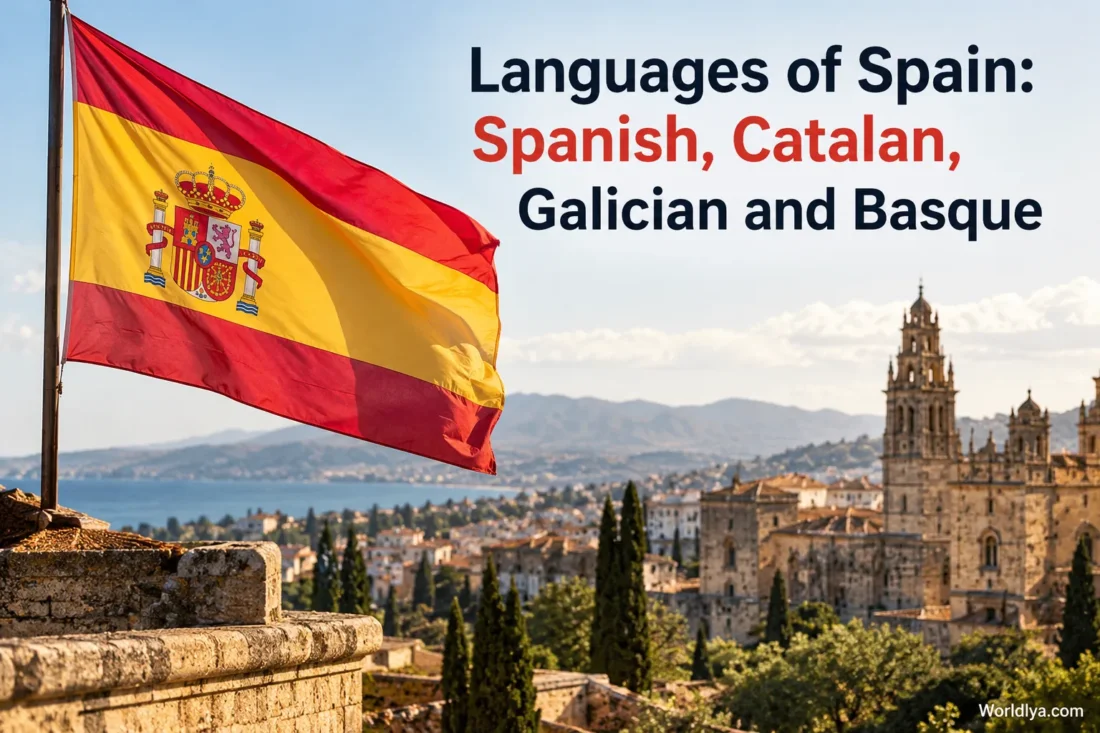
Spain is often introduced as a Spanish-speaking country, but that description leaves out much of what visitors actually see and hear. Spanish is the official language throughout the country, while Catalan, Galician and Basque also have official status in specific regions. Walk through Barcelona, Santiago de Compostela or Bilbao and the difference becomes visible on street signs, public transport, menus, schools, local websites and everyday conversations. These languages are not decorative regional variations. They are living languages used at home, at work and in public life.
How Spain’s Main Languages Fit Together
The easiest starting point is to separate national official status from regional co-official status. Spanish, called castellano in Spain’s Constitution, is official throughout Spain. Other Spanish languages can also be official within autonomous communities under their regional statutes.
That means a person in Galicia, Catalonia or the Basque Country may live in a place where two official languages are part of ordinary public life.
Spanish, Catalan, Galician and Basque Side By Side
| Language | Local Name | Language Family | Main Areas In Spain | Official Position |
|---|---|---|---|---|
| Spanish | Español / Castellano | Romance | Throughout Spain | Official throughout the country |
| Catalan | Català | Romance | Catalonia and the Balearic Islands | Co-official with Spanish in those communities |
| Galician | Galego | Romance | Galicia | Co-official with Spanish in Galicia |
| Basque | Euskara | Language isolate | Basque Country and part of Navarre | Co-official with Spanish in the Basque Country and the Basque-speaking zone of Navarre |
Three of the four languages in the table—Spanish, Catalan and Galician—developed from Latin and belong to the Romance language family. Basque is the exception. It is not a Romance language and has no demonstrated genealogical relationship with another living language.
Spanish Across The Whole Country
Spanish works across Spain. A visitor can use it in Madrid, Seville, Valencia, Barcelona, A Coruña, Bilbao, Palma and elsewhere. Regional languages do not replace Spanish at the national level.
You will also encounter two names for the language: Spanish and Castilian. In Spanish, these appear as español and castellano. The Spanish Constitution uses castellano when identifying the official language of the state, while español is also widely used in everyday speech and internationally.
Spanish spoken in Spain is not uniform. Pronunciation, rhythm and vocabulary vary from one region to another, just as English changes between cities and countries. These differences do not turn regional Spanish varieties into separate languages.
Useful distinction: Hearing Spanish in Catalonia, Galicia or the Basque Country does not tell you that the regional language is absent. Many communities are multilingual, and the language used can change with the setting, speaker or conversation.
Catalan In Catalonia and The Balearic Islands
Catalan, locally called català, is a Western Romance language descended from Latin. In Spain, it is co-official with Spanish in Catalonia and the Balearic Islands. It is used in education, local administration, publishing, television, radio, cultural life and ordinary conversation.
A visitor to Barcelona, Girona, Tarragona, Lleida, Mallorca, Menorca or Ibiza can therefore encounter Catalan before speaking to anyone. Railway displays, museum information, notices, websites and menus often make the multilingual setting immediately obvious.
What Written Catalan Looks Like
Catalan can look familiar to anyone who knows another Romance language, yet several spelling patterns stand out. Look for combinations such as ny, ll and the distinctive l·l, known as the geminated L. Words such as carrer, plaça, gràcies, sortida and benvinguts can quickly reveal that a text is Catalan rather than Spanish.
- carrer — street
- plaça — square
- sortida — exit
- gràcies — thank you
- bon dia — good morning
A naming detail worth knowing: in the Valencian Community, the co-official regional language is officially called Valencian or valencià. Visitors may therefore encounter valencià on local government, educational and cultural material rather than the word català.
Galician In Spain’s Northwest
Galician, or galego, is the co-official language of Galicia alongside Spanish. It developed from the Latin spoken in the northwest of the Iberian Peninsula and belongs to the Romance family.
If you arrive in Santiago de Compostela, A Coruña, Vigo, Lugo, Ourense or another Galician community, you may see Galician on municipal signs, public notices, cultural material and local media. It is also used in schools and public administration.
Why Galician Can Look Familiar
Galician shares many historical and linguistic connections with the other Romance languages of the western Iberian Peninsula. To someone who knows Spanish or Portuguese, parts of a Galician sentence may look recognizable, but Galician has its own standard spelling, grammar and vocabulary.
Some everyday words make it easier to spot:
- rúa — street
- grazas — thank you
- bo día — good day
- saída — exit
- benvido / benvida — welcome
The letter x is also visually noticeable in many Galician words and place names. Standard Galician uses letters such as ñ and combinations including ll, while accents mark stress or distinguish particular forms.
Basque Is Different From The Romance Languages
Basque is called Euskara in the language itself. Its linguistic background makes it stand apart immediately: Basque does not descend from Latin and is not part of the Indo-European language family. Linguists have not established a proven genealogical relationship between Basque and another living language.
It is co-official with Spanish throughout the Basque Country. In Navarre, Spanish is official throughout the autonomous community, while Basque has co-official status in the legally defined Basque-speaking zone.
What Makes Written Basque Easy To Notice
Basque uses the Latin alphabet, but its word shapes often look very different from Spanish, Catalan and Galician. Letter combinations such as tx, tz and ts appear frequently enough to be useful visual clues.
- kaixo — hello
- egun on — good morning
- eskerrik asko — thank you
- mesedez — please
- bai — yes
- ez — no
- agur — goodbye
Basque vocabulary is generally less immediately recognizable to speakers of Romance languages. That difference makes bilingual signs particularly useful: seeing the Spanish and Basque versions together can help a visitor identify which language is which within minutes.
Where Each Language Has Official Status
| Part Of Spain | Official Languages Visitors May Encounter |
|---|---|
| Most autonomous communities | Spanish |
| Catalonia | Spanish and Catalan; Aranese also has official status, with its traditional area in the Aran Valley |
| Balearic Islands | Spanish and Catalan |
| Valencian Community | Spanish and Valencian |
| Galicia | Spanish and Galician |
| Basque Country | Spanish and Basque |
| Navarre | Spanish throughout Navarre; Basque is also official in the Basque-speaking zone |
This regional pattern explains why two trips within Spain can feel linguistically different even when Spanish remains available in both places.
How To Recognize Each Language On A Sign
Spanish
Look for familiar forms such as calle, salida, gracias, bienvenido and ayuntamiento.
Catalan
Words such as carrer, sortida, gràcies and spellings with ny or l·l are useful clues.
Galician
Watch for rúa, saída, grazas, galego and other forms that may resemble both Spanish and Portuguese while remaining distinctly Galician.
Basque
Look for forms such as euskara, kaixo, eskerrik asko and frequent combinations including tx, tz and ts.
Useful Words In All Four Languages
You do not need to learn four languages before traveling around Spain. A few local words, though, make signs easier to decode and help connect a language name with the language you are hearing.
| English | Spanish | Catalan | Galician | Basque |
|---|---|---|---|---|
| Hello | Hola | Hola | Ola | Kaixo |
| Good Morning | Buenos días | Bon dia | Bo día | Egun on |
| Thank You | Gracias | Gràcies | Grazas | Eskerrik asko |
| Please | Por favor | Si us plau | Por favor | Mesedez |
| Yes | Sí | Sí | Si | Bai |
| No | No | No | Non | Ez |
| Goodbye | Adiós | Adéu | Adeus | Agur |
Why Place Names Can Change With The Language
One of the first surprises for travelers is seeing a place referred to by more than one name. Different languages can have different forms for the same city, district, road or geographic feature.
You may encounter pairs such as Donostia / San Sebastián or hear both Girona and Gerona in different-language contexts. Galicia also has place names whose Galician forms differ from traditional Spanish forms. The name used on an official road sign may therefore differ from the version found in an older English-language book or travel document.
This is less confusing once you recognize the language around the name. If a station display contains words such as sortida, you are probably reading Catalan. If nearby text includes eskerrik asko, the language is Basque.
Language Use In Schools and Public Life
Co-official status is visible beyond street signs. Catalan, Galician and Basque are used within education and public administration in their respective official territories. The exact balance between languages varies by autonomous community, educational model, institution and local setting.
That is why two bilingual regions do not necessarily look identical in daily life. One school system may use a regional language extensively as a teaching language, while another region can organize language use differently. Public websites may let users switch languages, local forms may be bilingual, and cultural institutions commonly publish material in the regional language.
For visitors, the practical point is simple: seeing a language other than Spanish on an official sign is normal in several parts of Spain.
Four Common Language Mix-Ups
- Catalan is not a form of modern Spanish. Both are separate Romance languages that developed from Latin.
- Galician is not simply Spanish spoken with a regional accent. It is a separate Romance language with its own standard form.
- Basque is not a Romance language. Its known linguistic ancestry is separate from Spanish, Catalan and Galician.
- Spanish remains official throughout Spain. Regional co-official languages add to Spain’s linguistic landscape rather than removing Spanish from those territories.
Spain Has More Linguistic Variety Than Four Names Suggest
Spanish, Catalan, Galician and Basque are the four language names visitors are most likely to encounter when reading a broad overview of Spain, but they do not describe every linguistic tradition in the country.
Aranese, a variety of Occitan traditionally spoken in the Aran Valley, has official status there within Catalonia. Other regional languages and varieties also receive different forms of recognition or protection in their traditional areas.
This matters because Spain’s language map is better understood as a set of overlapping local realities rather than a simple “one country, one language” pattern.
Which Language Should A Visitor Use?
If you speak Spanish, you already have a language that can be used throughout Spain. There is no need to assume that arriving in Catalonia, Galicia or the Basque Country requires fluency in another language.
Still, recognizing the local language makes travel easier. You can identify whether sortida, saída or another word means “exit,” understand why a city appears under different names, and make sense of bilingual displays without wondering whether you have crossed into another country.
The simplest way to remember Spain’s language map: Spanish is official nationwide; Catalan is co-official in Catalonia and the Balearic Islands; Galician is co-official in Galicia; Basque is co-official in the Basque Country and the Basque-speaking zone of Navarre. The Valencian Community uses the official regional name Valencian, while Aranese also has official status in its traditional area in Catalonia.
Sources
- Boletín Oficial del Estado — Spanish Constitution, Article 3
- Ministry of Education, Vocational Training and Sports — Co-Official, Regional and Minority Languages
- Government of Catalonia — Catalan As A Romance Language
- Xunta de Galicia — Legal Status Of The Galician Language
- Xunta de Galicia — Origin and History Of Galician
- Basque Government — Statute Of Autonomy and Official Status Of Euskara
- Basque Government — Origin and Linguistic Relationships Of Euskara