
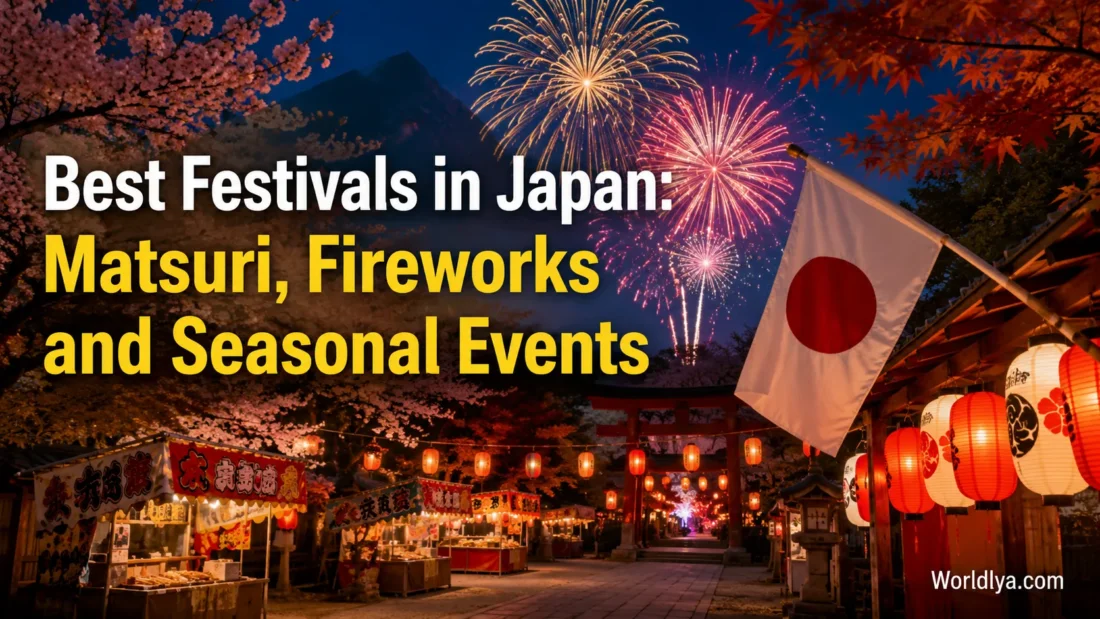
Japan’s festival calendar changes with the landscape. Snow sculptures fill northern city streets in February, flower-linked processions arrive in spring, lanterns and drums take over summer evenings, and illuminated floats roll through cool autumn nights. These events are not interchangeable attractions. Each one reflects a particular city, season, shrine, craft tradition, or style of community celebration. Pick the right festival and you do more than watch a parade—you see how a place expresses itself.
For a first visit, start with the experience you want. Choose Kyoto’s Gion Matsuri for monumental floats and a month of related events, Aomori Nebuta for glowing sculptural lanterns, Tokushima’s Awa Odori for street dancing, or Omagari Hanabi for fireworks judged as artistic performances. Winter travelers have an entirely different choice: Sapporo turns snow and ice into an open-air exhibition across several city districts.
Choose Your Festival Mood
- For grand traditional floats: Gion Matsuri, Takayama Festival, or Chichibu Night Festival.
- For dance and audience energy: Awa Odori.
- For illuminated art: Aomori Nebuta, Akita Kanto, or Sapporo Snow Festival.
- For fireworks: Nagaoka, Omagari, Sumida River, or Lake Toya.
- For a gentle historical procession: Aoi Matsuri or Jidai Matsuri in Kyoto.
- For families: Sendai Tanabata, Sapporo Snow Festival, or a daytime float display before an evening parade.
Japan Festival Calendar for 2026
The fixed-date festivals below are easier to place into a trip. Flower events and some local celebrations may shift with seasonal conditions. Fireworks can also be rescheduled when weather affects the venue. Treat the dates as a planning base, then confirm the official schedule before booking transport or reserved seating.
| Festival | Location | 2026 Timing | Main Experience |
|---|---|---|---|
| Sapporo Snow Festival | Sapporo, Hokkaido | February 4–11 | Snow sculptures, ice art, evening illumination |
| Takayama Spring Festival | Takayama, Gifu | April 14–15 | Historic floats, puppetry, old-town streets |
| Aoi Matsuri | Kyoto | May 15 | Formal procession in historical dress |
| Gion Matsuri | Kyoto | July 1–31; main float processions July 17 and 24 | Monumental yamahoko floats and evening street displays |
| Tenjin Matsuri | Osaka | July 24–25 | Land procession, river procession, fireworks |
| Sumida River Fireworks Festival | Tokyo | July 25 | Large urban river fireworks display |
| Aomori Nebuta Festival | Aomori | August 2–7 | Giant illuminated nebuta floats and dancers |
| Nagaoka Fireworks Festival | Nagaoka, Niigata | August 2–3 | Wide riverbank fireworks program |
| Akita Kanto Festival | Akita | August 3–6 | Lantern poles balanced by skilled performers |
| Sendai Tanabata Festival | Sendai, Miyagi | August 6–8; fireworks August 5 | Long paper streamers and decorated shopping arcades |
| Awa Odori | Tokushima | August 12–15 | Group dancing, music, and street performances |
| Omagari National Fireworks Competition | Daisen, Akita | August 29 | Daytime and evening competition fireworks |
| Nagasaki Kunchi | Nagasaki | October 7–9 | Rotating neighborhood performances and floats |
| Takayama Autumn Festival | Takayama, Gifu | October 9–10 | Autumn float processions and evening lanterns |
| Jidai Matsuri | Kyoto | October 22 | Large historical costume procession |
| Chichibu Night Festival | Chichibu, Saitama | December 2–3 | Illuminated floats, music, and winter fireworks |
What Matsuri Means in Japan
Matsuri is usually translated as “festival,” yet the word covers many kinds of events. Some are linked to a shrine or temple. Others grew around seasonal customs, local performing arts, snow, flowers, dance, or fireworks. A matsuri may last one afternoon, several nights, or an entire month.
You will often see a mikoshi, a portable shrine carried through the neighborhood. Large wheeled floats have regional names such as yama, hoko, yatai, or danjiri. Summer events commonly include yatai food stalls, taiko drums, flutes, festival coats, and light cotton yukata. The details change from one region to another, which is precisely why visiting more than one matsuri never feels repetitive.
A useful rule: do not choose only by fame. Choose by the visual experience, time of year, city route, and level of participation that fit your trip.
Best Spring Festivals in Japan
Takayama Spring Festival: Craftsmanship in Motion
Takayama’s spring celebration takes place on April 14 and 15 in the old town of Gifu Prefecture. Its decorated yatai floats are built with detailed woodwork, metal fittings, lacquer, textiles, and mechanical puppets. During daylight, you can study the workmanship at close range. When the evening procession runs, lanterns soften the outlines of the floats and the narrow streets become part of the stage.
- Choose it for: traditional craft, compact historic streets, and a slower visual pace than a dance festival.
- Stay for: both daylight display and evening illumination; they feel like two different events.
- Plan around: limited accommodation in central Takayama. Nearby rail-connected towns can widen your options.
Aoi Matsuri: Kyoto in Formal Procession
Held on May 15, Aoi Matsuri offers a quieter rhythm than Kyoto’s summer festival season. The procession moves from Kyoto Imperial Palace toward Shimogamo and Kamigamo shrines. Around 500 participants appear in clothing based on the Heian period, accompanied by ox carts, horses, and attendants.
This is a strong choice when you prefer costume, ceremony, and measured movement over drums and night lighting. Reserved seating can make the long procession easier to follow, while free roadside viewpoints offer more flexibility. Shade, water, and an early arrival make the wait more comfortable.
Best Summer Matsuri in Japan
Summer is the busiest festival season across much of Japan. Evenings bring lantern light, open-air dancing, decorated floats, and fireworks beside rivers or bays. The air can be hot and humid, so the difference between a memorable night and a tiring one often comes down to simple planning: light clothing, water, a small towel, and a route back to your accommodation.
Gion Matsuri: Kyoto’s Month-Long Festival Season
Gion Matsuri runs through July 1–31, so it is better understood as a festival season than a single parade. The best-known events are the Yamahoko Junko float processions on July 17 and July 24. The towering floats carry woven textiles, carved details, metal ornaments, musicians, and teams who guide the wheels through central Kyoto.
The evenings before each procession are called yoiyama. Streets around the float neighborhoods become pedestrian areas, historic houses display treasured screens or objects, and visitors can see the floats from a much shorter distance. For many travelers, these evenings are as rewarding as the procession itself because they reveal the festival’s neighborhood scale.
Best Planning Choice: Allow at least two festival periods in Kyoto—one yoiyama evening and one morning procession. This gives you close detail first, then the full movement of the floats.
Tenjin Matsuri: Osaka by Street and River
Osaka’s Tenjin Matsuri is held on July 24 and 25. Its appeal comes from the change of setting. Processions begin on land around Osaka Tenmangu Shrine, then the focus shifts to boats on the Okawa River. The main evening combines illuminated vessels, music, city lights, and fireworks.
Choose Tenjin Matsuri when you want a festival woven into a modern city rather than separated inside a single venue. The riverbanks offer broad views, but bridges and waterside paths fill early. A reserved viewing area or a location farther from the central launch zone can provide a calmer evening.
Aomori Nebuta Festival: Giant Lantern Art
From August 2 to 7, central Aomori fills with enormous illuminated floats shaped as dramatic figures and scenes. Their painted surfaces are built to glow from within, giving faces, armor, fabric folds, clouds, and waves a sculptural depth that ordinary parade lighting cannot create.
Musicians and haneto dancers move beside the floats. Visitors may be able to join the dance when wearing the required costume, which can be rented or purchased locally. The final day changes the pattern: a daytime procession is followed by an evening marine procession and fireworks at Aomori Bay.
- Choose it for: large-scale illuminated art and an energetic parade route.
- Photograph it from: a position where the float can turn or approach at an angle; the side view reveals its depth.
- Extend the visit: the Nebuta Museum WA RASSE displays festival floats and explains their construction throughout the year.
Akita Kanto Festival: Lantern Poles Above the Street
Akita Kanto runs from August 3 to 6. Performers balance tall bamboo poles hung with rows of paper lanterns, shifting them between hands, shoulders, foreheads, and hips. Seen together along Kanto Odori, the lantern poles resemble glowing stalks moving above the avenue.
This event rewards patience. The visual effect grows as more poles rise at the same time and the sky darkens behind them. Daytime skill demonstrations also make the balancing techniques easier to understand. After the main evening display, designated interaction periods may allow visitors to view equipment and meet participants, depending on the year’s program.
Sendai Tanabata Festival: Streets Filled With Paper Streamers
Sendai celebrates Tanabata from August 6 to 8, with a fireworks event commonly held on August 5. The central shopping arcades are hung with handmade decorations that combine a large paper ornament with long streamers. Walking beneath them is the main experience; this is not a parade that passes once and disappears.
Sendai Tanabata suits travelers who want flexible timing. You can enter the arcades during the day for color and craft detail, return in the evening for illumination, and explore side streets when the main route feels busy. The covered setting also makes the event easier to enjoy during light summer rain.
Awa Odori: Tokushima Becomes a Dance Floor
Awa Odori takes place from August 12 to 15. Dance groups known as ren move through central Tokushima to flutes, drums, shamisen, and bells. Some groups perform with precise choreography; others project a looser street style. The festival’s character comes from that contrast and from the closeness between performers and spectators.
Paid stands give a clear view of scheduled groups, while free street areas feel more spontaneous. Visitors can also look for participation zones or informal dance opportunities. You do not need polished steps. Follow the rhythm, respect staff directions, and let the group set the pace.
Best Fireworks Festivals in Japan
Japanese fireworks events are called hanabi taikai. Many are carefully programmed rather than treated as a short finale. Shell shape, color sequence, timing, music, river width, and viewing distance all affect the experience. Large displays may use reserved zones, ticket lotteries, or assigned seating, so a casual arrival is not always enough.
Sumida River Fireworks: Tokyo’s Classic Urban Display
The Sumida River Fireworks Festival is scheduled for July 25, 2026. Nearly 20,000 fireworks are launched from two areas along the river, with viewing spread through Asakusa and neighboring districts. Tokyo buildings, bridges, river bends, and narrow side streets shape the sightlines, so this feels very different from a broad rural riverbank display.
Arrive with a viewing zone in mind rather than walking toward the loudest sound. Bridges may operate as moving routes, and some riverside sections have access controls. A place slightly farther from the launch area can provide more room to see the full burst pattern.
Nagaoka Fireworks: A Wide Sky Above the Shinano River
Nagaoka holds its major fireworks display on August 2 and 3 each year. The venue stretches along the Shinano River, giving large formations room to open across a broad field of view. The experience is highly organized, and ticketed seating is central to many viewing plans.
Nagaoka works well for travelers who want a full evening program rather than a short city display. Book transport and accommodation early, read the seating map, and note which side of the river connects most easily with your return route. After the final sequence, stations and roads become busy at once.
Omagari Hanabi: Fireworks as Judged Art
The 98th National Fireworks Competition is scheduled for August 29, 2026, at Omagari Hanabi Park in Daisen, Akita Prefecture. Pyrotechnicians compete in defined categories, and the program includes both daytime and evening fireworks. Daytime entries rely on colored smoke, form, and density because bright bursts cannot dominate the sky in the same way.
The evening program tests circular shell construction, freestyle forms, and creative sequences. This makes Omagari the right choice for viewers who notice symmetry, timing, color layers, and the way a display develops as a complete piece. Reserved seating is strongly recommended, and local accommodation often fills long before the event.
Lake Toya Long-Run Fireworks: Flexibility in Hokkaido
Lake Toya offers a different model: short nightly fireworks over an extended season, commonly running from late April through October. Displays move across the lake from a boat, allowing several waterfront hotels and public areas to see the show.
This is a practical choice when a one-night national event does not fit your schedule. Pair the evening display with a lake walk or an overnight stay, then check the current operating calendar and weather notice on the day.
Fireworks Viewing Notes
- Use only official viewing areas and follow barriers around launch zones.
- Bring hearing protection for young children or anyone sensitive to loud sound.
- Carry a small ground sheet only where seating rules allow it.
- Download route maps before arrival; mobile networks can slow when large audiences gather.
- Keep the return journey simple. A direct walk to a quieter station may be easier than changing lines near the main venue.
Best Autumn Festivals in Japan
Takayama Autumn Festival: Lanterns in the Old Town
Takayama’s autumn festival is held on October 9 and 10 around Sakurayama Hachiman Shrine. It shares the city’s celebrated float culture with the spring event, yet the route, shrine connection, seasonal light, and participating floats differ.
Autumn evenings in the Hida region are cooler than summer festival nights, making it easier to remain outside for the lantern procession. Visit the float exhibition in daylight first. Once you understand the carvings and mechanical details, the evening movement becomes far more readable.
Nagasaki Kunchi: Neighborhood Performances With a Distinct Local Style
Nagasaki Kunchi runs from October 7 to 9. Presenting neighborhoods rotate, so the program is not identical every year. Performances may feature large props, decorated boats, dragon dance, music, or choreographed group movement. This rotation keeps the festival closely tied to the districts that prepare each presentation.
Ticketed venues offer complete scheduled performances, while streets and public areas may provide shorter views as groups move between locations. Read the year’s program before choosing a day. A performance that matters most to you may appear at a particular venue or time.
Jidai Matsuri: Kyoto’s Historical Costume Parade
Jidai Matsuri is held on October 22. Around 2,000 participants represent different periods of Kyoto’s history through clothing, equipment, roles, and procession groups. The route begins at Kyoto Imperial Palace and continues toward Heian Jingu Shrine.
This event is easy to appreciate when you choose one stable viewpoint and let the full sequence pass. Look beyond the most ornate costumes: changes in hats, sleeves, armor, carts, and group formation help distinguish the periods represented.
Best Winter Festivals in Japan
Sapporo Snow Festival: A City Built From Snow and Ice
The 2026 Sapporo Snow Festival ran from February 4 to 11 across the Odori, Susukino, and Tsudome sites. Odori Park carries the large snow sculptures and projection displays. Susukino focuses on ice sculpture along a city street. Tsudome adds snow activities suited to families.
Do not try to rush all three areas in one short visit. See Odori in daylight for carved detail, return after dark for illumination, and place Tsudome in a separate daytime slot. Footwear matters more than fashion here: insulated boots with grip, warm socks, gloves, and layered clothing will keep you outside longer.
Chichibu Night Festival: Floats and Fireworks in December
Chichibu Yomatsuri takes place on December 2 and 3 in Saitama Prefecture. Six large decorated floats move through the city to drum and flute music, with the main night on December 3. Winter fireworks rise above the illuminated floats, creating an unusual pairing rarely found in the summer-heavy hanabi season.
Chichibu is reachable from Tokyo, yet the late finish makes the return trip worth planning in advance. Reserved areas, special transport arrangements, and street access can vary. Warm layers and comfortable shoes are essential because much of the experience involves standing outdoors after sunset.
How to Pick the Right Festival for Your Trip
For First-Time Visitors
Choose an event with clear transport, several viewing periods, and strong visitor information. Gion Matsuri, Sapporo Snow Festival, Sendai Tanabata, and Aomori Nebuta all offer more than one chance to understand the event.
For Photographers
Look for depth, movement, and a predictable route. Takayama, Aomori Nebuta, Akita Kanto, and Omagari reward careful viewpoint choice. Reserved photography areas may have separate rules.
For Families
Favor daylight displays, flexible routes, toilets nearby, and easy breaks. Sendai Tanabata, Sapporo’s Tsudome site, Aoi Matsuri, and daytime float exhibitions are easier to pace than a late-night riverbank event.
For Active Participation
Awa Odori offers the clearest dance-centered atmosphere. Aomori Nebuta may allow properly dressed visitors to join as haneto dancers. Follow the current participation rules rather than stepping into a procession uninvited.
For a Short City Break
Sumida River Fireworks, Tenjin Matsuri, Aoi Matsuri, and Jidai Matsuri fit naturally into major-city itineraries. Keep the festival day light so delays in walking routes do not disrupt other reservations.
For a Dedicated Festival Trip
Build the journey around Omagari, Nagaoka, Aomori Nebuta, Takayama, or Chichibu. These events justify advance accommodation, reserved seats, and at least one buffer night.
What to Wear and Bring
- Summer: breathable clothing, water, a small towel, sun protection, and a folding fan. Yukata are welcome but not required.
- Spring and autumn: light layers and a compact rain jacket. Evening temperatures may feel much cooler than midday.
- Winter: insulated footwear with grip, gloves, warm socks, and layers that can be adjusted indoors.
- For every season: a charged phone, offline route map, small bag, portable battery, and cash for stalls that do not take cards.
- For seated events: only bring chairs, cushions, or ground sheets when the organizer permits them.
Festival Etiquette That Makes the Day Easier
- Follow the route direction. Large events may turn bridges, lanes, or station exits into one-way walking routes.
- Keep procession space open. Do not step into the road for a photograph unless staff clearly invite visitors forward.
- Ask before close-up portraits. Wide photographs of a public parade are common, but individual performers and families may prefer privacy.
- Carry your rubbish. Use official collection points or take packaging with you when bins are full.
- Keep tripods out of walking lanes. Some events restrict them entirely or allow them only in assigned photography areas.
- Let local participants lead. Join dances, chants, or float interaction only in areas where participation is welcomed.
Useful Japanese Festival Words
| Word | Meaning | Where You May See It |
|---|---|---|
| Matsuri | Festival | Event names, banners, tourism notices |
| Hanabi | Fireworks | Fireworks programs and venue maps |
| Taikai | Large gathering or event | Hanabi taikai, a fireworks event |
| Mikoshi | Portable shrine | Shrine processions |
| Yatai | Festival stall or, in some regions, a float | Food areas and Takayama float terminology |
| Yukata | Light cotton summer robe | Summer matsuri and fireworks nights |
| Odori | Dance | Awa Odori and other dance events |
| Yoiyama | Festival eve period | Gion Matsuri evenings before processions |
| Junko | Procession | Official schedules and parade descriptions |
| Unten Chushi | Service suspended | Transport notices during weather adjustments |
Common Questions About Festivals in Japan
Do Japanese Festivals Require Tickets?
Many street processions, shrine grounds, and public displays are free to enter. Reserved stands, premium fireworks areas, scheduled performance venues, and photography sections may require tickets. For major events, sales can open months in advance.
Can Visitors Wear Yukata?
Yes. Yukata are commonly worn at summer festivals and fireworks events. Choose comfortable footwear, secure loose sleeves around food or crowds, and use a dressing service when you are unfamiliar with the ties and layers.
Which Festival Is Easiest From Tokyo?
Sumida River Fireworks takes place inside Tokyo. Chichibu Night Festival is reachable from the capital but requires more return planning because the main events continue into the evening. Kyoto, Osaka, Sendai, and Nagaoka are also connected to Tokyo by fast rail services, though an overnight stay is usually more relaxed.
What Is the Best Month for Matsuri?
July and August offer the widest choice of large matsuri and fireworks events. February suits snow festivals, April and May bring formal spring processions, and October offers cooler conditions for float and costume festivals.
Are Festivals Suitable for Children?
Many are, especially daytime displays, shopping-arcade decorations, snow activity sites, and seated processions. For late fireworks or dense parade routes, bring hearing protection, agree on a meeting point, and choose a viewing area with easy access to toilets and transport.
How Early Should I Arrive?
For a neighborhood display or open arcade, one to two hours may be enough. For famous fireworks, reserved-seat entry, or a narrow procession route, arrive several hours early and follow the organizer’s access time. An early arrival also lets you locate exits before the audience grows.
A Japanese festival is easiest to enjoy when you leave space around it. Keep the afternoon flexible, learn the route, and stay long enough to notice how the event changes after sunset. The famous moment may last ten minutes; the character of the matsuri appears in everything around it—the preparations, music, neighborhood displays, food stalls, costumes, and the careful work that brings the procession to the street.
Sources
- Japan National Tourism Organization: Festivals and Events
- Kyoto City Official Travel Guide: Gion Matsuri Festival
- Osaka Official Tourism Information: Tenjin Festival 2026
- Aomori Nebuta Festival Official English Site
- GO TOKYO: Tokyo Fireworks Festival Information
- Nagaoka Fireworks Official Website
- Omagari Hanabi Official Website: National Fireworks Competition
- Hokkaido Official Tourism Site: Sapporo Snow Festival
- Nagasaki Kunchi Official English Site