
Updated: August 19, 2026 What changed?
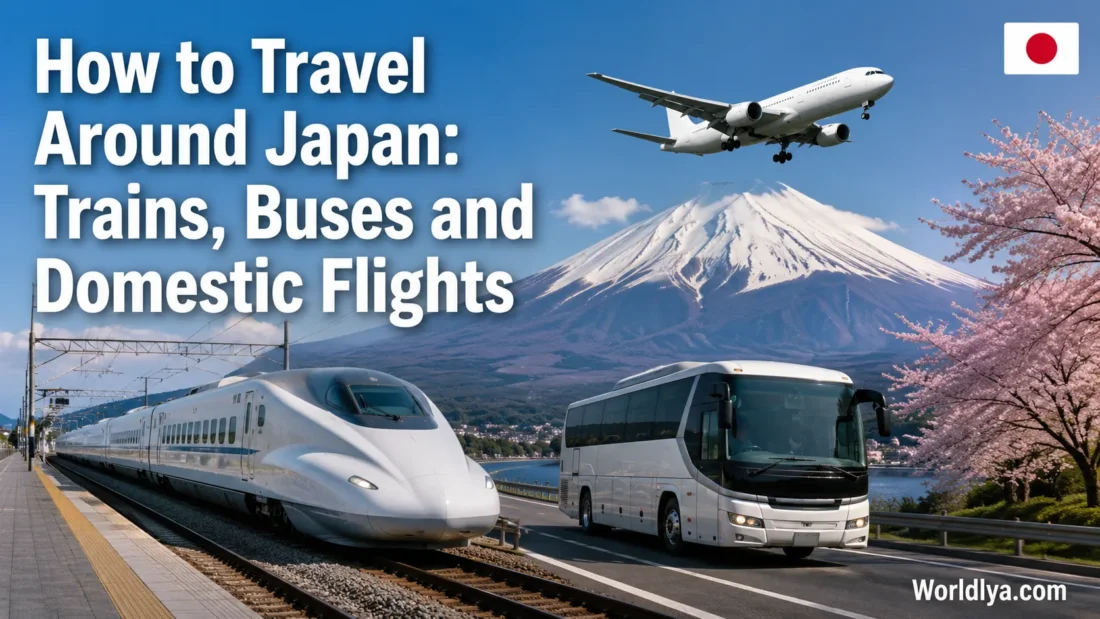
Japan is one of the easiest countries to explore without renting a car. Trains carry you between major cities with clean timing and clear station signs. Buses reach places where rail lines thin out. Domestic flights make long north–south journeys feel lighter, especially when your route includes Hokkaido, Kyushu, Okinawa or several far-apart regions. The real trick is not choosing one transport type and forcing it onto every route. It is knowing when each one quietly makes the trip smoother.
Best Way to Move Around Japan Depends on Your Route
Think of Japan transport like a well-stocked tool drawer. Shinkansen trains are the polished tool you reach for on city-to-city routes. Local trains and subways handle daily movement inside big metro areas. Highway buses work well when price matters or the destination is not served neatly by rail. Domestic flights make sense when distance starts eating into your holiday time.
A simple rule helps: use trains for the classic golden routes, buses for regional pockets and budget nights, and flights for long jumps across the country.
Train, Bus or Flight: Which One Fits Your Route?
Most first-time visitors picture Japan through trains, and that picture is mostly fair. Yet a train-only plan can become expensive or awkward once you add rural valleys, mountain towns, islands or very long cross-country hops. Use the table below as a planning shortcut before you start buying tickets.
| Transport Type | Best For | Feels Right When | Watch For |
|---|---|---|---|
| Shinkansen | Tokyo, Kyoto, Osaka, Hiroshima, Nagoya, Kanazawa and other major rail cities | You want comfort, speed and city-center arrival | Reserved seats and large luggage rules on some lines |
| Local Trains and Subways | Daily city travel, short regional trips, airport access in many cities | You are moving around Tokyo, Osaka, Kyoto, Fukuoka, Sapporo or nearby towns | Rush hours, station exits and platform changes |
| Highway Buses | Budget travel, night trips, towns with less direct rail service | You can trade time for lower cost or easier access | Seat type, luggage policy and departure terminal location |
| Domestic Flights | Hokkaido, Kyushu, Okinawa and long multi-region trips | A train day would swallow too much of your itinerary | Airport transfer time, baggage rules and check-in deadlines |
Traveling Around Japan by Train
Japan’s rail network is not one single thing. It is a layered system. There are Shinkansen bullet trains for fast intercity routes, limited express trains for longer regional journeys, local trains for smaller stops, and subway lines inside large cities. Once you understand that layer cake, stations feel less like a maze.
Shinkansen Works Best Between Major Cities
The Shinkansen is often the cleanest choice for routes such as Tokyo to Kyoto, Tokyo to Osaka, Osaka to Hiroshima, Tokyo to Kanazawa and Tokyo to Sendai. The reason is simple: major stations are usually central, boarding is orderly, and you avoid the extra airport transfer at both ends.
For many travelers, the train day becomes part of the trip rather than dead time. You can buy an ekiben station lunch box, sit by the window and arrive near the city center without waiting at baggage claim. It is not “cheap by default,” but it is often the most balanced choice when comfort and time both matter.
Helpful station habit: arrive early enough to find the right gate, platform and car number without rushing. Large Japanese stations can feel like small indoor cities, especially Tokyo Station, Shinjuku, Shin-Osaka and Kyoto.
Reserved Seats, Non-Reserved Seats and Green Cars
Many Shinkansen services have both reserved and non-reserved seating, while some services may be reservation-only. Reserved seats are better when you travel with family, carry larger bags or move during popular holiday periods. Non-reserved seats can be fine on quieter routes, but you may need to queue and accept whatever is available.
Green Car is the higher-comfort seating class on many JR trains. It usually means wider seats and a calmer cabin. It is not needed for every traveler, but it can be worth considering on longer routes if comfort is a priority.
Large Luggage on Shinkansen Needs a Little Planning
If your bag is very large, do not treat luggage as an afterthought. On some Shinkansen lines, oversized baggage with total outside dimensions over 160 cm should be placed in designated oversized baggage areas or compartments. For the Tokaido, Sanyo, Kyushu and Nishi-Kyushu Shinkansen lines, reserving a seat with oversized luggage space in advance is the safer plan.
Traveling lighter changes the whole mood of the trip. Japan’s coin lockers and luggage forwarding services can make multi-city travel feel less like dragging furniture through a station.
IC Cards Make Local Travel Much Easier
For city travel, an IC card is one of the most useful things you can have. Suica, PASMO, ICOCA and other regional cards work like prepaid tap cards for many trains, subways, buses, vending machines and convenience stores. You tap in, tap out and avoid buying a small paper ticket every time.
Most regions have their own card name, but many IC cards can be used across different parts of Japan. There are exceptions, especially on certain local bus routes or when moving between separate fare areas, so keep a small amount of cash as a backup. It is boring advice, yes. It also saves awkward moments.
Use an IC Card For
- Subway and local train rides
- Many city buses
- Some taxis and shops
- Vending machines and lockers in many stations
Do Not Assume It Covers
- Every rural bus route
- Long-distance Shinkansen fares by itself
- Every private railway add-on ticket
- All airport limousine buses
Should You Buy a Japan Rail Pass?
The Japan Rail Pass can be useful, but it is no longer an automatic purchase for every visitor. It works best when your itinerary includes several long JR train rides within a short period. If your trip is mostly Tokyo, Kyoto and Osaka with slow days in each city, individual tickets or a regional pass may fit better.
The nationwide pass is sold in 7-day, 14-day and 21-day versions. Ordinary class is the standard option. Green class costs more and gives access to Green Car seating on eligible services.
For Exchange Orders purchased on or after October 1, 2026 through designated overseas sales agents, JR has set new prices. The purchase date is based on local time at the place of purchase. Exchange Orders bought by September 30, 2026 keep the earlier price schedule, while JR’s online sales service has its own listed prices.
| Japan Rail Pass Type | 7 Days | 14 Days | 21 Days |
|---|---|---|---|
| Ordinary Adult | 53,000 yen | 84,000 yen | 105,000 yen |
| Green Adult | 74,000 yen | 116,000 yen | 147,000 yen |
| Ordinary Child | 27,000 yen | 42,000 yen | 53,000 yen |
| Green Child | 37,000 yen | 58,000 yen | 74,000 yen |
Important detail: the pass covers most JR lines, but not every train in the same way. For example, using Nozomi or Mizuho services on the Tokaido, Sanyo or Kyushu Shinkansen lines requires a special extra ticket for Japan Rail Pass holders. Always check the exact train type before assuming the pass fully covers the ride.
When the Rail Pass Often Makes Sense
- You will take several long JR train rides within the pass window.
- Your route crosses multiple regions, not just one city pair.
- You want flexible side trips by JR train.
- You prefer one pass over buying many separate long-distance tickets.
When Individual Tickets May Be Better
- You stay mostly in one region, such as Kansai or Tokyo plus nearby day trips.
- Your long-distance travel is limited to one or two rides.
- You plan to use domestic flights for longer hops.
- Your route uses many private railways or buses outside JR coverage.
A Simple Route Test Before Paying For a Pass
Write your long-distance travel days on paper. Not your hotel nights. Not your sightseeing wish list. Only the days when you move between cities.
- Add the likely major train rides inside a 7, 14 or 21-day window.
- Check whether each ride is on JR lines and whether your preferred train type is fully covered.
- Compare the pass cost with separate tickets or a regional pass.
- Choose the pass only if it saves money or gives comfort you actually value.
If the numbers are close, choose the simpler option. A trip should not feel like an accounting exam.
Traveling Around Japan by Bus
Buses are the quiet heroes of Japanese travel. They may not get the same attention as the Shinkansen, but they solve many practical problems. A highway bus can link cities for less money. A local bus can take you from a station to a temple district, mountain trail, hot spring town or coastal village. In some areas, the bus is not the backup plan. It is the main plan.
Highway Buses For City-to-City Travel
Japan has long-distance highway buses linking major cities and tourist areas. They often cost less than trains or flights, and many routes operate during the day or overnight. A night bus can also save one hotel night, though comfort depends on seat type and how well you sleep while moving.
Common long-distance bus routes include connections between Tokyo, Osaka, Kyoto, Nagoya, Kanazawa and regional hubs. Booking websites often show seat type, departure point, arrival point, luggage notes and whether the bus has rest stops.
Local Buses For Short Regional Movement
Outside major city centers, buses may use a numbered ticket system. You board from the middle or rear door, take a small ticket, watch the fare screen, then pay near the driver when you leave. Some buses accept IC cards. Some do not. Keep coins or small notes ready, especially outside big cities.
This is where many visitors slow down. That is not a bad thing. A small bus rolling past rice fields or forest roads can make the journey feel more local than any high-speed train ever could.
| Bus Type | Use It For | Planning Tip |
|---|---|---|
| City Bus | Neighborhood movement, temple areas, stations to local sights | Check whether IC cards are accepted; keep small cash as backup |
| Airport Bus | Airport to hotel districts or major stations | Useful when it drops closer to your hotel than a train station |
| Highway Bus | Intercity budget travel and overnight routes | Compare seat type, terminal location and arrival time |
| Sightseeing Bus | Loop routes in tourist areas | Good for compact city visits when stops match your plan |
Domestic Flights Across Japan
Domestic flights become attractive when the map stretches. Japan has many airports serving domestic and international routes, and flights can be very practical for connecting distant regions. Trains are wonderful, but Tokyo to Okinawa is not a train day. Tokyo to Sapporo may be possible by rail with transfers, yet many travelers prefer to fly because it protects their time.
Japan Airlines, All Nippon Airways and low-cost carriers operate domestic routes. Larger airlines may offer visitor-oriented fares on selected routes, while low-cost carriers can be cheaper if your luggage is light and your schedule is flexible. Always read baggage rules before paying. A low fare can lose its charm when checked bags, seat selection and airport transfers are added later.
When Flying Usually Makes Sense
- Tokyo to Sapporo: flying is often easier for Hokkaido trips.
- Tokyo or Osaka to Okinawa: flying is the natural choice for island travel.
- Tokyo to Fukuoka or Kagoshima: compare train comfort with flight time and airport transfers.
- Multi-region trips: flying one long leg can free up a full sightseeing day.
When Trains May Still Beat Flights
For city pairs like Tokyo–Kyoto, Tokyo–Osaka or Osaka–Hiroshima, the Shinkansen often wins because you travel from center to center. Flights may look faster on paper, but airports add transfer time, check-in time, security and baggage waiting. A plane can be right for a fare deal or a special schedule. It just needs the full door-to-door calculation.
Door-to-Door Thinking Saves Better Than Guessing
Before choosing between train and flight, compare the whole journey:
- Hotel to departure station or airport
- Waiting and boarding time
- Main travel time
- Arrival station or airport to your next hotel
- Baggage time and possible extra fees
The cheapest ticket is not always the cheapest day. Losing half a day in transfers has a price too.
Route Examples For First-Time Japan Trips
These examples are not strict rules. They are common route patterns that help you sense which transport type usually fits.
| Route | Usually Best | Why It Works |
|---|---|---|
| Tokyo to Kyoto | Shinkansen | Fast city-center to city-center travel with frequent departures |
| Kyoto to Nara | Train | Short regional route with easy station access |
| Tokyo to Fuji Five Lakes | Train or Bus | Bus can be direct from major terminals; rail may need transfers |
| Osaka to Hiroshima | Shinkansen | Smooth intercity ride between major hubs |
| Tokyo to Sapporo | Flight | Long distance makes flying practical for most itineraries |
| Osaka to Okinawa | Flight | Island route where air travel is the natural fit |
| Kanazawa to Shirakawa-go | Bus | Regional bus access works well for this mountain village route |
How to Book Transport Without Overcomplicating It
Japan rewards planning, but you do not need to reserve every subway ride like a military operation. Book the parts that can shape your trip: long-distance trains, domestic flights, highway buses, airport transfers when needed, and any ride tied to a fixed hotel check-in or event time.
Train Booking
For Shinkansen and limited express routes, you can book at station ticket counters, ticket machines or supported online services. If you use a rail pass, check the seat reservation process for that pass. During busy travel seasons, reserved seats give peace of mind.
Bus Booking
For highway buses, book ahead through official bus company websites or reputable booking platforms. Read the departure terminal carefully. In cities like Tokyo and Osaka, the bus terminal may not be the same place as the train platform you used earlier.
Flight Booking
For domestic flights, compare full cost rather than headline fare. Add checked baggage, seat choice, airport transfer and departure time. Early-morning flights may be cheap, but they can force an expensive taxi or a hotel near the airport.
Money-Saving Choices That Do Not Spoil the Trip
Saving money on Japan transport is not only about hunting the lowest fare. It is about matching the route to the right tool. A poorly chosen “cheap” option can turn into stress, missed time or extra transfers. A sensible choice feels calm before it feels clever.
International Tourist Tax Is Now 3,000 Yen
From July 1, 2026, Japan’s International Tourist Tax is 3,000 yen per departure, up from 1,000 yen. Airlines and cruise operators usually collect it as part of the international ticket price. Certain eligible tickets issued by June 30, 2026 can still use the earlier 1,000-yen rate.
The tax generally applies to people leaving Japan by aircraft or ship, regardless of nationality or travel purpose, although exemptions apply in specific cases. It is worth including in the final travel budget rather than treating the ticket headline price as the whole cost.
- Use IC cards for local trips instead of buying small paper tickets all day.
- Compare highway buses for routes where time is flexible.
- Check regional rail passes if your trip stays inside one area.
- Fly long distances when a rail day would reduce your actual sightseeing time.
- Pack lighter so luggage fees, lockers and transfers do not quietly add up.
Comfort Tips For Smooth Travel Days
Small habits make transport days easier. They also help you blend into the rhythm of Japanese stations and buses without feeling watched or rushed.
Before You Leave
- Save your route offline.
- Check the exact station name.
- Know your platform and car number.
- Keep ticket, pass or QR code ready.
During the Ride
- Place bags where they do not block aisles.
- Use headphones for audio.
- Keep your voice low in shared spaces.
- Watch station signs before your stop.
After Arrival
- Move away from gates before checking maps.
- Confirm the best station exit.
- Use lockers if your hotel check-in is later.
- Top up your IC card before it gets too low.
Best Transport Mix For Common Travel Styles
A good Japan itinerary often mixes transport types. That does not make the plan messy. It makes it realistic.
| Travel Style | Best Mix | Why |
|---|---|---|
| First-Time Classic Route | IC card + Shinkansen + occasional local bus | Works well for Tokyo, Kyoto, Osaka and nearby day trips |
| Budget City Hopping | IC card + highway buses + selected trains | Helps reduce long-distance costs while keeping cities reachable |
| Hokkaido or Okinawa Add-On | Domestic flight + local trains or buses | Protects travel time on long-distance routes |
| Rural and Scenic Trip | Regional rail + buses + luggage forwarding | Fits smaller towns where direct train access is limited |
| Family Trip | Reserved trains + airport buses + fewer transfers | Comfort and simpler movement matter more than squeezing every yen |
Seven-Day Transport Plan Example
Here is a calm sample for a short first visit. It avoids rushing through too many regions and shows how transport choices can stay simple.
- Day 1: Tokyo Arrival — airport train or airport bus, then IC card for local movement.
- Day 2: Tokyo — subway, JR local lines and walking.
- Day 3: Tokyo to Kyoto — Shinkansen with reserved seats if carrying luggage.
- Day 4: Kyoto — local bus, subway and walking between districts.
- Day 5: Nara Day Trip — regional train from Kyoto or Osaka.
- Day 6: Osaka — local trains and subway.
- Day 7: Departure — airport train or bus based on hotel location and luggage size.
Fourteen-Day Transport Plan Example
With two weeks, you can add one farther region without turning the trip into a checklist. This is where a domestic flight or rail pass comparison becomes useful.
| Trip Part | Transport Choice | Reason |
|---|---|---|
| Tokyo Area | IC card + local trains | Flexible city movement |
| Tokyo to Kyoto or Osaka | Shinkansen | Fast central connection |
| Kansai Day Trips | Regional trains | Easy access to Nara, Kobe, Himeji or nearby towns |
| Osaka to Hiroshima | Shinkansen | Comfortable city-to-city rail route |
| Hiroshima to Tokyo | Shinkansen or flight | Compare total travel time and ticket cost |
| Optional Okinawa or Hokkaido Add-On | Domestic flight | Long distance makes flying practical |
Common Mistakes to Avoid
Most Japan transport mistakes are small, but they stack up. Avoid these and your route will feel easier from the first day.
- Buying a rail pass before pricing your actual route. A pass is useful only when it matches the itinerary.
- Ignoring airport transfer time. A short flight can still become a long door-to-door day.
- Carrying oversized luggage without checking train rules. Reserve luggage space where required or use forwarding.
- Assuming every bus accepts IC cards. Keep cash ready outside major cities.
- Choosing the wrong station name. Many cities have several stations with similar names.
- Booking too many hotel changes. Japan is easy to move around, but packing every morning gets old fast.
What to Check Before Each Travel Day
The night before a move, spend five minutes checking the details. It is the travel version of putting your shoes by the door.
- Departure station, terminal or airport name
- Exact departure time and boarding point
- Ticket type, pass validity or booking QR code
- Platform, train number, bus bay or airline check-in detail
- Arrival station exit or hotel transfer route
- Luggage size, storage plan and locker option
- Enough balance on your IC card for local movement
Frequently Asked Questions
Is Train Travel Enough For a Japan Trip?
For many first-time routes, yes. Tokyo, Kyoto, Osaka, Nara, Hiroshima and many other major destinations are well served by rail. Add buses for local sights and flights for long-distance regions such as Okinawa or Hokkaido.
Do I Need to Reserve Shinkansen Seats?
Not always, but it is wise on busy routes, family trips, luggage-heavy journeys and popular travel periods. Some trains may also be reservation-only, so check before boarding.
Are Highway Buses Comfortable in Japan?
Comfort varies by operator, seat type and route length. Day buses are fine for many medium routes. Overnight buses can save money, but choose better seat types if sleep quality matters.
Are Domestic Flights Worth It?
Domestic flights are worth checking for long routes, especially Hokkaido, Kyushu and Okinawa. For shorter city pairs on the main island corridor, Shinkansen may still feel easier once airport transfers are included.
Can I Use Suica or PASMO Everywhere?
IC cards work widely for trains, subways, many buses and small purchases, but not everywhere. Some rural services and special tickets may require cash or separate booking. Keep a backup payment option.
Should I Carry Cash For Transport?
Yes, a small cash backup is smart, especially for local buses, lockers, older ticket machines and rural routes. You may not use it every day, but you will be glad to have it when needed.
Best Overall Strategy
The smoothest way to travel around Japan is to build the trip around rail, then add buses and flights where they clearly help. Use an IC card for daily movement. Use Shinkansen for major city pairs. Use buses for budget routes and places rail does not reach cleanly. Use domestic flights when distance is too large for a pleasant travel day.
Japan rewards travelers who plan lightly but not lazily. Check your route, choose the transport that fits the day, and leave enough breathing room between connections. The country’s transport system can feel fast and precise, but your trip does not need to feel rushed.
Sources
- Japan National Tourism Organization: Transportation in Japan
- Japan National Tourism Organization: Traveling by Rail
- Japan National Tourism Organization: IC Travel Cards
- Japan National Tourism Organization: Shinkansen
- Japan National Tourism Organization: Bus Travel in Japan
- Japan National Tourism Organization: Domestic Air Travel
- Japan Rail Pass Official Site: Types and Prices
- National Tax Agency Japan: International Tourist Tax
- Japan Airlines: Japan Domestic Routes and Visitor Fares