
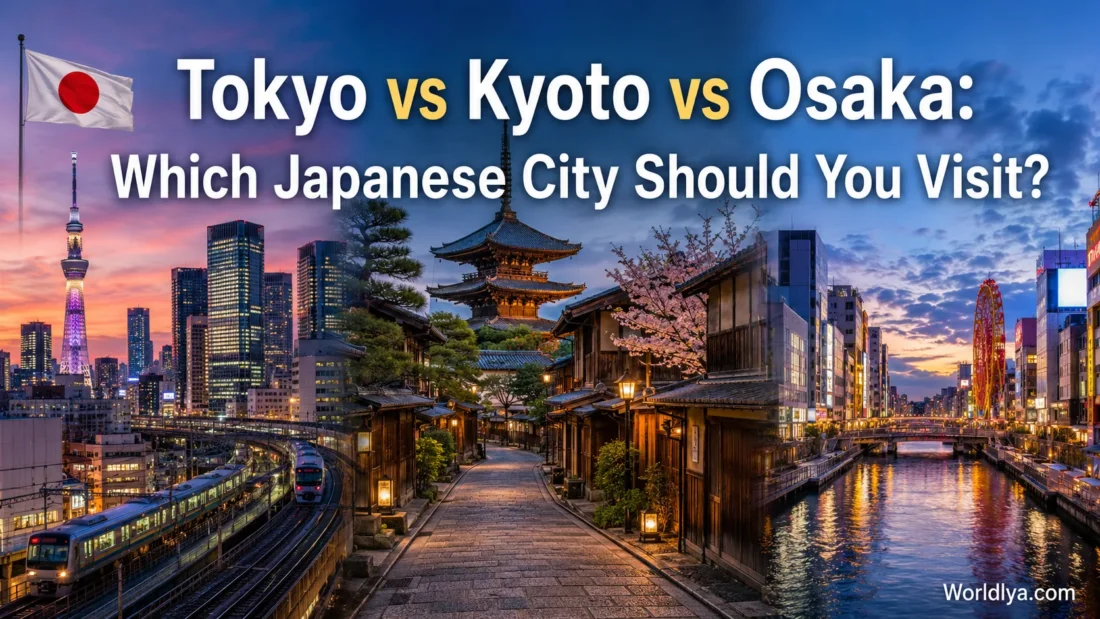
Tokyo, Kyoto, and Osaka are often placed on the same Japan itinerary, but they do not give the same kind of trip. Tokyo feels wide, layered, and full of choices. Kyoto rewards slower walking, early mornings, gardens, temples, craft streets, and quiet pauses. Osaka is easier to enter without a strict plan: food streets, bright districts, friendly energy, and simple access to the Kansai region. The right city depends less on which one is “better” and more on what you want your days to feel like.
Think of the three cities as different travel moods. Tokyo is a full bookshelf. Kyoto is a carefully kept notebook. Osaka is a warm kitchen with the door open. You can enjoy all three, but if your time is short, choosing well will make your Japan trip feel smoother from the first day.
The Simple Decision
For Variety and First-Time Energy
Choose Tokyo if you want a city that can fill every hour differently: museums in the morning, shopping in the afternoon, skyline views at night, and neighborhoods that feel like separate mini-cities.
For Culture and Slower Walking
Choose Kyoto if your ideal Japan trip includes temple paths, traditional streets, gardens, tea, crafts, and the feeling of moving through history without rushing every stop.
For Food and an Easy Base
Choose Osaka if you want casual meals, bright evening areas, practical transport, and a city that works well as a base for Kyoto, Nara, Kobe, and other Kansai day trips.
If this is your first trip to Japan and you have at least a week, the easiest answer is not to choose only one. Visit Tokyo plus Kyoto, then add Osaka for food, evening atmosphere, or a Kansai base. If you have only three or four days, choose one city and do it properly.
City Personality Check
| City | Best Fit | What Your Days Feel Like | Plan Around This |
|---|---|---|---|
| Tokyo | First-timers, shoppers, museum lovers, pop culture fans, food explorers, city photographers | Fast choice-making, many train rides, different neighborhoods each day, lots of “one more place” moments | Stay near a useful train line and group your sightseeing by area |
| Kyoto | Culture-focused travelers, couples, garden lovers, walkers, slow travelers, temple and shrine visitors | Early starts, scenic walks, gentle meals, traditional architecture, quiet lanes, seasonal beauty | Popular places are better early in the morning or later in the day |
| Osaka | Food-focused travelers, repeat visitors, families, day-trip planners, nightlife seekers, casual explorers | Easy evenings, station-to-station movement, street food, shopping arcades, cheerful city energy | Decide whether you want to stay near Namba for evenings or Umeda for transport |
Tokyo: Choose It for Variety, Scale, and First-Time Ease
Tokyo is the city to choose when you want Japan to feel big from the start. It is not just one downtown. It is a chain of neighborhoods, each with its own rhythm. Shinjuku feels busy and vertical. Shibuya is young, bright, and visual. Ginza is polished. Asakusa gives you older streets and temple atmosphere. Ueno works well for museums and parks. You do not need to “finish” Tokyo. You sample it.
Tokyo is also forgiving for first-time travelers because it offers many versions of a good day. Rainy weather? Choose museums, department stores, food halls, cafés, and indoor observation decks. Clear weather? Add parks, river walks, open-air shopping streets, and skyline views. Traveling with different interests in the same group? Tokyo handles that well.
- Choose Tokyo if you want the widest mix of food, shopping, museums, modern architecture, pop culture, and train-connected neighborhoods.
- Stay longer if you enjoy large cities and want day trips such as Kamakura, Yokohama, Nikko, or Hakone.
- Keep it easier by choosing two areas per day instead of crossing the whole city repeatedly.
- Good first Tokyo areas include Shinjuku, Shibuya, Ginza, Tokyo Station, Ueno, and Asakusa, depending on your budget and style.
Tokyo feels best when you stop trying to see everything. Pick a neighborhood, give it time, and let the side streets do part of the work.
Who Will Enjoy Tokyo Most?
Tokyo is ideal for travelers who like options. If your travel style is “let’s see what is around the next corner,” Tokyo keeps answering. It is also a strong choice for people who prefer modern hotels, easy convenience stores, varied dining, and late-day flexibility.
Tokyo may feel less relaxed if you want most attractions within a short walk of each other. Distances matter. Train transfers are normal. The city is easy once you understand your route, but it rewards planning by district.
Kyoto: Choose It for Culture, Walking, and Slower Days
Kyoto is the city many travelers imagine before visiting Japan: temple gates, garden paths, wooden townhouses, seasonal flowers, stone lanes, and quiet corners that ask you to slow down. The city is not frozen in the past; it is lived in. That is why Kyoto works best when you treat it like a place, not a checklist.
The joy of Kyoto often sits between major sights. A walk through Higashiyama, a morning near Arashiyama, a calm garden visit, a small sweet shop, a craft store, a riverside pause near the Kamo River. These moments are not filler. They are the trip.
- Choose Kyoto if you care most about temples, shrines, gardens, traditional neighborhoods, tea culture, craft streets, and seasonal scenery.
- Stay longer if you want slow mornings, early visits, and enough time to enjoy areas rather than jumping between them.
- Keep it easier by grouping sights by side of the city: eastern Kyoto, northern Kyoto, Arashiyama, downtown, and station area.
- Good first Kyoto areas include Kyoto Station for transport, Kawaramachi for food and access, Gion or Higashiyama for atmosphere, and Arashiyama for a scenic stay.
Gentle Kyoto Tip: some famous sites sit near everyday residential streets. Move calmly, keep voices low in temple and shrine areas, and visit early when possible. The city feels much better when you leave space for local life around you.
Who Will Enjoy Kyoto Most?
Kyoto suits travelers who enjoy atmosphere more than speed. It is a strong match for couples, solo travelers, photographers, walkers, garden lovers, and anyone who wants a trip that feels less like a list and more like a set of scenes.
Kyoto may feel less ideal if you want late-night energy every evening or if your group prefers big-city shopping and constant novelty. It has excellent food and shopping, but its real strength is texture: lanes, gardens, gates, quiet details, and place memory.
Osaka: Choose It for Food, Ease, and Kansai Energy
Osaka is often described through food, and that is fair, but it is not the whole story. The city is practical, direct, and easy to enjoy without overplanning. Namba, Dotonbori, and Shinsaibashi bring bright evenings and food streets. Umeda is useful for trains, shopping, and high-rise views. Shin-Osaka is plain but handy if your trip depends on Shinkansen movement.
Osaka works especially well when you want a base in Kansai. Kyoto is close enough for a day trip, Nara is easy to reach, and Kobe can be added without turning the trip into a puzzle. If Tokyo is a giant map and Kyoto is a quiet album, Osaka is the table where people gather at night.
- Choose Osaka if you want food-first travel, casual evenings, shopping arcades, easy train links, and a more relaxed city base.
- Stay longer if you want to day-trip around Kansai while keeping one hotel.
- Keep it easier by choosing Namba for nightlife and food, Umeda for transport, or Shin-Osaka for rail convenience.
- Good first Osaka experiences include food streets, covered shopping arcades, castle-area walks, observation decks, and relaxed neighborhood dining.
Osaka Planning Note: if your trip includes both Kyoto and Osaka, you do not always need to change hotels. Many travelers stay in one Kansai city and visit the other by train. Stay in Kyoto for atmosphere; stay in Osaka for food, evening energy, and day-trip flexibility.
City Fit Snapshot
The scores below are not official rankings. They are a practical travel fit chart, based on how each city usually feels for visitors choosing between them.
Tokyo
Kyoto
Osaka
Use this as a planning helper, not a fixed rule. A traveler who loves museums may rate Tokyo higher; a traveler who wants quiet mornings may rate Kyoto higher; a traveler who plans several Kansai day trips may rate Osaka higher.
Which City Is Better for First-Timers?
For a first Japan trip, Tokyo is the strongest single-city choice if you can visit only one place. It gives the broadest mix: old and new, casual and refined, food and shopping, museums and parks, day trips and skyline views. You can build many kinds of trip from one Tokyo hotel.
If your first trip is long enough for two cities, pair Tokyo with Kyoto. That pairing gives a clean contrast: modern city layers first, traditional atmosphere next. Add Osaka when you have extra time, want more food-focused evenings, or prefer to base yourself in Kansai.
If your first trip is only about western Japan, Kyoto plus Osaka can be enough. They are close, easy to combine, and very different in mood. Kyoto gives the cultural depth; Osaka gives the relaxed evening rhythm.
How Many Days Should You Spend?
| Trip Length | Smart City Split | Why It Works |
|---|---|---|
| 3 Days | Tokyo only or Kyoto only | Three days is too short for all three. Pick one city and avoid losing time to hotel changes. |
| 5 Days | Tokyo 3 + Kyoto 2 or Kyoto 3 + Osaka 2 | Good for a two-city contrast. Keep the route simple and stay near transport. |
| 7 Days | Tokyo 3 + Kyoto 3 + Osaka 1 | Enough for the classic first-timer route, especially if Osaka is treated as an evening and food stop. |
| 10 Days | Tokyo 4 + Kyoto 3 + Osaka 2 + 1 flexible day | This gives room for a day trip, a slower day, or a weather-friendly swap. |
| 12 Days or More | Tokyo 4–5 + Kyoto 3–4 + Osaka 2–3 + day trips | Better for travelers who want both main sights and neighborhoods beyond the obvious stops. |
Where Should You Stay?
Your hotel area can change how each city feels. A good location does not need to be fancy. It needs to reduce friction: fewer awkward transfers, easier meals nearby, and a comfortable return after a long walking day.
| City | Area | Good For | Travel Feel |
|---|---|---|---|
| Tokyo | Shinjuku | First-timers, transport, food, nightlife, wide hotel choice | Busy, practical, energetic |
| Tokyo | Ginza / Tokyo Station | Shopping, train access, polished hotels, easy Shinkansen start | Organized, central, refined |
| Tokyo | Ueno / Asakusa | Museums, parks, older streets, often better value | More local, relaxed, walkable |
| Kyoto | Kyoto Station | Train trips, bus access, luggage ease, first visit logistics | Practical and connected |
| Kyoto | Kawaramachi / Gion | Dining, evening walks, historic areas, riverside access | Atmospheric and convenient |
| Osaka | Namba | Food streets, shopping, evenings, first Osaka stay | Lively and casual |
| Osaka | Umeda | Rail links, shopping, day trips, airport access | Urban and practical |
Food, Shopping, Temples, or Night Views?
Food
Osaka is the easiest pick for casual eating and evening food walks. Tokyo has the widest range overall, from tiny counters to polished dining rooms. Kyoto is better for slower meals, sweets, tea, and traditional-style dining.
Shopping
Tokyo wins for variety: fashion, electronics, character goods, design stores, vintage areas, and department stores. Osaka is strong for shopping arcades and station malls. Kyoto is better for crafts, tea, textiles, paper goods, ceramics, and small gifts.
Temples and Gardens
Kyoto is the clear choice. Tokyo has temples, shrines, and gardens too, but Kyoto gives you more depth in less distance. Osaka has cultural sites as well, yet it works better as a food and base city for most first visits.
Night Views and Big-City Feel
Tokyo gives the strongest big-city scale. Osaka gives the most relaxed night-out feeling. Kyoto is better for evening walks, lantern-lit lanes, and riverside pauses rather than skyline drama.
The Train Reality Between the Three Cities
Tokyo, Kyoto, and Osaka are commonly combined because rail travel makes the route practical. The Tokaido Shinkansen links Tokyo with Kyoto and Shin-Osaka. Train type, ticket choice, station location, and hotel location all affect door-to-door time, so do not plan only by the train ride printed on a timetable.
| Route | Planning Use | Simple Advice |
|---|---|---|
| Tokyo to Kyoto | Long-distance city change | Use it as a proper travel block. Leave time for station movement, luggage, and hotel check-in. |
| Kyoto to Osaka | Easy Kansai movement | Good for day trips or evenings, especially when your hotel is near a useful station. |
| Tokyo to Osaka | Long-distance city change | Works well at the start or end of a route, especially if your flight plan supports it. |
| Kyoto and Osaka as One Base | Less packing, fewer hotel changes | Choose Kyoto if you want atmosphere at night. Choose Osaka if you want food, transport, and evening energy. |
If you plan to buy a rail pass or use the fastest services, check the current ticket rules before purchasing. Rail pass conditions and train categories can change, and the most useful choice depends on your full route, not only one ride.
Sample Routes That Do Not Feel Rushed
7 Days: First Japan Taste
- Days 1–3: Tokyo for neighborhoods, food, museums, and skyline views.
- Days 4–6: Kyoto for temples, gardens, Higashiyama, Arashiyama, and slower evenings.
- Day 7: Osaka for food streets and a relaxed final Kansai day, or use it as your departure base.
10 Days: Balanced Classic Route
- Days 1–4: Tokyo, with one flexible day for a nearby trip or a slower neighborhood day.
- Days 5–7: Kyoto, with early mornings and grouped sightseeing areas.
- Days 8–9: Osaka, with one evening in Namba and one day for Osaka sights or a Kansai day trip.
- Day 10: Return or continue depending on your flight city.
12 Days: Less Packing, More Breathing Room
- Days 1–5: Tokyo, including one day beyond the main central districts.
- Days 6–9: Kyoto, with one quiet morning and one craft or food-focused afternoon.
- Days 10–12: Osaka, with time for food, shopping, and a nearby day trip.
Season and Timing Notes
All three cities work year-round, but the feel changes by season. Spring flower periods and autumn foliage periods are popular in Tokyo, Kyoto, and Osaka. Kyoto’s scenic areas can feel especially sought-after during these times, so early starts and flexible plans help.
- Spring: good for parks, riverside walks, gardens, and seasonal sweets. Book earlier if traveling during peak flower weeks.
- Summer: better with indoor breaks, evening walks, light clothing, and a slower daily pace.
- Autumn: excellent for gardens, temple paths, city parks, and photography-friendly days.
- Winter: often easier for museums, food trips, shopping, hot drinks, illuminations, and calmer sightseeing schedules.
Small Travel Manners That Make the Trip Easier
Travel in Japan feels smoother when your habits match the place. You do not need to be perfect. A few simple choices go a long way.
- Keep station movement calm: step aside before checking maps or phone routes.
- Use luggage wisely: pack lighter, use coin lockers when helpful, and consider luggage delivery for longer routes.
- Respect quiet spaces: lower your voice in temples, gardens, trains, and residential lanes.
- Plan food gently: small restaurants may have limited seating, so arrive early or keep a backup nearby.
- Give each city room: one open evening can save a trip from feeling too scheduled.
Your City Pick by Travel Style
| Travel Style | Choose This City | Why |
|---|---|---|
| I Want One City Only | Tokyo | It offers the broadest range for a short Japan trip. |
| I Want the Most Traditional Atmosphere | Kyoto | Temples, gardens, old lanes, crafts, and slower walks are easier to build into every day. |
| I Want Food and Easy Evenings | Osaka | The city is casual, lively, and easy to enjoy after dark. |
| I Want a First-Time Japan Pair | Tokyo + Kyoto | This gives the cleanest contrast between modern city travel and cultural atmosphere. |
| I Want Kansai Without Moving Hotels | Kyoto or Osaka | Both can work as a base. Kyoto is calmer at night; Osaka is easier for food and transport. |
| I Want Shopping Variety | Tokyo | Tokyo gives the widest range across fashion, design, electronics, pop culture, and department stores. |
| I Want a Softer Pace | Kyoto | Kyoto rewards early starts, walking routes, gardens, and pauses between sights. |
FAQ
Is Tokyo, Kyoto, or Osaka Better for a First Trip to Japan?
Tokyo is the strongest single-city pick for most first-time visitors because it offers the widest range of experiences. For a better first trip, combine Tokyo and Kyoto if you have enough days. Add Osaka for food, evening atmosphere, and a Kansai base.
Can You Visit Kyoto and Osaka on the Same Trip?
Yes. Kyoto and Osaka are close enough to combine easily by train. Many travelers stay in one city and visit the other as a day trip or evening trip. Kyoto is better if you want a calmer base; Osaka is better if you want food, shopping, and transport ease.
Should You Stay Overnight in Osaka or Just Visit from Kyoto?
Stay overnight in Osaka if you want to enjoy its evening food areas without thinking about the last train back. Visit from Kyoto if your schedule is short and your main interest is a simple food-and-shopping day.
Is Kyoto Enough Without Tokyo?
Kyoto can be enough if your main goal is culture, gardens, temples, traditional streets, and a slower pace. If you also want big-city shopping, pop culture, skyline views, and a wider range of neighborhoods, Tokyo adds a different side of Japan.
Is Osaka Better Than Tokyo for Food?
Osaka is easier for casual food walks and relaxed evening eating. Tokyo has more total variety and more dining styles across a larger city. Pick Osaka for easy food energy; pick Tokyo for range.
Which City Should Families Choose?
Tokyo and Osaka are usually easier for families who want varied activities, shopping, casual meals, and transport options. Kyoto works well for families who enjoy walking, gardens, scenic routes, and calmer cultural stops, but the daily plan should not be overloaded.
Sources
- GO TOKYO – Experiences
- Kyoto City Official Guide – Sample Itineraries
- Kyoto City Official Guide – Responsible Travel
- Discover Osaka – Eat and Drink
- Japan National Tourism Organization – Responsible Travel Guide
- JR Central – Tokaido Shinkansen and Japan Rail Pass Information
- UNESCO World Heritage Centre – Historic Monuments of Ancient Kyoto